Instagram translates reels in the author's voice: nine languages
The help centre names nine languages that translated Reels work in, and Russian isn't among them. We go through what that means for an author from the CIS and what to do instead of waiting.
- Social media & AI
- Mechanics breakdown
- ≈ 8 min
Instagram has learned to translate speech in reels and voice it in another language. For an author this looks like a ready-made entrance into a foreign market — right up to the moment you open the list of supported languages and don't find Russian there.
How the voice translation works, which nine languages the platform names, and what a Russian-speaking author should do while the tool is available to them only as a viewer. Eight minutes of reading.
Voice translation and the language switch
From the viewer's side it looks like this.
Instagram's help centre has a separate page about watching translated reels. The mechanics are described literally step by step.
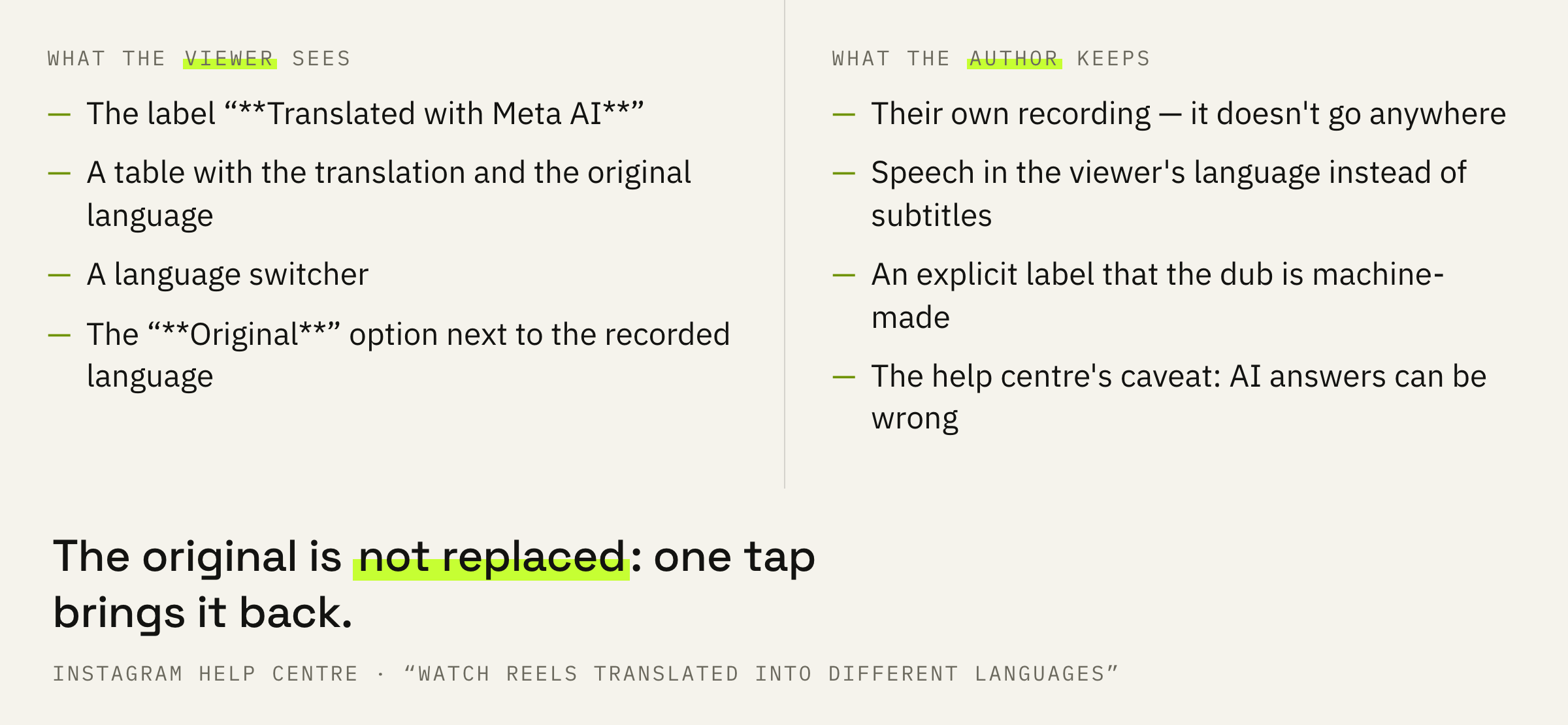
When viewing a translated reel, click Translated with Meta AI. You'll see a sheet showing the translated and original language. Tap the language you'd like to hear. The language the reel was recorded in will say Original next to the radio button.
Instagram help centre · watching a Reels video translated into other languages
Note two details. First: the translation is labelled openly, the viewer sees that they are hearing a machine. Second: the original doesn't go anywhere, you can return to it with one tap.
From the author's side this is exactly what had been missing for years for entering a foreign market. Not subtitles you have to read, but speech in the viewer's language — and your own recording stays available.
Nine languages, and Russian isn't among them
The line worth opening the help centre for before making plans.
Further down the same page there is a limitation, and it decides everything.
Translated reels on Instagram aren't yet available for everyone, and are currently only available in Spanish, English, Hindi, Portuguese, Bengali, Tamil, Telugu, Marathi and Kannada.
Instagram help centre · same page
Nine languages. English, Spanish and Portuguese — the three largest markets of the western hemisphere. Hindi, Bengali, Tamil, Telugu, Marathi and Kannada — six languages of India, Instagram's largest market by number of users.
Russian isn't on the list. Nor is any other language of the CIS.
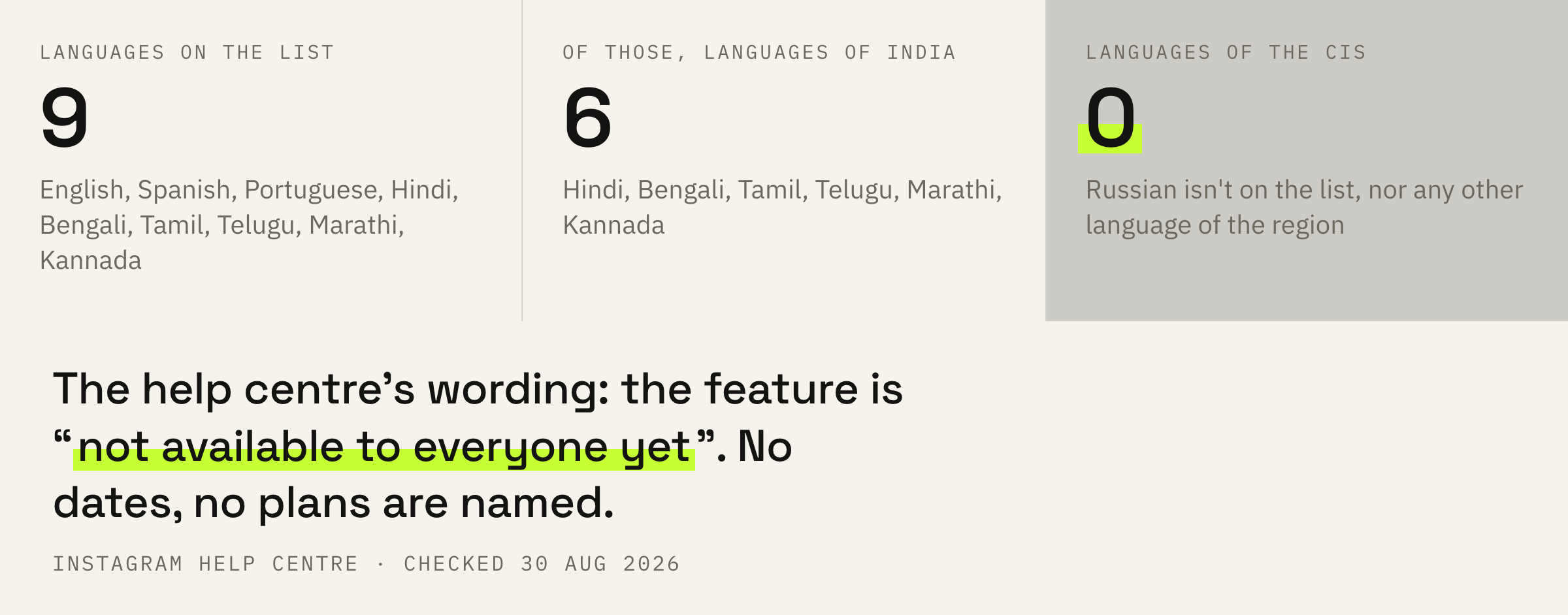
The platform speaks only about the current list and adds that the feature “isn't available to everyone yet”. This is not a statement that Russian won't appear, and not a decision about the region. This is the state of things today, and planning has to be done by it.
As a viewer yes, as a source not yet
The gap worth seeing before you build plans.
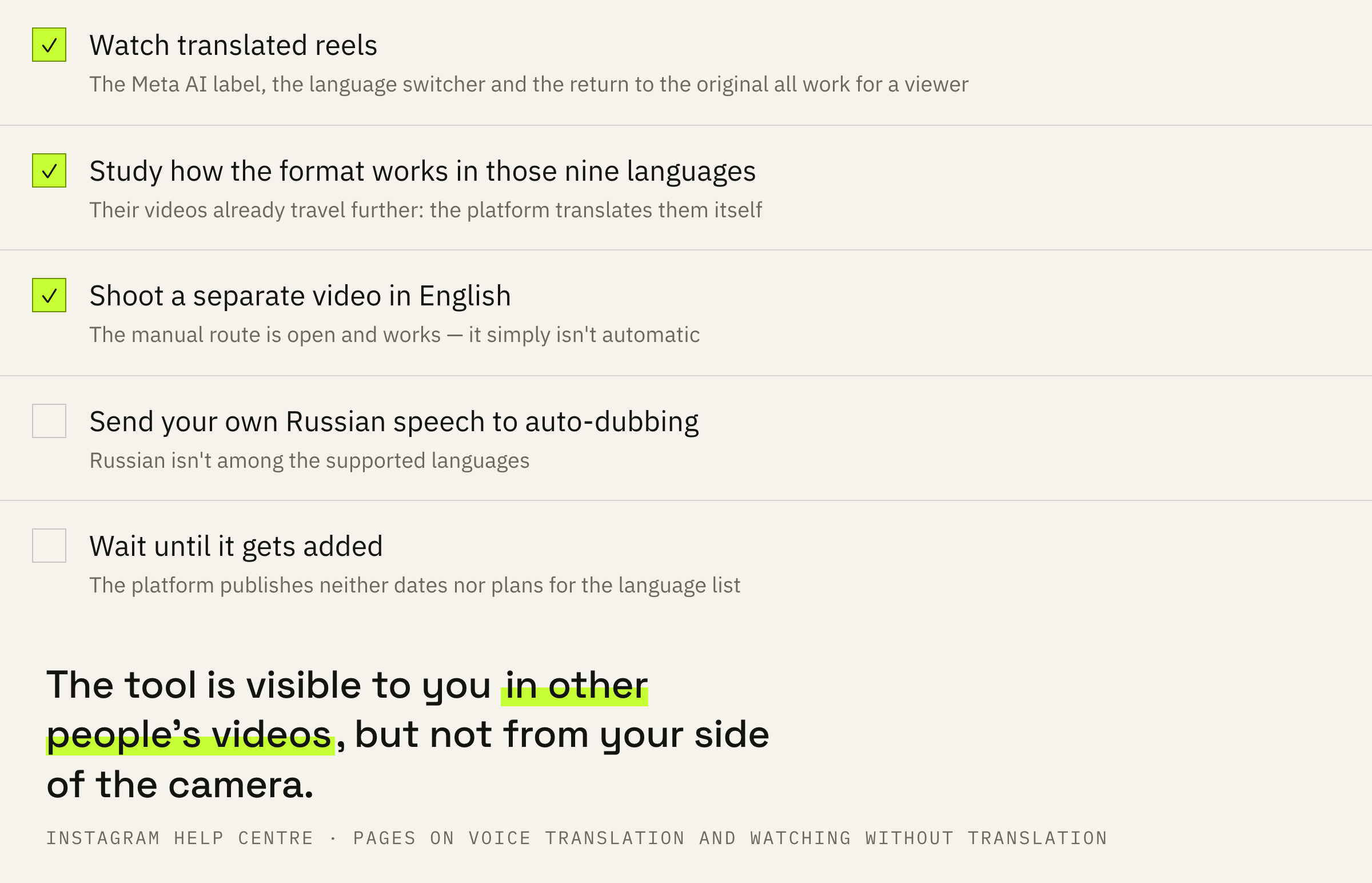
Let's split this into two directions. As a viewer you can already watch translated reels today: pick a language, return to the original, see the Meta AI label.
As an author you can't yet hand your Russian speech over to automatic dubbing. The tool exists, works and is visible to you in other people's videos — but not from your side of the camera.
The practical conclusion is simple. For a Russian-speaking author, reaching an English-speaking audience stays manual: your own English version, your own subtitles, your own editing. The platform doesn't take that work on yet.
What decides the fate of a video inside the platform itself we covered separately: how long a reel should be and how reach works on Instagram.
And a separate caveat from the platform itself, worth keeping in mind for everyone already using the translation: “The AI bot's responses may be wrong or inappropriate. Don't use them to make important decisions”. Machine dubbing is a draft, not a finished localisation.
If your videos work at home but don't travel to another market, we'll look at your recent posts and tell you what's in the way first.
What to do this week
Four steps for those looking at the western market.
First: open a few other people's reels in English and see whether the label “Translated with Meta AI” appears. That way you'll see the feature at work and understand whether it has reached your app.
Second: look at how authors in those nine languages build their videos. The platform already translates them, which means their format now travels wider than yours — and that is the one worth studying.
Third: shoot one video in English yourself. Don't translate an old one: shoot a new one on the same mechanics, but with English speech. That is the only way to check whether your topic works beyond its own language.
Fourth: compare it with Russian videos of the same length. Not by the number of views, but by watch-through: it shows whether attention holds when the language is different.
Shoot five videos in English and compare their watch-through with five Russian ones of the same length. If the difference sits inside your usual spread, the topic carries over. If the English ones sag by half, the platform's language isn't the issue: the mechanics were tied to the local context.
What not to do
Four decisions around a tool you don't have yet.
And the opposite extreme: deciding that since Russian isn't on the list, the western market is closed. It is open exactly as it was open before this feature appeared. The road there is just still on foot.
What to do next
Two minutes for today.
Open five other people's English-language reels and look for the label “Translated with Meta AI”. That is the fastest way to understand what the feature looks like and who it has already reached.
If you're planning English-language videos, start with the format, not with the language. What holds attention in the first seconds at all we covered here: why a reel gathers 200 views.
We'll look at your videos and tell you which mechanics carry over to another market and which rest on the local context.
If you want to go beyond your own language — leave a request. We'll get in touch if there are slots available at the moment. There is usually a queue and a wait.