Reels stuck at 200–500 views: why, and what to change
The signals Instagram uses to decide whether to keep showing your reel, which of them you can see in your own stats, and why ads here treat the symptom instead of the cause.
- Social media & AI
- Diagnostics
- ≈ 11 minutes
A reel goes out, picks up 200–500 views and fades. So does the next one. Below: which signals Instagram names itself, which of them your stats actually show, and why one reel ends up with two different play counts.
Five Reels metrics with exact definitions, two traps hidden inside them, and a checking order built on what the platform actually shows you. Eleven minutes to read.
First, make sure it isn't just bad luck
One weak reel means nothing.
A single reel can flop for a dozen reasons, random ones included. Drawing conclusions from one post is pointless.
You have to look at several in a row and compare them on one and the same metric. Which one exactly we'll get to below, because there are five of them and people mix them up constantly.
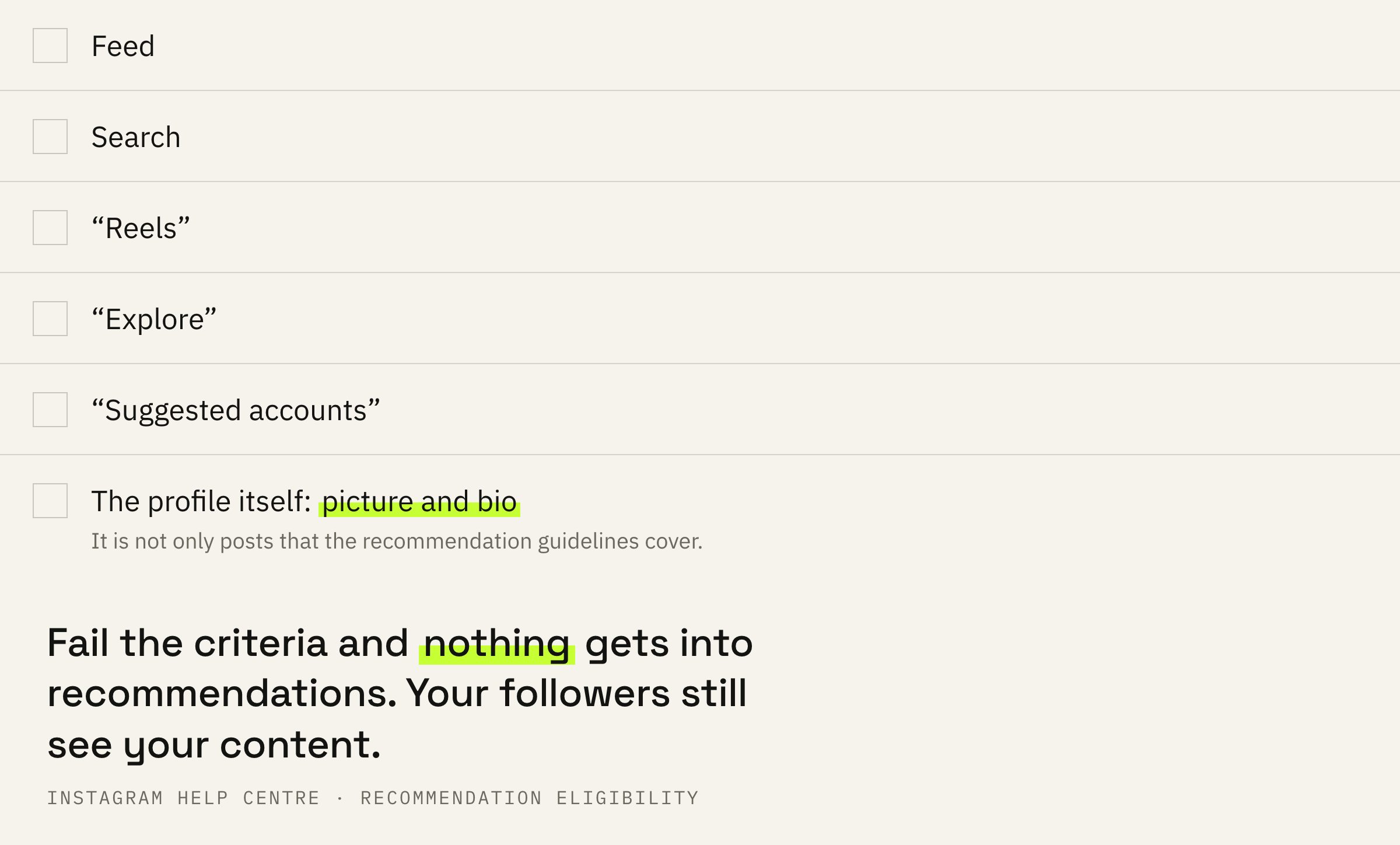
Reels stats are available only for reels published from 14 May 2021 onward, and they live for two years from the publication date. The account has to be public: a private one has no stats at all.
What signals Instagram decides by
Three of the four aren't about your reel at all.
Start not with guesses but with what the platform says about itself. Instagram lists its Reels ranking signals openly and notes that it lists them roughly in order of importance.
Hence an unpleasant but useful conclusion. Three signals out of four describe the viewer and their past. Only one is about what you filmed.
That explains why the same reel performs differently for two authors, and why comparing your numbers with someone else's is pointless. You have different viewers with different histories.
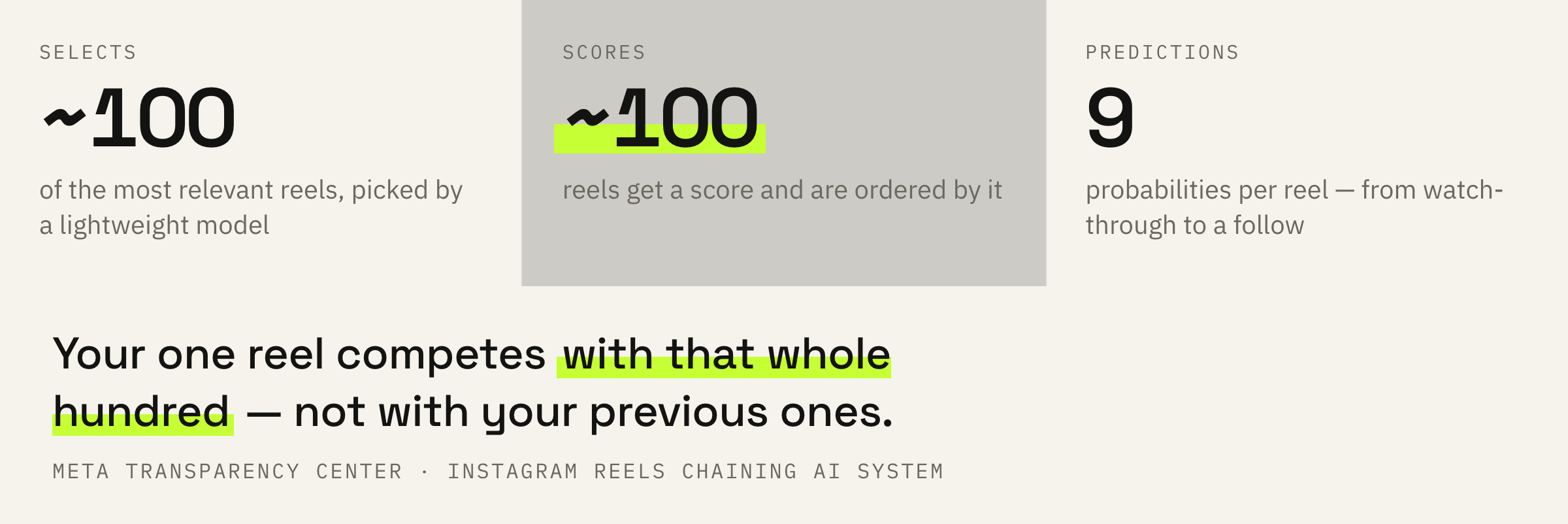
Separately, the platform names what it predicts for showing a reel to people who don't follow you: likelihood of a reshare, of watching to the end, of a like, and of tapping through to the audio page.
That's about showing to people who don't follow you. For the Reels feed the platform has a separate system card, and there the predictions number nine.
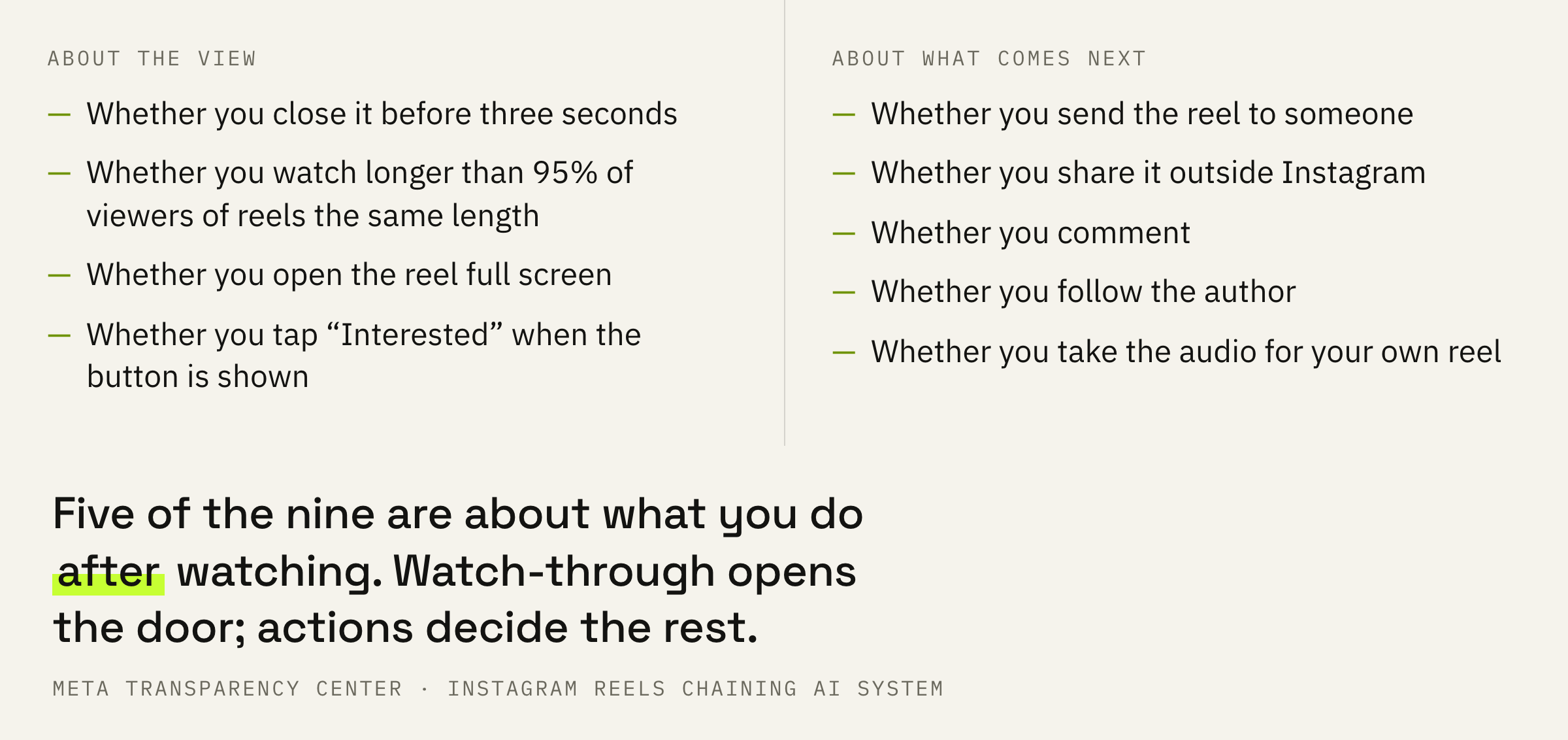
Watching through and resharing sit in that list alongside the like. The platform predicts them the same way it predicts a like. A reel people watch through and forward travels further than a reel people merely like.
What your stats show
Five metrics, and two of them are counted differently than you'd think.
This is where people go wrong most often. Instagram gives you five metrics per reel, and three of them have non-obvious definitions.
On your profile grid the number under a reel is plays without replays, while in Insights views are counted with replays. These are two different numbers for one reel, and both are correct. You can't compare them with each other.
Average watch time is divided by initial plays, while the numerator includes replays. So for a reel people rewatch, the average duration can exceed the reel's own runtime. That isn't a glitch in the stats.
Open the Reels tab on your profile, pick a reel, tap Insights. If there's no such option, the reel is older than two years or the profile is private.
The 200–500 view corridor reads through comparing two metrics. If accounts reached is noticeably higher than views, the reel was shown but not played: the first frame didn't land.
If reach and views are close but average watch time is short, people started and dropped off. Then what needs redoing is whatever happens after the opening, and the cover can stay as it is.
How this looked for a client
The starting point, and what came two months later.
One of our clients started exactly there: reels at 200–500 views, while the expert filmed regularly and filmed on point. It wasn't laziness and it wasn't the camera.
Ten reels in two months. Not a hundred and not four hundred — what it looks like when you go the other way is covered in the story about a plan for 480 pieces of content.
What decides things isn't the number of reels, it's what happens in the first second and a half of each one.
How to check a single reel
Four steps, all inside your own stats.
Step one. Compare accounts reached with views. A big gap in favour of reach means the reel was shown but people didn't play it.
Step two. Look at average watch time and keep in mind that the divisor counts only initial plays. Compare this number only against your own reels.
Step three. The platform names resharing among the things it predicts for showing to non-followers. A reel with reshares gets carried further, even if it has fewer likes.
Step four. Follows from a reel show whether it worked as an introduction. Reach without follows means people watched and forgot.
The four steps above check one reel. If they explained nothing, look at the account as a whole: Instagram has an Account Status section for exactly that.
All four steps happen on one screen and take a minute per reel. Compare among your own reels: someone else's account has different viewers and a different engagement history, so their numbers tell you nothing.
If reels go out regularly and views stay flat — we'll look at your account and tell you which of the three causes you're stuck on.
What not to do: ads instead of the cause
Ads close the symptom and leave the cause in place.
When organic doesn't grow, the first urge is to buy traffic. A reel with 200 views really can be shown to ten thousand people.
One client came to us spending 10–15 thousand dollars a month on ads while his reels sat at 5–10 thousand views — that's Dostonjon's case.
Paid traffic here wasn't a strategy, it was a painkiller. It closed the symptom — too few impressions — and let him avoid looking for the reason there were so few.
The check is simple: switch the ads off for a week. If everything stops, you're paying not to fix things.
What to do next
One reel this week.
Take your next reel and redo only the first second and a half in it. Not the topic, not the edit, not the length, only the opening.
Then compare two numbers on it against your previous reels: the gap between accounts reached and views, and average watch time. One reel is enough to see a shift, ten to know whether it repeats.
We'll look at your profile, tell you which formats will bring reach in your niche specifically, and work out how long it takes to pay off.
If you want reels to become a predictable source of leads — leave a request. We'll get in touch if there are open slots at the moment. Usually there's a queue and you have to wait.