Why more content doesn't mean more leads
How much to post without tanking your reach: a plan for 480 pieces of content cut lead flow by ten times. We break down why the feed selects instead of stacking.
- Social Media & AI
- Case Study
- ≈ 7 minutes
We needed 15,000 sign-ups for a free webinar in two weeks. We figured it came down to volume, so we planned 480 pieces of content. Two weeks later, leads dropped tenfold.
Why the algorithm punishes volume, and what we did once it became obvious. Seven-minute read.
The logic behind planning 480 pieces
It seems so obvious that no one checks it.
The task was clear: 15,000 sign-ups by the end of week two. One video was already bringing in a set number of sign-ups.
Then comes the multiplication every other marketer does. If one video brings X, four hundred videos will bring four hundred X.
We opened two extra accounts and planned 14 posts a day. Storytelling formats, carousels, videos with captions, podcast clips, webinar cutdowns.
Two weeks' worth of content was shot and edited in three days.
The mistake wasn't the workload or the shooting quality. It was arithmetic that seems so obvious nobody bothers to check it.
What happened in two weeks
Two points in time, with nothing in between hinting at what was coming.
We don't have a diary of what happened between these two points, and we're not going to invent one. The case simply is what's above: done in three-four days, collapsed two weeks later.
Not enough.
Why volume doesn't work
The feed picks the best of what you post.
The feed doesn't show everything you've posted. It picks the best of it and shows only that.
Meta describes this mechanism in Instagram's feed ranking system card, and it's laid out step by step there. The system gathers all available posts from people you follow, removes anything that violates the rules, then a lightweight model selects roughly 700 of the most relevant, and around 500 of those get a relevance score and are ranked by it.
Think of it as shelf space. It's finite, and only the best of your posts make it onto it.
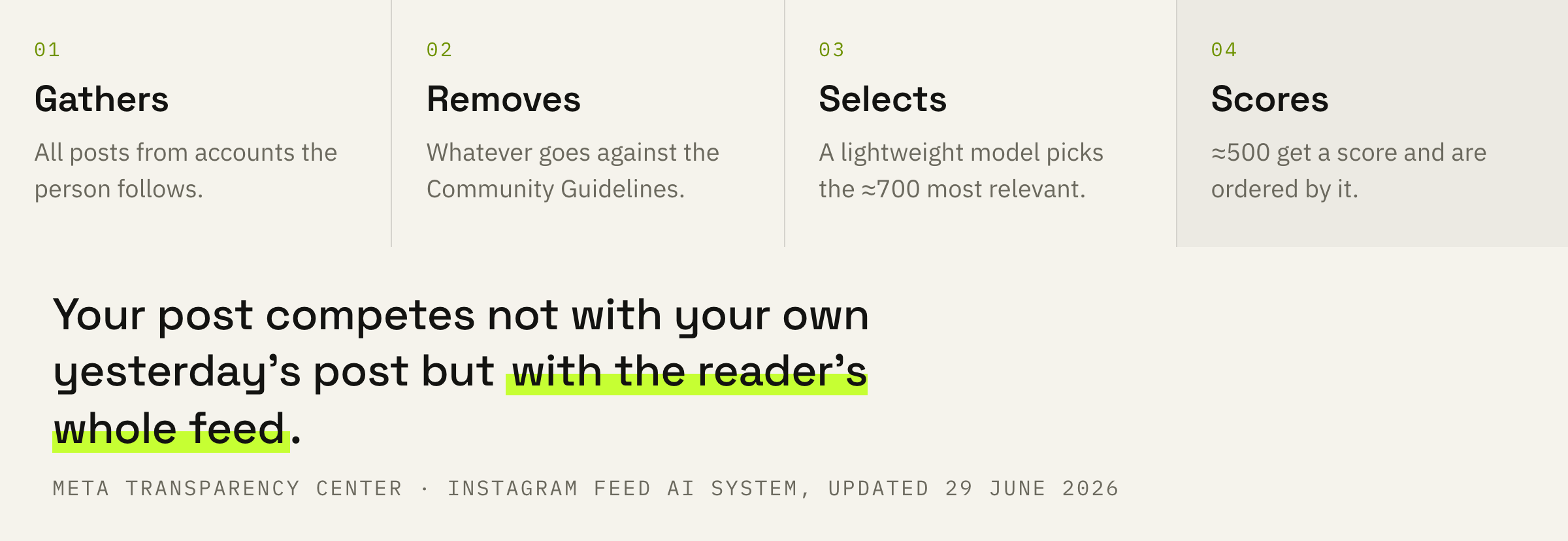
When you post twenty videos a day, the platform is choosing from your own twenty. The weak ones don't get added to the strong ones — they compete with them for the exact same spot.
We diluted our own strong content with weak content, with our own hands.
Recommendations — meaning shows to people who don't follow you — are covered in a separate card by Meta. There, the system takes a slice of Instagram's public content and filters it using ten predictions at once.
Read that first point slowly. The quality of every single post is scored by a machine and factored into selection as an independent signal.
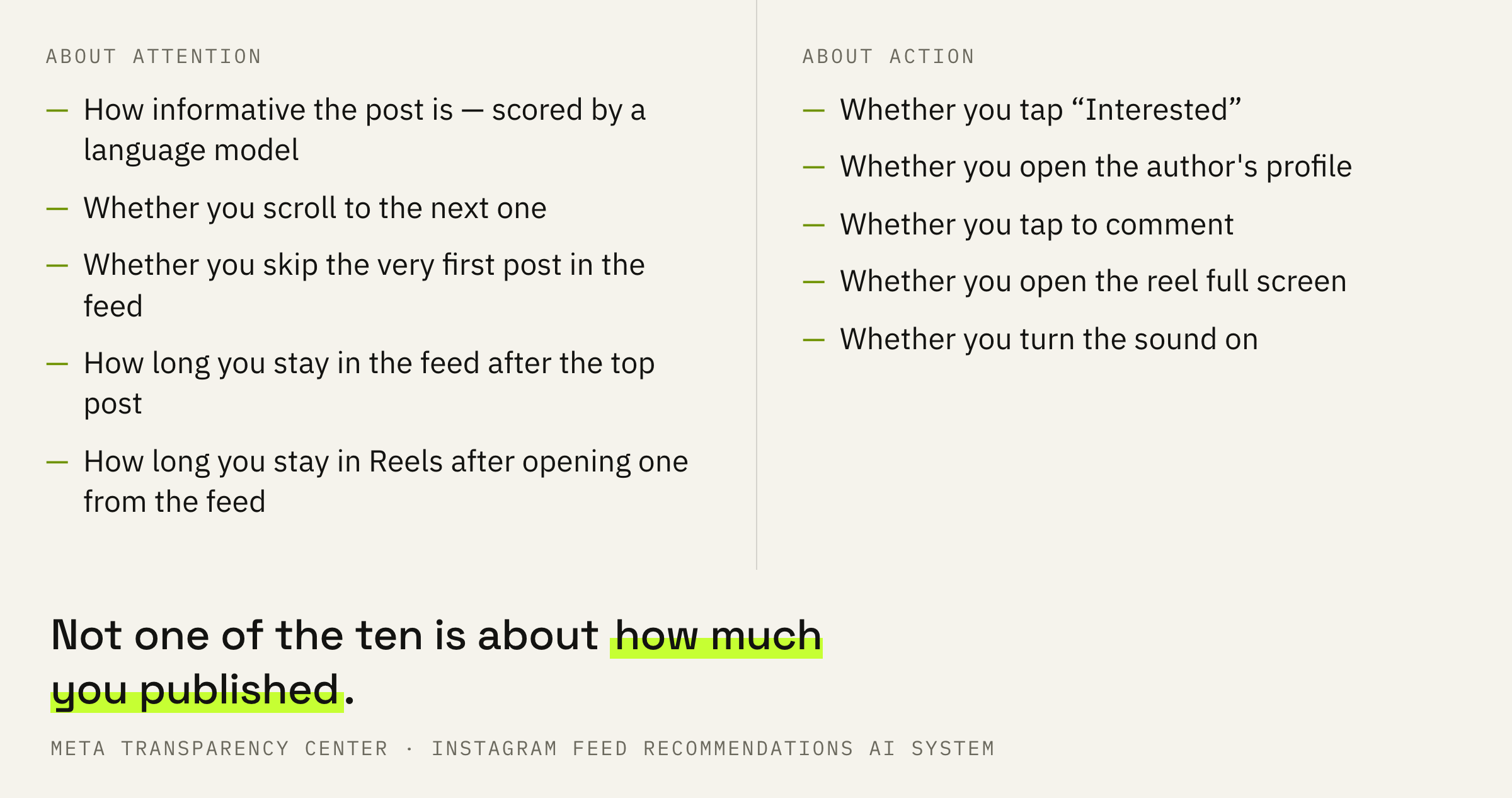
Twenty average videos a day don't give you twenty chances. They give you twenty quality scores, most of which drag you down.
One flawless video instead of twenty mediocre ones.
The algorithm doesn't add up volume — it picks the best. Twenty average videos end up competing with each other for the same spot.
The pivot and how it all ended
What we did once the numbers became impossible to ignore.
We stopped the plan halfway through. Instead of twenty mediocre videos, we started making one flawless one, and put a call-to-action into the funnel in every single one.
In the remaining week, we picked up another 12,000 sign-ups. Without spending a single cent on ads.
The project was delivered, the goal was hit. But we hit it through selection, not volume — and we learned that the hard way.
Consistency and volume are not the same thing. One post a day, every day, holds your reach. Twenty posts a day steal reach from each other.
If your reach dropped after you started posting more often — that's almost always the reason why. We'll look at your account and tell you where to apply selection.
What to do next
Three things to do this week.
Track your average reach per post by week. If the total is growing but the average reach is dropping, you're already inside this trap.
Where to find strong formats instead of weak ones — check out the breakdown on finding other people's viral posts.
We'll look at your profile, tell you which formats will get reach specifically in your niche, and calculate how long it'll take to pay off.
If you want content to become a predictable source of leads — send a request. We'll get in touch if there are open slots right now. Usually there's a waitlist, so you might have to wait.