Case study: Dostonjon Soyibov
Goal: drop paid traffic, make Reels a predictable source of leads and collect 15,000 webinar signups.
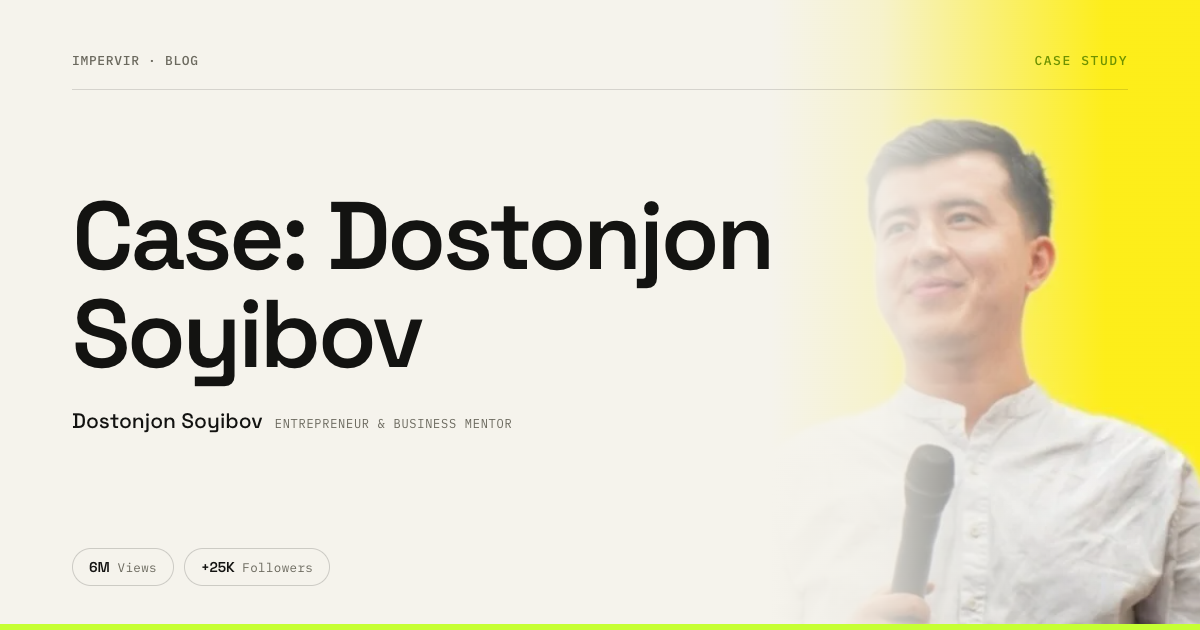
“Reels gave what years of work couldn't — recognition and a flow of clients”
Dostonjon Soyibov, Entrepreneur & business mentor
- Business education
- Instagram Reels
- 2 months
How we got 6 million views, +25,000 followers and 15,000 webinar registrations without spending a cent on ads.
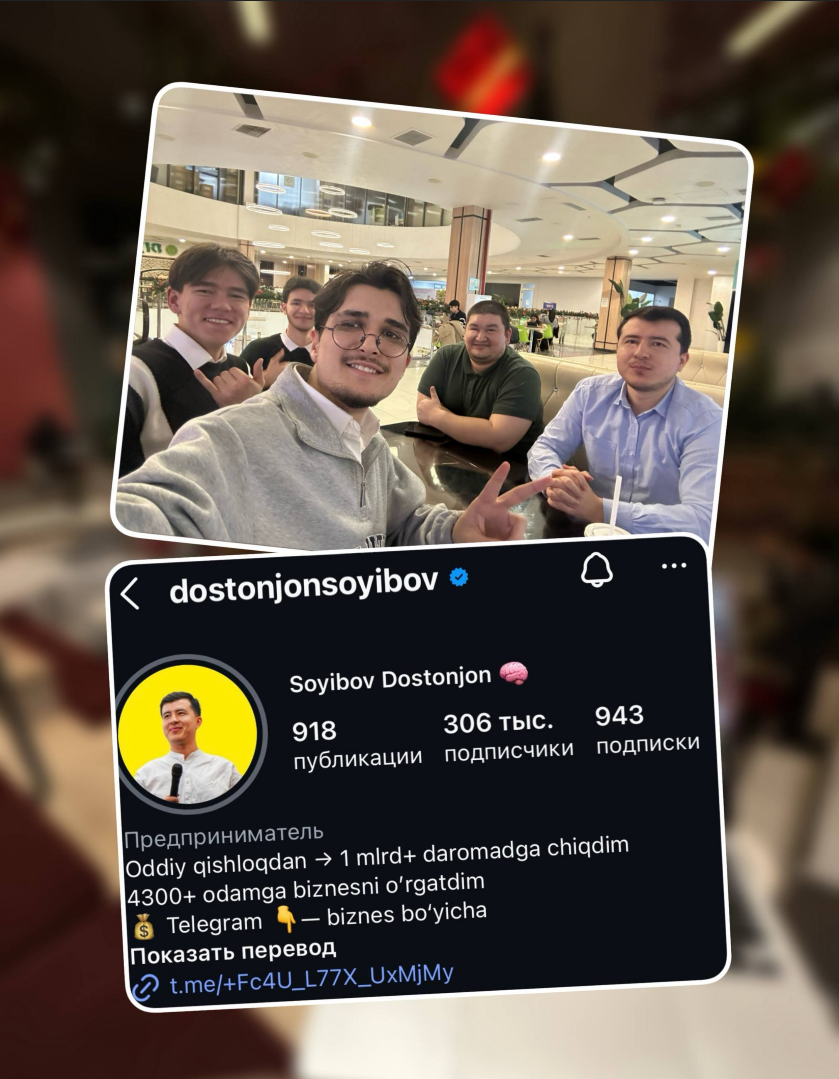
Client: Dostonjon Soyibov — entrepreneur, speaker and business mentor. He helps people reach a stable income by sharing his own experience, observations and practical business tools on his blog.
Niche: teaching people to earn online — for beginners and for working entrepreneurs.
Below: exactly what we did step by step, which formats grew the reach, and an honest account of one decision that nearly derailed the whole project.
This case is more interesting than the others precisely because we got it wrong in the middle. Not on a detail, but on the logic itself: we made a decision that sounded reasonable and almost cost us the deadline. Studying wins is useful; studying mistakes is more useful.
There was content. There was no controllable result.
At the start, Dostonjon's situation was typical for experts in business education: videos went out chaotically, with no schedule and no strategy. The main traffic was bought.
Reels were averaging 5,000–10,000 views. Publishing had no system, and every video was a lottery: nobody knew in advance what would fly and what would sink.
Dostonjon was mostly doing the marketing himself: inventing scripts on the fly during the shoot and finding formats by trial and error. That drained his resource and got in the way of scaling.
The editing was different from video to video, so the personal brand never became visually recognisable.
The main acquisition tool was paid ads. The budget reached $10,000–15,000 a month.
Dostonjon filmed without a clear addressee: he had never articulated who his viewer was, and the topics missed the people who should have been watching.

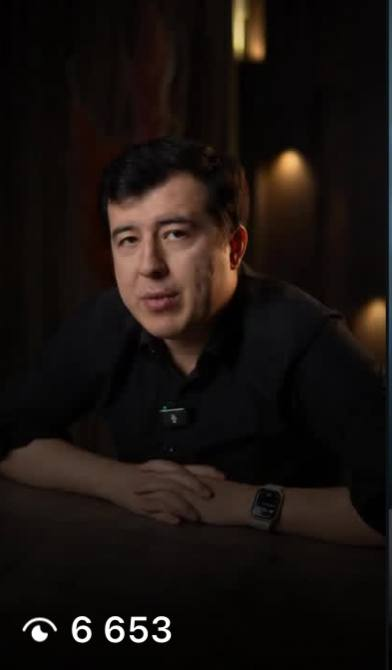
Notice how these five points are connected. Expensive traffic isn't a separate problem, it's a consequence: when organic doesn't work predictably, ads are the only way left to reach an audience. And organic doesn't work because there is no focus and no positioning. Paid traffic here wasn't a strategy, it was a painkiller.
Buying traffic while organic stands still? We'll look at your content and tell you what to change in it to get off the ad budget.
The brief and the guarantee
The starting point and the promise.
Dostonjon came with a clear task: stop the chaos in the content and turn Reels into the main traffic channel he could count on. And build a personal brand that works without his daily involvement.
So at the first meeting we proposed a turnkey Reels production format: content, marketing and production entirely on our side.
1,000,000 views in two weeks. The kind of target most marketers won't take on. We were confident in our own playbook.
Positioning
From «a source of knowledge» to a role model.
The first thing we worked on was the expert's image. Before working with us, Dostonjon positioned himself as a classic entrepreneur delivering dry, useful information.
His Reels felt like lectures, and the «dull expert» image capped the audience: people consumed the information but saw no reason to follow the person.
What we changed. We moved from the idea of «a source of knowledge» to the idea of a role model. We rebuilt the positioning so that at the very first touch the viewer reads a personality, not a set of tips.
The goal was to provoke an instant reaction: «Yes, this is exactly the person I want to be like».
The difference is subtler than it looks. An expert as «a source of knowledge» answers the question «what should I do». A role model answers the question «who should I become». People come to the first when they need a specific tip — and leave once they have it. They stay with the second, because the journey is longer than one answer.
In practice that changed everything: which stories Dostonjon tells, what he shows around him in the frame, how he ends a video. The usefulness didn't go anywhere — what changed is what a person watches to the end for.
The blog stopped being a textbook and became a space where the audience gets not only value, but Dostonjon's vision, scale and values.
Reels formats
Three formats instead of guessing.
We rethought how the profile was filled and made it clearer to an ordinary person. People open Reels not for «useful information» but for bright emotions and a break after work or studying. Complex, overloaded content was a barrier — so we removed it.
We audited the US and CIS markets, went through competitors and focused on three formats. Three isn't for variety: each one covers its own stretch of the path. The first brings in strangers, the second proves competence, the third turns an expert into a person you want to follow.
Dynamic videos for instant motivation and an emotional response. They work excellently for holding attention and collecting views.
No academic style. Dostonjon explains complex business processes through his own experience and personal cases, in simple words. That removes the barrier of complexity.
We shift the emphasis from dry facts to a personal stance, stories and the expert's past. People subscribe first of all to a personality, not to usefulness.
Video examples: viral, expert, through personality — they open in a new tab.
Filming and editing
Ten videos in three days.
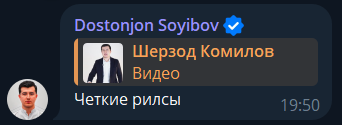
We wrote the scripts, adapted the videos that had taken off to fit Dostonjon, and set a filming day.
We always film on a professional camera: it underlines the expert's status in the frame.
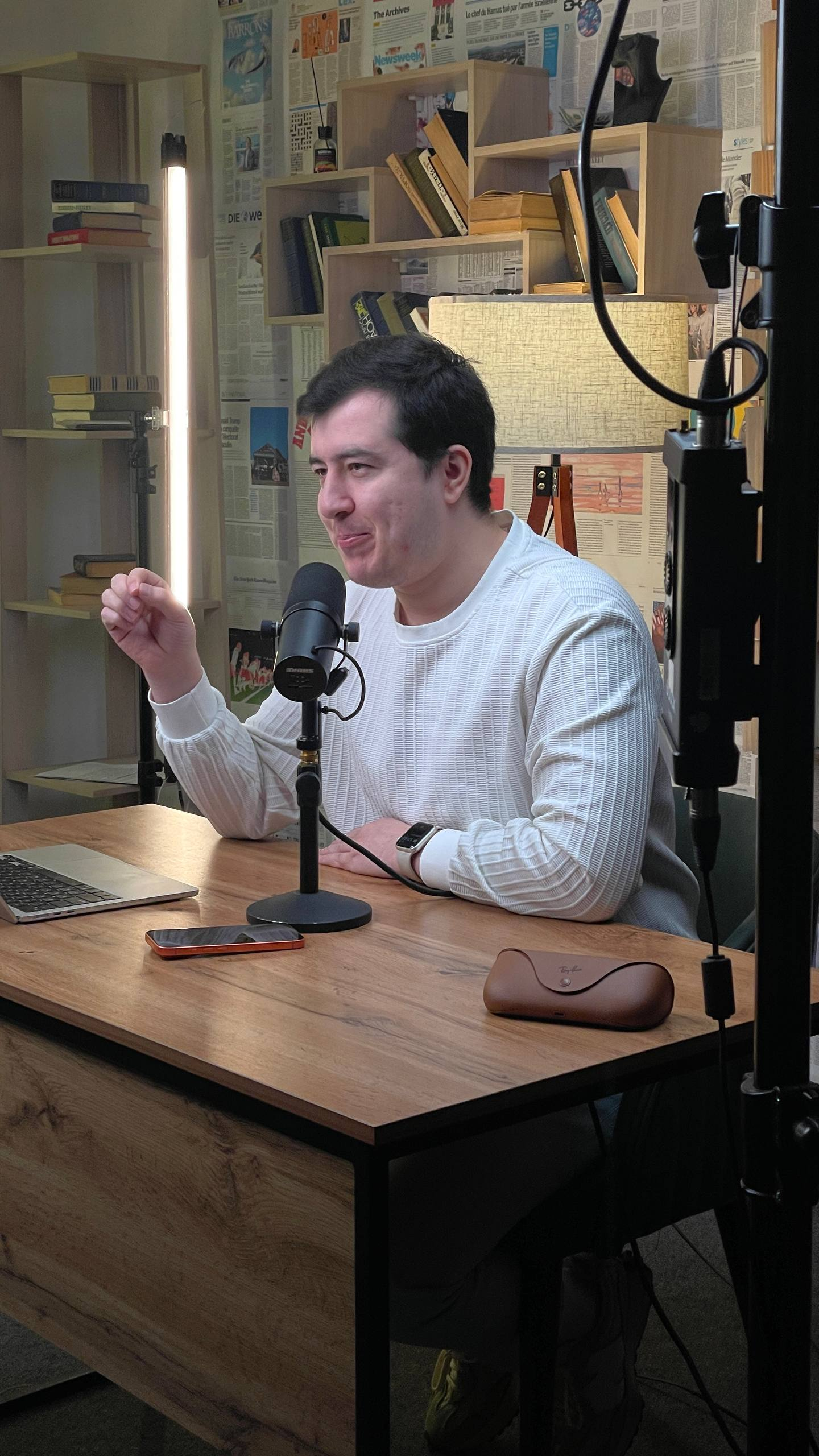
Then came the editing, and there was almost no time for it: we delivered ten finished Reels in under three days.
Dostonjon got the videos and hadn't expected that level: he was used to agencies cutting corners on quality.

Testing
A ceiling of 300,000 and a week to the deadline.
After the shoot we started testing what exactly hooks Dostonjon's audience. In the first week we did more than 200,000 views.
Not bad, you'd think. But for us it was a weak result: you could see the videos hitting a ceiling and not taking 100–200 thousand each.
We tried different things — hard trigger Reels that hit pain points and provoked a reaction; personal videos where Dostonjon opened up and showed his path. There were results, but not the scale we were counting on.
Less than a week was left, and the counter showed only 300,000 views. Not enough.
What we did. We pulled the team into an emergency session. We opened the statistics and looked at which seconds people dropped off, what they rewatched and what they simply swiped past.
The decision came quickly: combine the authority of studio filming with the dynamics of viral motivational videos set to trending music. We rebuilt the content plan completely, betting on a different delivery.
Until then we had kept the formats apart: studio videos carried the status, viral ones carried the reach. The statistics showed that the viewer drops off exactly at the seam — where a serious picture demands a serious tempo. We stopped choosing between solidity and dynamics and joined them in one video.
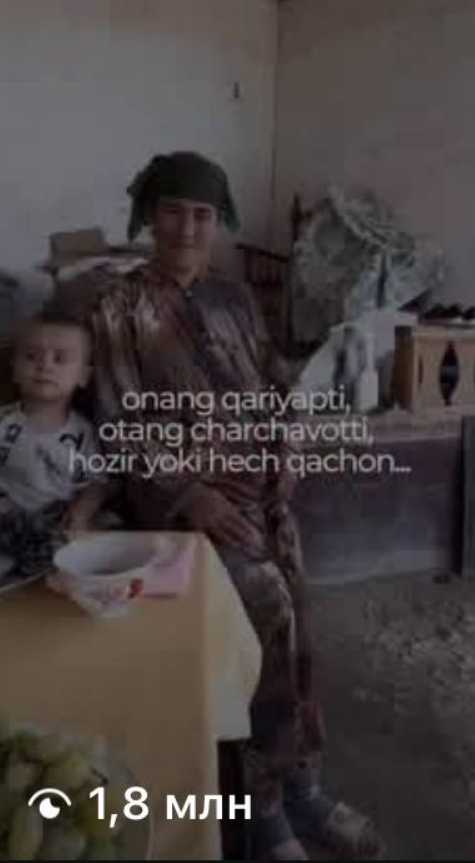
The first video made the new way collected 1,800,000 views in under two days.
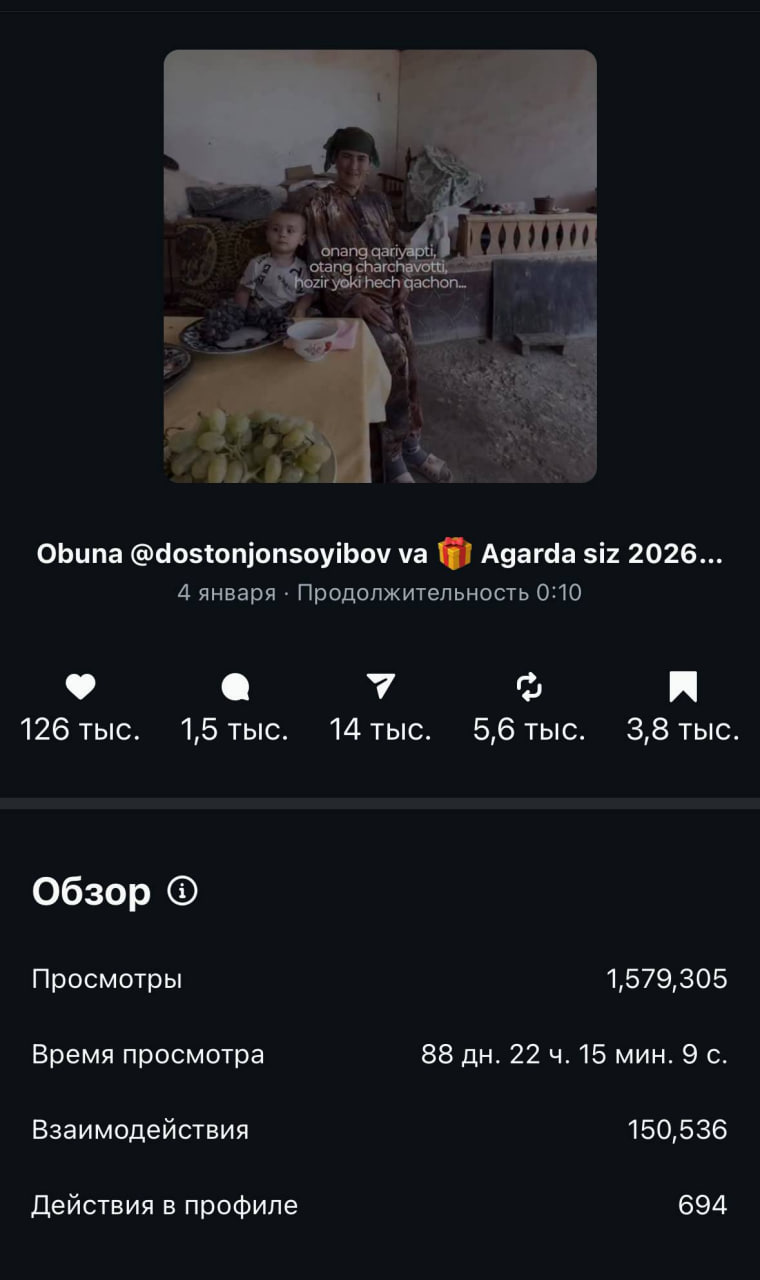
In the end, in under two weeks, we pushed the reach to almost 2,000,000 views. And all of it is pure organic, without a single cent on ads.
Strategy, scripts, filming, editing and publishing — on us. From your side — one filming day.
After that we met Dostonjon again to discuss the next steps for the personal brand. And we agreed to bring him 15,000 registrations for a free webinar that was taking place at the end of the week.
The task got many times harder. Hooking a person is one thing. Making them take a target action is quite another: click the link, leave their details and set aside time to attend. That is no longer «content for views», that is a full sales funnel at work.
A view costs the viewer zero effort. A registration costs attention, personal details and a promise to spend an hour of their life with you. There is a chasm between those two actions, and you cannot jump it with volume of content — which is exactly what we were about to find out the hard way.
We decided we needed to publish 480 pieces of content to get 15,000 registrations. That turned out to be a fatal miscalculation.
For the task we set up two extra accounts and packaged them. The plan came out at 14 publications a day: storytelling posts, carousels, Reels with captions, podcast Reels, cuts from webinars and offline seminars.
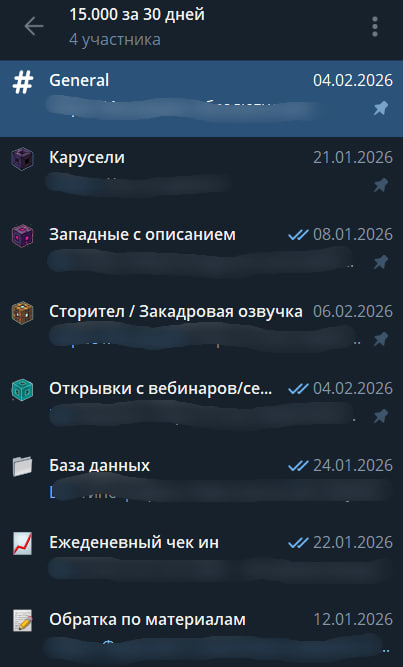
We prepared the materials and made two weeks of content in three or four days. And then the crisis hit.
Two weeks in, everything collapsed. Reach dropped, the flow of enquiries fell tenfold. We were publishing dozens of pieces and standing still: we had 3,000 registrations, and 12,000 were still to go. There was almost no time left.
I sat down, looked at the statistics and realised: I had been trying to reinvent the wheel, complicating the system to the point of absurdity.
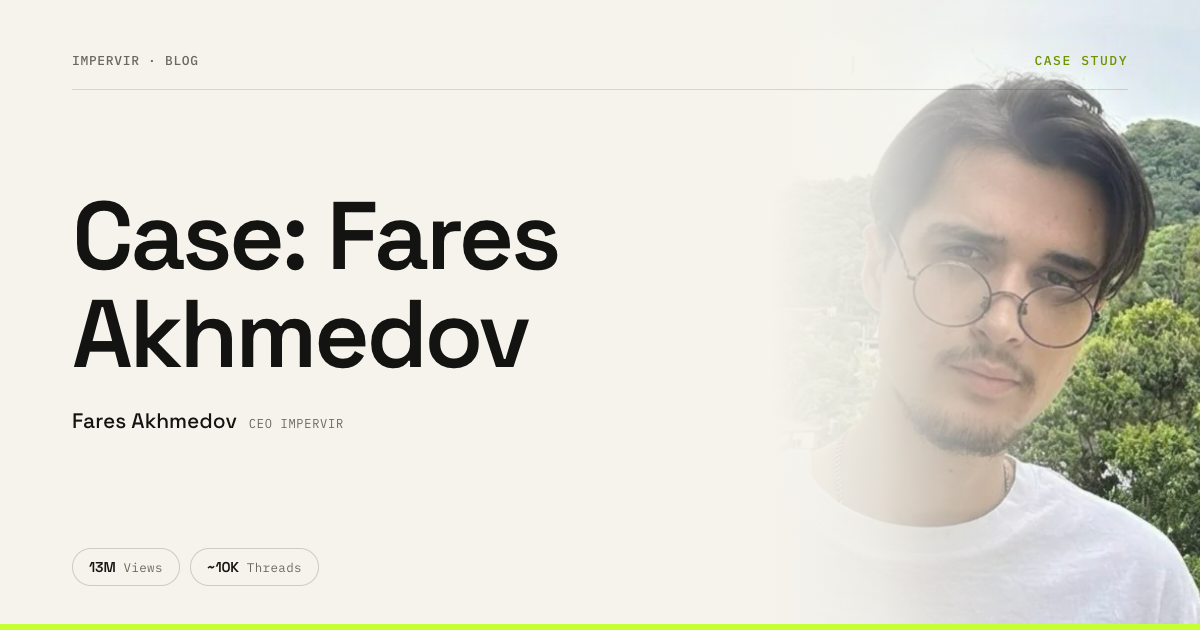
Fares Akhmedov, IMPERVIR
A large amount of content guarantees no result at all. And the volume dragged the quality down — we were simply drowning our useful content in endless noise.
The mistake was in arithmetic that seems obvious and is therefore never checked: if one video brings X registrations, then four hundred videos will bring four hundred X. But the algorithm doesn't add up, it selects. It shows the best of what you publish — and the more weak material sits next to it, the lower the average score of the whole account. We diluted the strong with the weak with our own hands.
At that moment we made a hard but the only correct decision: cut off everything unnecessary. We rebuilt the content structure completely, betting on quality rather than quantity.
Instead of twenty mediocre videos that only created noise, we started releasing one — but flawlessly worked through. Every video got a call to action that led the viewer clearly into the funnel.
A week was left until the deadline. In that week the system came alive and delivered the remaining 12,000 registrations — without a cent spent on ads.
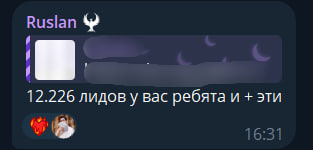
A system. Working formats that turn views into enquiries.
Automation. Chatbots and funnels warm the audience up around the clock, with no involvement from the expert.
Reach. 6,000,000 views in two months — organic only.
Loyalty. +25,000 targeted followers who came for the expertise, not the hype.
Positioning. A clear image of an expert worth following.
Savings. Ads used to cost $10,000–15,000 a month. Here the ad budget is zero.
If you want a stable result on social media, a strong personal brand and Reels as your main source of traffic — book a consultation. On the call I'll walk through your situation personally and show you how to build a personal brand in 2026.
I'll get in touch if there are open slots right now. Usually there's a queue and you have to wait.