How to find someone else's post that already went viral and repeat it on your own account
Repacking other people's threads: where to look, how to select by spike in multiples relative to baseline, what to take, and where the line between repacking and copying runs.
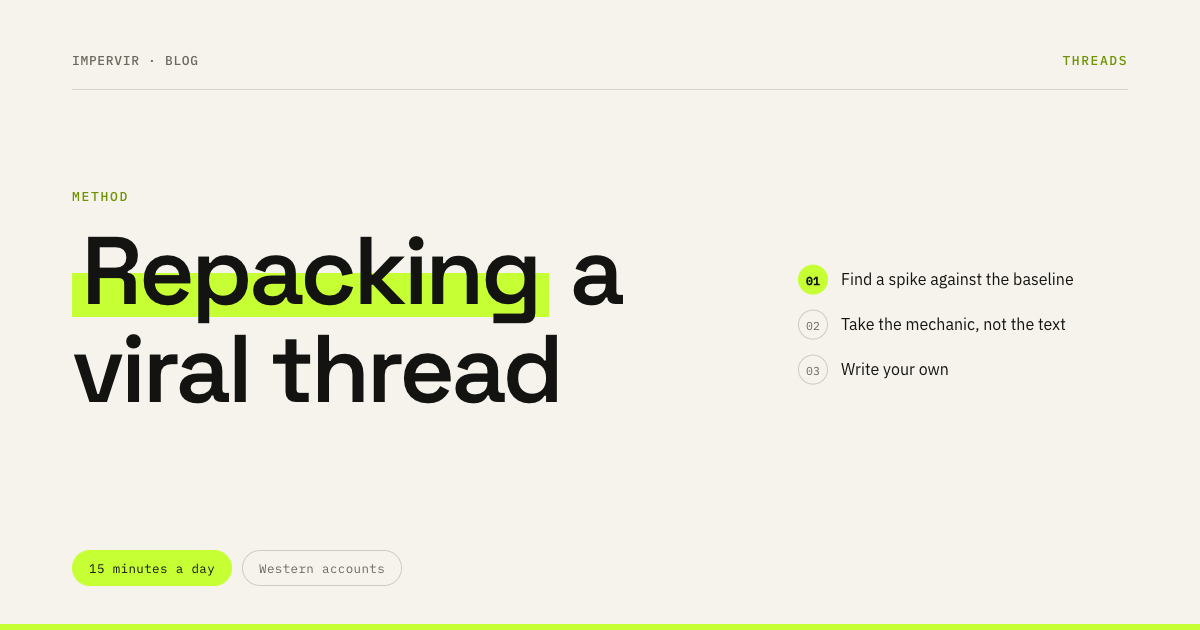
- Threads
- Method
- ≈ 8 minutes
A strong post almost never comes from your own head. It comes from someone else's feed, where it already got a response, and gets rewritten in your voice.
A way to find working posts in fifteen minutes a day, plus one filter that cuts nine out of ten finds. Eight minutes to read.
Coming up with things from scratch costs more than it seems
Every post is a hypothesis, and half of hypotheses don't hold up.
We spent a long time writing posts from a blank page and called it honest work. It turned out to be the most expensive habit in the blog: forty minutes on a text no one had pre-tested.
Every post is a hypothesis. A hypothesis made up from scratch only gets tested by publishing it, and half of those tests go to waste.
A post that already went viral elsewhere has already had its hypothesis tested. All you have left to test is the second thing — whether it works with your audience.
This approach is called repacking. You take the working mechanics — that is, the structure and the type of hook — and fill it with your own topic, your own experience, your own voice.
Watch Western accounts, not local ones
Russian-language Threads lags behind by about six months.
Formats that already worked in the English-language feed have barely been brought here yet. That's why most of the scouting happens on Western accounts in your niche — that's how we got 13 million views in two months.
You should watch local accounts too, but only as verification. If a format has already spread through Russian-language feeds, you're too late.
If a hook has already spread through Russian-language feeds, you're too late and you're just picking up the tail. Watch whether the format has become recognizable: once a reader can guess the second line from the first, the window has closed.
Count in multiples, not absolute numbers
This is where almost everyone gets it wrong.
A post from a million-follower account with 300,000 views says nothing at all. Any of their posts pulls that in.
What matters is the ratio to the author's baseline. An account with 3,000 followers whose post pulled in 100,000 gave a thirty-times spike — and that's repeatable from scratch.
Other people's stats are private, so you estimate the baseline from two things: follower count and the response on the author's neighboring posts.
More precisely, what's actually hidden is exactly what sits in the "Insights" section: views, engagement, and the follower breakdown are visible only to the author themselves. What stays visible from outside on the post are reposts, replies, and likes, and that's enough.
Open three posts before and three after. If the one you're analyzing pulled in multiples more than its neighbors, it's a real find.
We take the fourth one. A thirty-times spike relative to baseline is repeatable from scratch; a ×1.1 from a million-follower account is not.
A post gets multiples more reactions than the same author's neighboring posts. If it gets about the same, that's not a spike — that's just an ordinary day for them.
Take the structure, not the text
The type of hook, the order of thoughts, and the role of the first line.
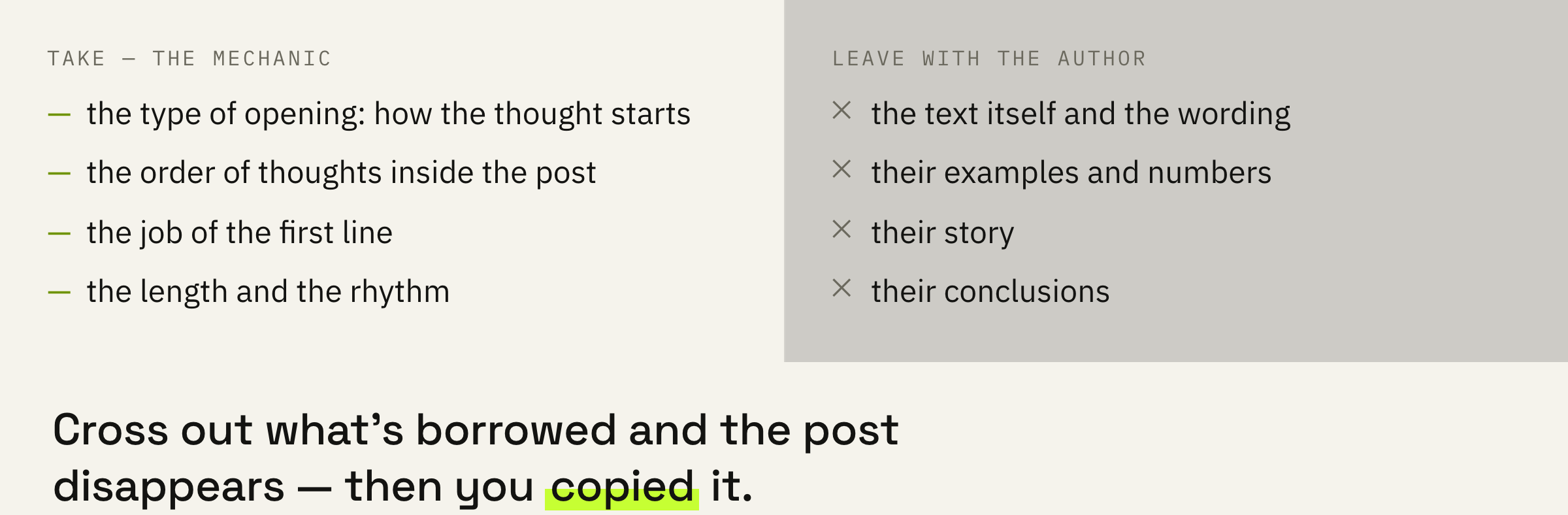
From the post you found, you take away three things: the type of hook, the order of thoughts, and the role of the first line. The actual text stays with the author.
Take our own post, for example:
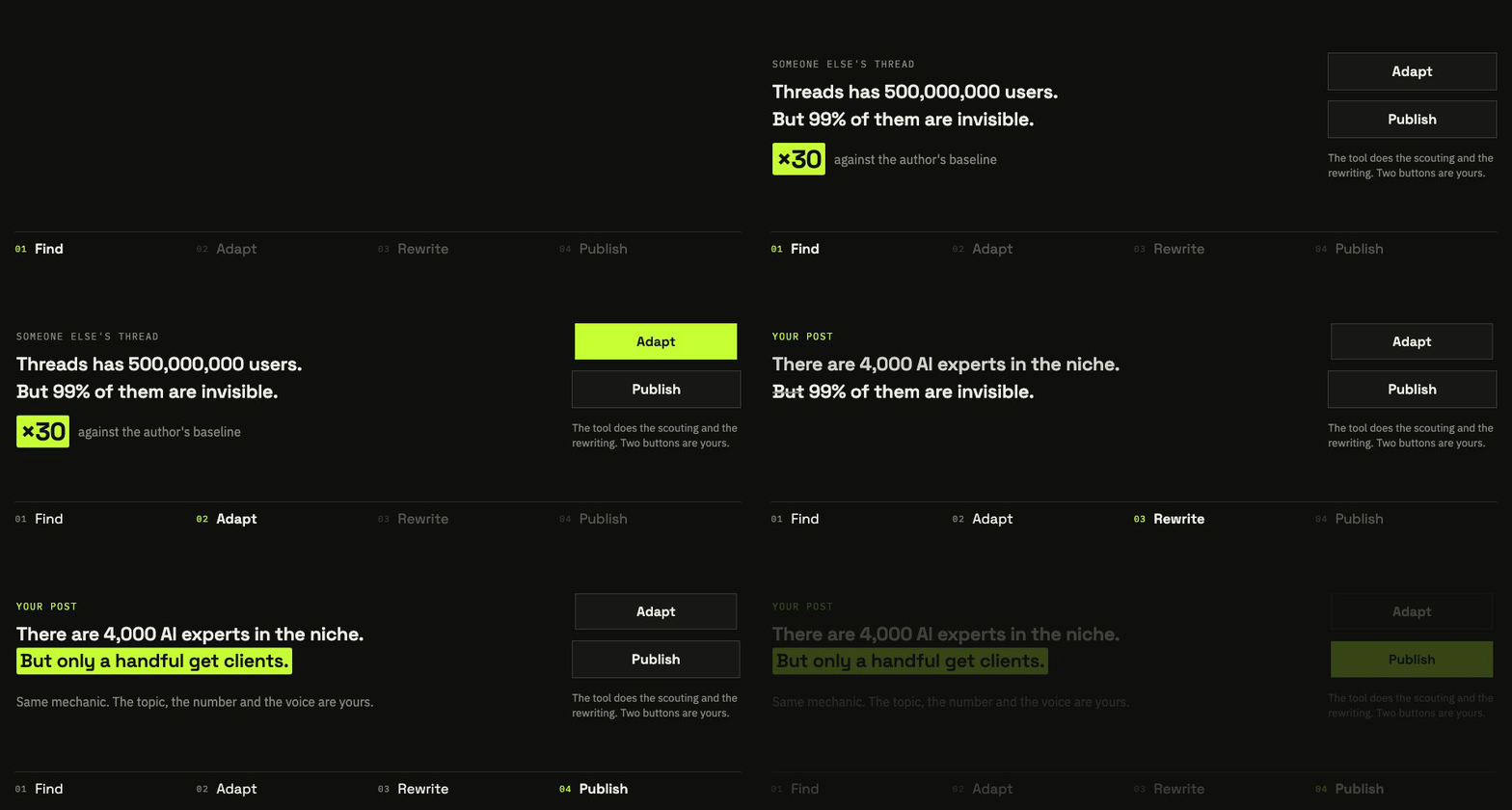
Threads has 500,000,000 users. But 99% of them are invisible
202 reactions and 76 comments, while neighboring posts were pulling in ten.
The mechanics here are simple. A big number, then a cutoff that turns the reader from an observer into a participant.
The same mechanics work on anything. Plug in your own niche and your own number, and the text becomes yours from the very first word.
After that, the post needs to lead somewhere. That's a separate breakdown: where you should actually be driving people from Threads.
Where the line runs
Between repacking and copying.
Copying is when you carry over someone else's words. Repacking is when you carry over the form and put in your own meaning.
There's one test: remove from your post everything taken from the donor author. If the post disappears after that, you copied. If it stays and reads fine, you made your own.
This platform has even spelled out this line in writing. Instagram considers original what you created yourself or what reflects your own point of view. It considers non-original something copied exactly, or without substantial reworking.
The list of what doesn't count as reworking there is short and sobering: a frame, a watermark, a speed change, and a caption crediting the author. None of that makes someone else's material yours.
Instead, they recommend adding overlaid text that does more than just describe what's happening, or a voiceover, storyline, or graphics that meaningfully reinterpret the source. That's exactly what repacking is — just described in the platform's own language.
Content flagged as non-original doesn't get pushed to people who don't follow you. Starting April 30, 2026, the rule won't just cover Reels — it'll hit photos and carousels too. You can earn the right back: an account becomes eligible for recommendations again once most of its posts from the last thirty days are judged original, and that count keeps rolling.
This is Instagram's own rulebook. We didn't find a separate one for Threads, and we're not going to copy-paste the penalties one-to-one. But as a description of the line between "borrowed the format" and "stole the content," it's more precise than anything we could write ourselves.
You take the mechanics, you bring your own meaning
It took us years to get to this understanding — you'll get it in eight minutes of reading.
How much time this takes per day
Fifteen to twenty minutes, not a minute more.
After that you're just scrolling someone else's feed, which looks like work but isn't.
Start one list and drop your finds into it: a link and one line on what caught your eye. In two weeks you'll have your own bank of formats, and you won't have to invent things from scratch anymore.
A strong topic can carry five to ten posts. Once you find a format that works, run it all the way through. It's too early to drop it for the sake of novelty right after the first win.
What to do next
Two paths: by hand, or faster.
Open three Western accounts in your niche, pick one post each that spiked well above their baseline, and rewrite each one in your own voice. It'll take an evening and cost you nothing.
You don't have to do that scouting by hand — the tool finds viral threads on its own, drops them into a table, and rewrites them for you. All that's left is to check and publish.
Day one is free — no card, no signup. Set it up in ten minutes and test it on your own account.
Try it free for 1 dayNot ready for a tool yet — follow the system above, it's free and it works.