How long should a reel be: the two ceilings people confuse
Reel length has two limits: 20 minutes is the technical ceiling and 3 minutes is the border past which the video stops being shown to new people. Length also picks the group you get compared against.
- Social media & AI
- Problem breakdown
- ≈ 8 min
The question “how long should a reel be” usually gets answered with a number of seconds borrowed from someone else's experience. The platform has written something different about it: there are two ceilings, they are about different things, and the second one decides whether people who don't follow you will see the video at all.
The two length limits the platform states itself, and the difference between them. Why length also picks the group you get compared against. Eight minutes of reading.
Twenty minutes and three minutes
Both numbers come from the platform, and they are about different things.
Instagram's help centre has a page about recording reels, and it carries two limits one after another. The first one is technical.
You can record one or multiple clips that add up to 20 minutes.
Instagram help centre · how to record a reel
The second one follows as a note, and it is the one that answers the question in the headline.
Note: Reels over 3 minutes won't be recommended to new audiences.
Same page, note to the duration limit
Twenty minutes is how much the app will let you record. Three minutes is the border past which the video stops being shown to people who don't follow you. The first limit is technical, the second decides the fate of your reach.
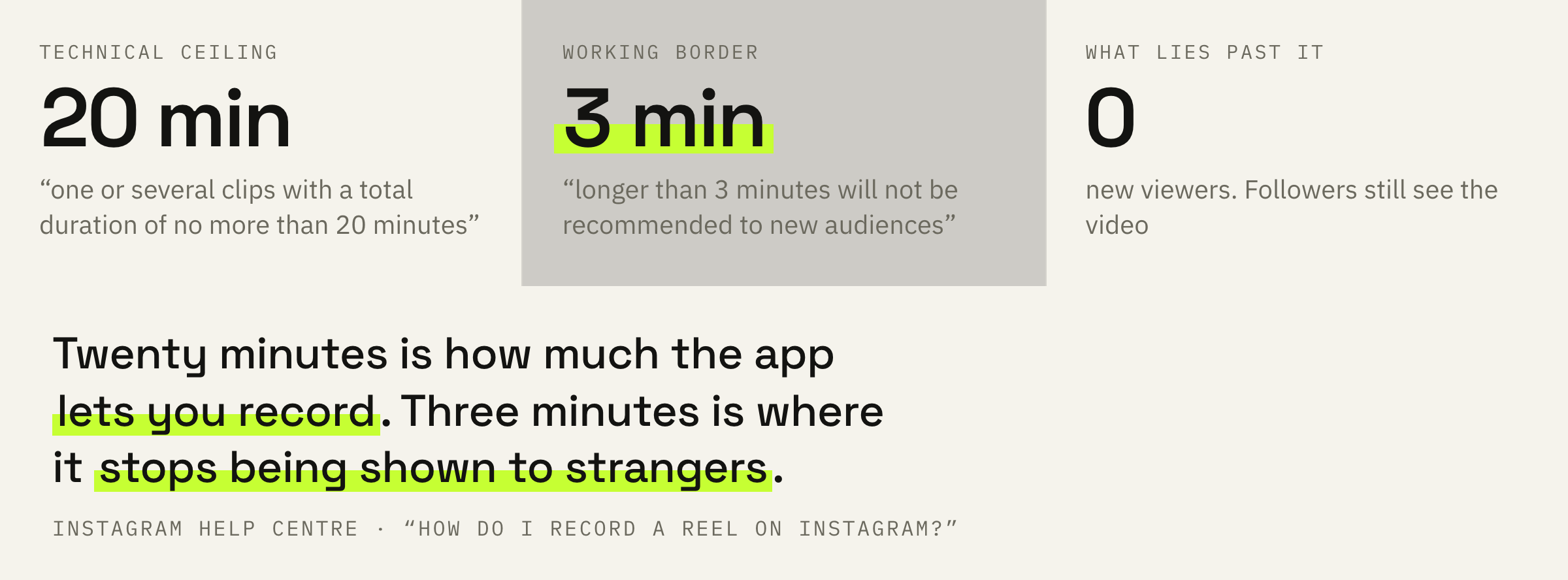
The card for that same article in help centre search is captioned more briefly and more honestly: “record and edit videos three minutes or shorter”. So the platform itself treats that as the working length.
What happens past three minutes
The video doesn't disappear. It stops travelling beyond your own audience.
The platform's wording is precise, and it is worth reading literally. It doesn't say a long video will be deleted or shown less. It says it will not be recommended to new audiences.
Followers can still see such a video: it stays in the profile, in the following feed and at the link. Exactly one channel gets switched off — the one that brings strangers in.
A video longer than three minutes only makes sense for the audience you already have. As a growth tool it doesn't work, and that is the platform's decision, not a verdict on your filming.
How showing to followers differs from showing to strangers, and why those are two separate paths, we covered separately: why your reel isn't shown to followers.
From here comes a simple planning rule. The long format is for going deep with your own people: a detailed explanation, answers to questions, a recorded live. The short one is for everything meant to bring new people in.
You get compared to reels of your own length
Length picks not only your admission, but your rivals too.
Inside the videos that are admitted, a second mechanism is at work, and it explains why the advice “make it shorter” helps differently from what's promised. The platform publishes nine predictions it computes for a video in the Reels feed. One of them is about watch-through.
How likely you are to watch more of a reel than 95% of users who watched reels of the same length.
“AI system for Instagram Reels video chaining”, Meta Transparency Center
Three words are the key here: “of the same duration”. Your video is compared not with everything out there, but with videos of your length. And duration itself sits in the list of input signals in plain text.
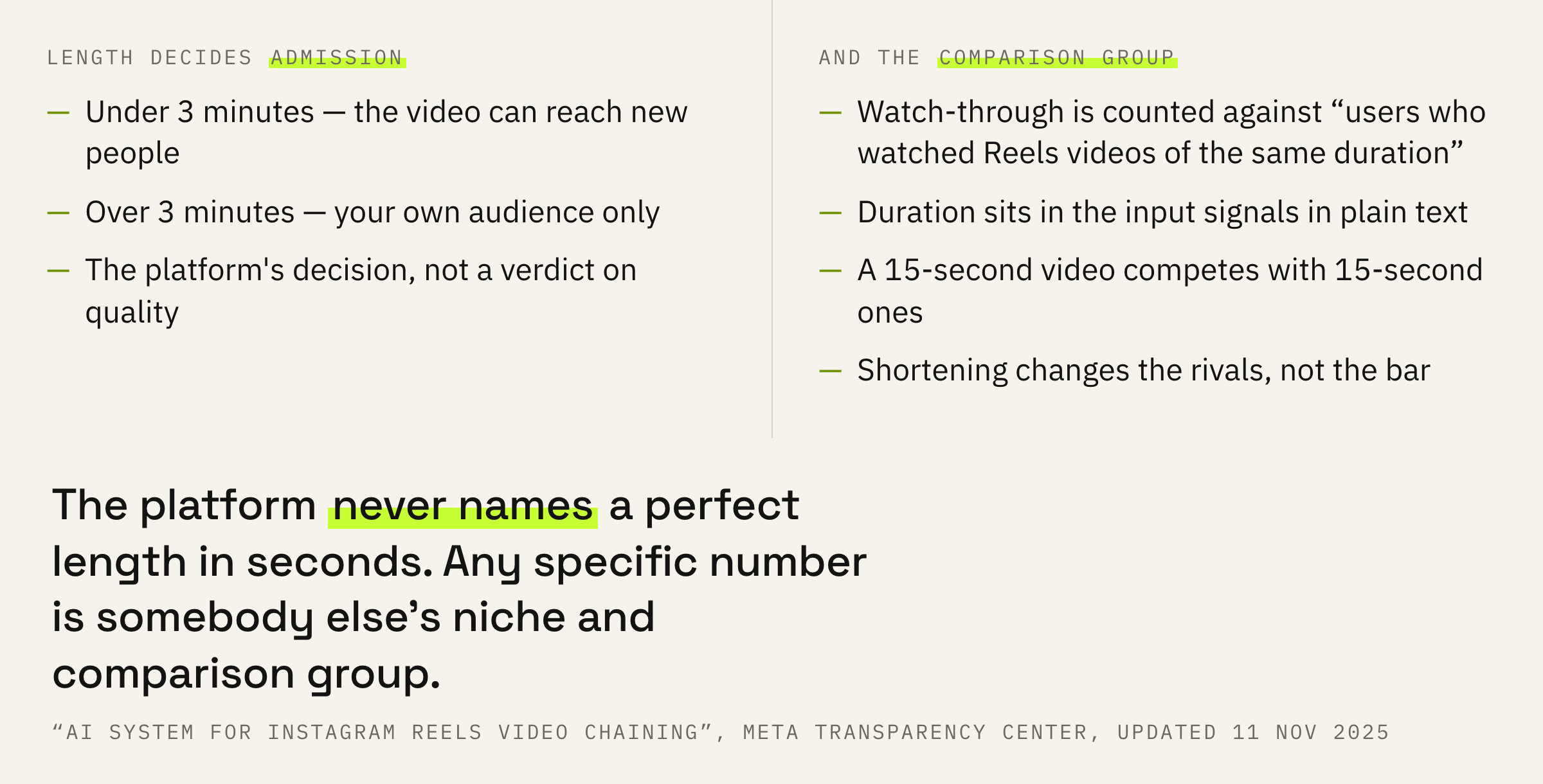
Shortening moves the video into a different comparison group; it does not lower the bar. A fifteen-second video competes with fifteen-second ones, and those get watched through differently than minute-long ones.
This also answers the question “which length is best”. The platform never names a best length in seconds, and any specific number from someone else's article is someone else's niche, someone else's audience and someone else's comparison group.
If your videos gather views inside your audience and never travel beyond it, we'll look at your recent reels and tell you where the exit to new people is lost.
How to choose a length and hold it
Four steps, and none of them is about hunting for the perfect second.
First: decide what the video has to do. Bring new people in — stay inside three minutes. Explain something to your own — length stops being a limit, but growth is not something to expect from it.
Second: once you've picked a length, hold it for at least a week. Changing it every day, you land in a new comparison group every time and lose the ability to compare results with your own.
Third: work on the opening. Among the signals for the three-second-view prediction the platform names how many times a post was skipped within two seconds of it opening. That is the shortest window you influence directly, and it doesn't depend on total length.
Fourth: compare videos of one length against each other. Five minute-long ones against five minute-long ones. A minute-long one can't be compared to a fifteen-second one: those are different groups, and the conclusion would come out of noise.
In two weeks, open the stats for five new videos and five earlier ones of the same length. If you held the length, you'll see the effect of the change. If you changed both length and delivery, you'll learn what helped only by accident.
Average watch time suits this comparison worse than it looks: replays land in its numerator but not in its denominator. A short looping video gets an inflated average, which is exactly why it can only be compared with videos of the same length.
What not to do
Four decisions people make out of someone else's numbers.
If your videos don't gather views even inside your own audience, length is not the issue: a breakdown of reels stuck at 200–500 views.
What to do next
One decision for this week.
Look at your last ten videos and write their lengths next to the number of viewers. Most likely the lengths will all differ, which means comparing them against each other was never possible.
Then pick one length for the job and shoot five videos in a row at it. That is the first batch whose results you can honestly compare.
We'll look at your videos, sort them by length and watch-through and tell you which format works on new people and which only on your own.
If you want your videos to travel beyond your own audience — leave a request. We'll get in touch if there are slots available at the moment. There is usually a queue and a wait.