How many reports does it take to block an Instagram account
Neither the Help Centre nor the Transparency Center names a report threshold: technology finds most violations before the first report, and the queue is ranked by harm.
- Social media and AI
- How it works
- ≈ 8 minutes
“Let us gather ten reports and the account gets taken down” is the most durable belief about moderation. Neither the Instagram Help Centre page nor Meta’s Transparency Center names a number of reports. What they do say is different: technology finds most violations before the first report, the review queue is built around possible harm, and your report changes your own feed first of all.
Why no Meta document names a number of reports. Who finds most of the violations. Which signals put one case ahead of another in the review queue. What a report does to your feed. What can be checked if someone reported you. Eight minutes of reading.
Nobody names a number of reports
Neither the Instagram Help Centre nor Meta’s Transparency Center.
Start with what the documents do not contain at all.
Neither the Help Centre page about sending a report nor the Transparency Center sections about detecting violations names the number of reports after which an account is closed. There is no threshold there in any form: no figure, no range, not even a hint that such a counter is kept.
Instead of a counter the documents describe an order, and it begins long before the first report.
Our technology proactively detects and removes the vast majority of violating content before anyone reports it.
Meta Transparency Center · ‘Detecting violations’
Read that literally. Most removals happen before anyone even has a reason to press the button. A report here is not a trigger but a second entrance to the very same queue.
That does not take people out of the process. Review teams work alongside the technology, and the Transparency Center gives their scale in a separate line.
Altogether, they review content in more than 80 languages.
Meta Transparency Center · the same page
More than 80 languages in review is about who gets your particular case. The material goes to a person who reads the language of the post, which is why there is no single shared queue.
The review queue and its order
Possible harm and reach set the order.
If there is no threshold, the question remains: by which signal are some cases handled before others. The Transparency Center answers it directly.
We then use technology to rank and prioritise content so that our review teams can focus on the most important cases first. This includes content with the potential for offline harm, such as posts related to terrorism and suicide, and viral content that violates our policies and has the potential to reach a large audience.
Meta Transparency Center · ‘How technology helps prioritise review’
Two signals are named in that line, and the number of reports is not among them. The first is the potential for real harm, and the examples given are extreme ones. The second is virality: violating material that can reach a large audience moves up.
Hence a consequence that breaks the original question. Ten reports about a harmless clip and one report about material with real risk are not ten against one. They are two different queues.
Then comes the half of the mechanism that gets forgotten entirely.
Whether potentially violating content is reported by people or detected by Meta's technology, automation helps us quickly route the content to reviewers who have the right subject matter and language expertise.
Meta Transparency Center · the same page
Look at how that sentence begins. Material found by the technology and material coming from a report travel the same way: both go to reviewers with the right topic and the right language. A report does not create a separate faster route.
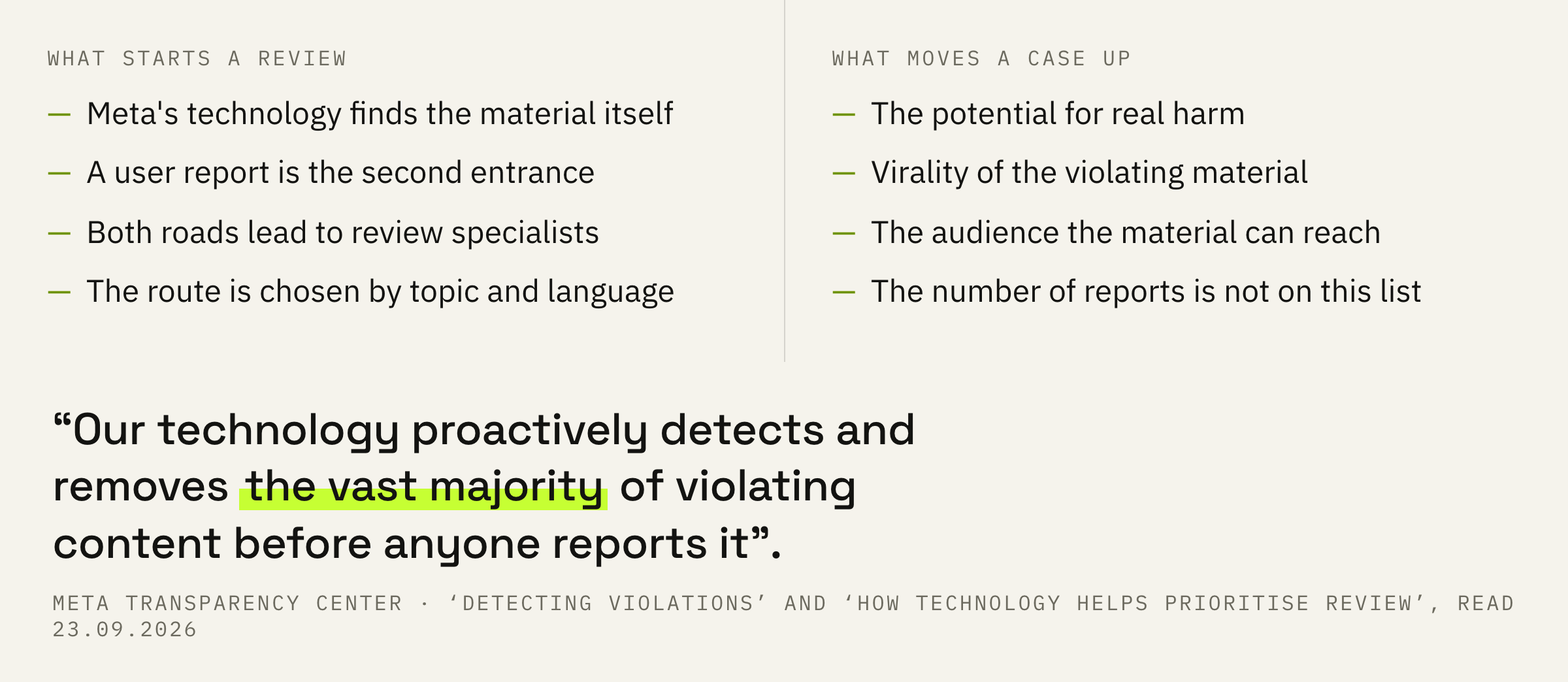
An agreement in a group chat to report all at once does not move the queue. Priority is described by two signals: potential real harm and the reach of the violating material. The number of senders is not in those signals.
Anonymity and one exception
The rule works in both directions at once.
Now about the act itself, the fear of which is the usual reason people do not report at all.
Keep in mind that your report is anonymous, except if you’re reporting an intellectual property infringement. The account you reported won’t see who reported them.
Instagram Help Centre · the page about reporting a profile or a post
The exception is exactly one and it is named in the same line: a report about an intellectual property infringement. In every other case the sender’s name stays closed.
The other side of the rule is just as hard. If someone reported you, the author cannot be found, neither in the app nor through support. Searching for the culprit among competitors and offended followers ends in guesses.
The app lists nine reasons for reporting a post, from the one about not liking the content to an intellectual property infringement. For a profile there is one more, about the age of the owner.
Your feed changes first
The only consequence promised outright.
The most practical line of the Help Centre lies where people usually do not look for it.
Even if we don’t remove the content or profile you reported, we understand that you likely want to see less of this type of content on Instagram. We may use your report to make content similar to what you reported appear lower in your feed or in the recommendations we make for you, like Suggested Posts and Explore.
Instagram Help Centre · the same page
That is the only consequence of a report the platform promises you outright. It does not promise removal, nor the closing of an account. Similar material shown lower it does promise, and in three places at once: in the feed, in Suggested Posts and in Explore.
Hence a conclusion that changes the meaning of the action. A report is first of all a setting for your own feed, and it works regardless of what gets decided about somebody else’s account.
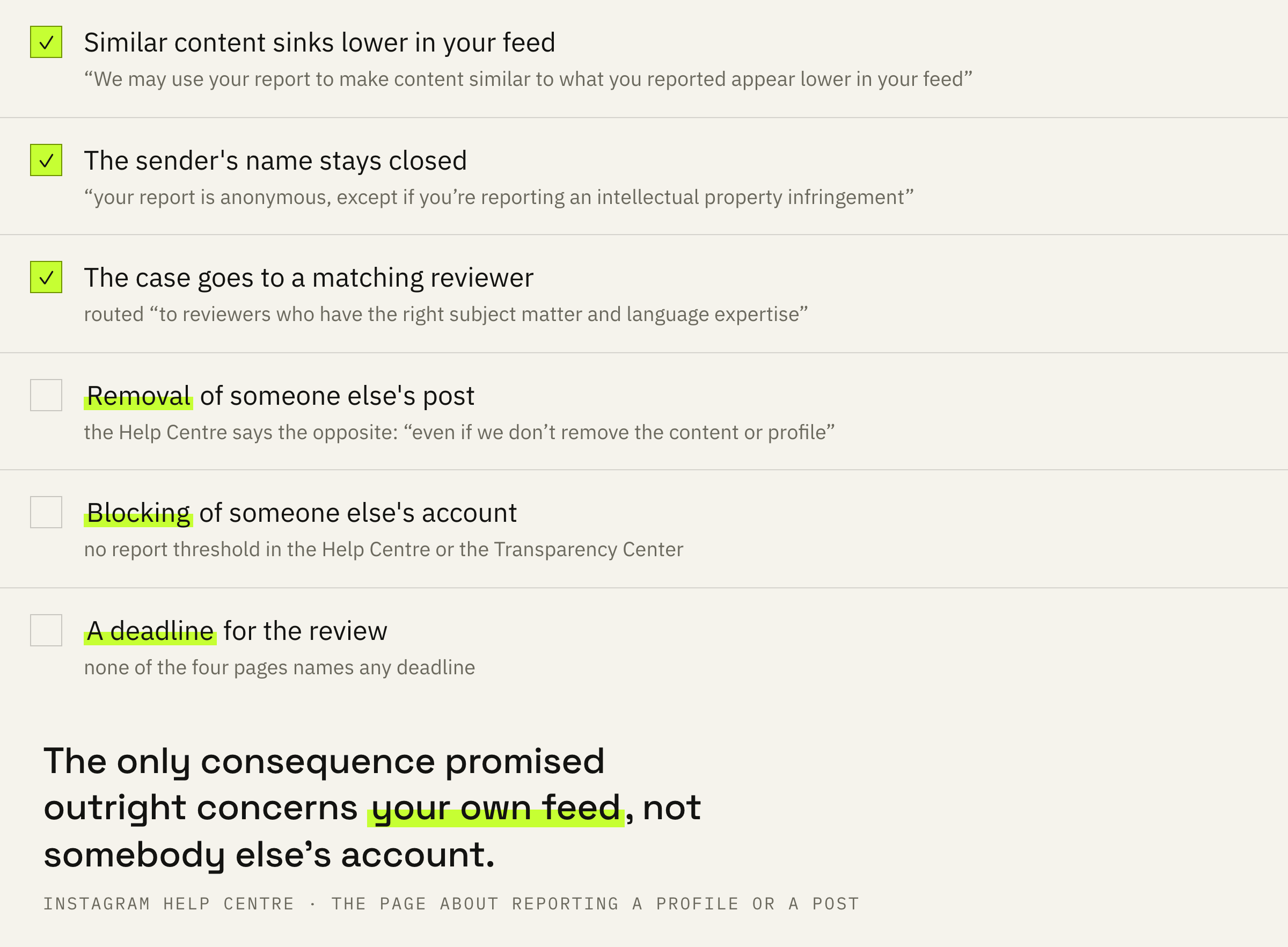
A neighbouring tool does the same job on a larger scale: resetting your recommendations rebuilds the whole selection, while a report lowers one type of material.
If someone reported you
What takes a minute to check, and what cannot be learned.
The reverse fear sounds like this: several reports have arrived, so the account will be closed soon. That does not follow from the documents.
A report by itself is not a decision. It sends the material into the same queue, where it is judged by the rules of the platform and not by the number of senders.
There is something to check, and the check takes a minute. Instagram settings hold a section with the account status, where it is written in words whether your posts were removed and whether recommendations are open, and it is covered separately.
We will open the account status section, go through the removed posts and compare views inside each format, to separate a restriction from an ordinary dip.
What cannot be learned is worth accepting in advance. The platform publishes neither the number of reports, nor their authors, nor review deadlines. Any figure like “they block you after fifteen reports” comes from other people’s retellings, and the documents do not have it.
Reports and a drop in views are worth keeping apart. A fall in reach is more often explained by the format and by a comparison with the wrong period, and a report is the last version on that list.
The order of steps and three mistakes
Five steps for both sides of the conversation.
First, if you are the one reporting: choose the reason on the merits. The list in the app is long, and the item about not liking the content sends the case somewhere other than where you expected.
Second: do not count senders. The signals of priority are described, and the number of reports is not one of them.
Third, if someone reported you: open the account status section and read the wording in full. Until that screen is open, every conclusion rests on feelings. If the matter is other people’s clips and repeated texts, the platform has a separate rule about originality.
Fourth: look at what exactly was removed. Removals move the conversation away from reports and onto the specific rule the material was taken down by.
Fifth: do not wait for a date. The platform does not publish review deadlines, and refreshing the screen every hour speeds nothing up.
Ask two questions in a row. Which rule was broken and how large the possible harm is. The first answer decides whether there is a subject for a report at all. The second explains why one case is handled straight away while another waits its turn.