What Instagram counts as unoriginal content
The platform calls borders, watermarks and crediting the author immaterial edits. Instead of percentages it offers a test in one phrase, and it counts the return to recommendations over 30 days.
- Social media & AI
- Mechanics breakdown
- ≈ 9 min
Instagram has a separate document about originality, and it is written unusually concretely: it lists what does not count as an edit and offers a test that fits in one phrase. After it you no longer need to argue about “have I changed enough”.
The two cases of unoriginal content, the list of edits the platform calls immaterial, the test in one phrase, and how an account gets its right to recommendations back. Nine minutes of reading.
What the platform counts as original
The definition is short and comes with examples.
Original content is work that you wholly created or reflects your unique perspective.
Instagram · Original Content Guidelines
Then come the examples: photos or videos you shot; what you designed; what you substantially edited. That last item is the subject of every argument.
The platform describes the unoriginal through two cases. The first: content that includes another creator's work and in the making of which you took no part. The second: content you did not produce or shoot and which carries no substantial edits.
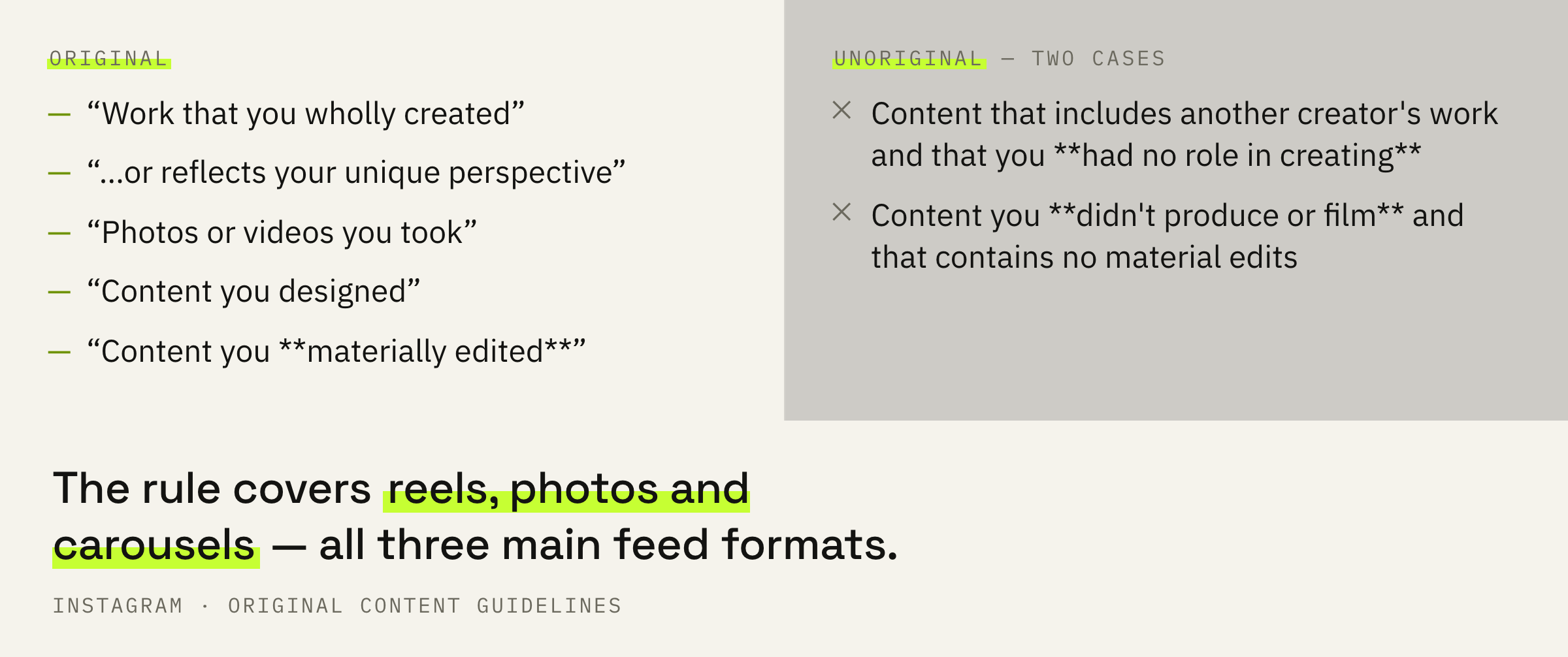
The rule applies not only to videos. That same document lists reels, photos and carousels — that is, all three main formats of the feed.
What doesn't count as an edit
A list that closes half the questions.
The argument usually runs around what to count as a substantial edit. The platform answers from the other side and lists what a substantial edit is not.
Examples of minor and immaterial edits include but are not limited to: borders, watermarks, speed changes, just crediting the original creator.
Instagram · Original Content Guidelines
Read that list once more, because it gathers every habitual trick of “uniquifying”. A border around somebody else's video doesn't make it yours. Neither does crediting the author in the caption, though that doesn't cancel the courtesy.
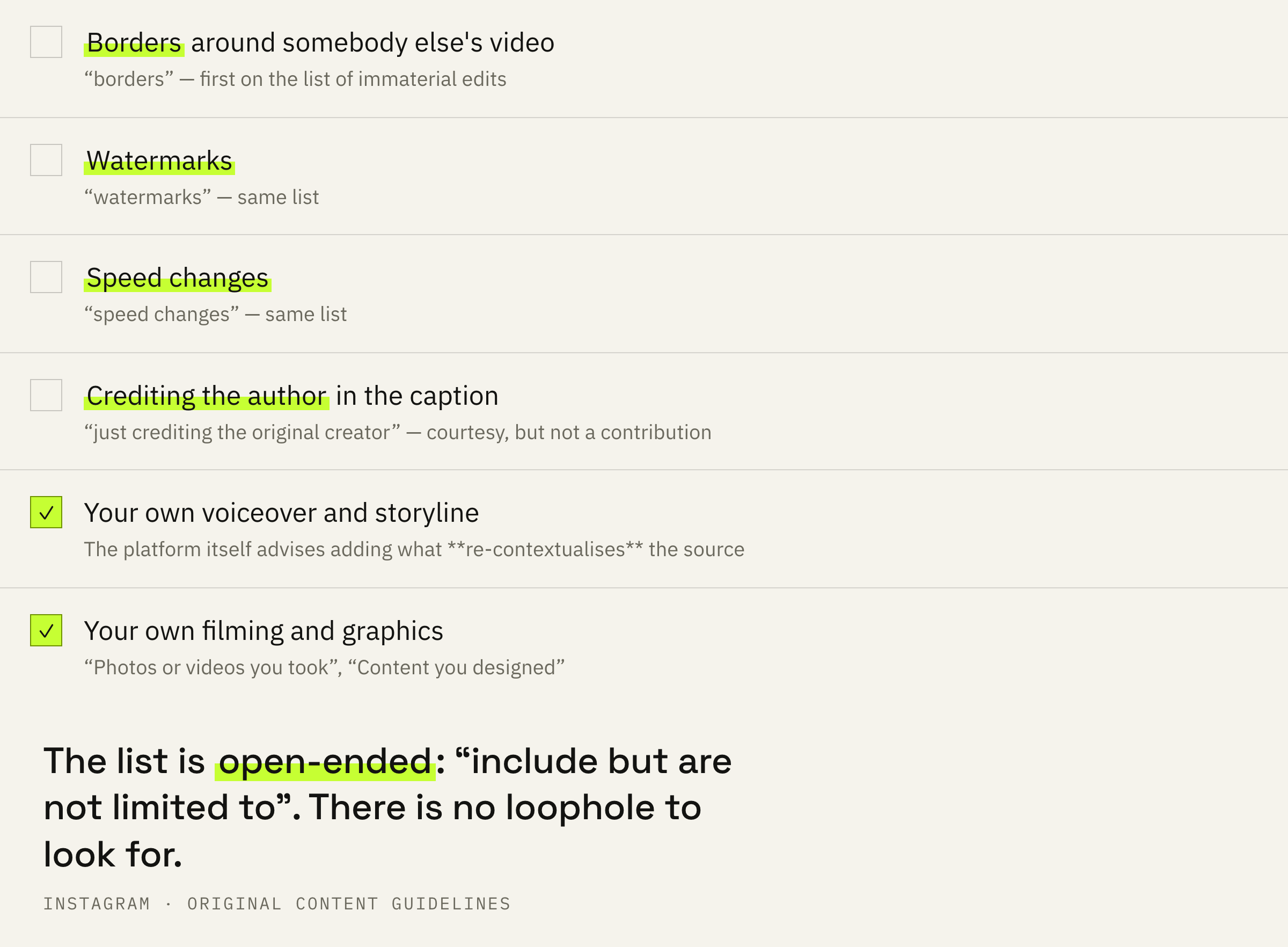
The list is open: the original reads “include but are not limited to”. So it isn't exhausted by what's listed, and looking for a loophole in it is pointless. A threshold of “what percentage do I have to change” doesn't exist anywhere either.
The test in one phrase
It alone was worth opening the document for.
Instead of percentages the platform offers a thought experiment. It is short and works on any material.
If someone could remove your contribution to your post or reel, and the content would virtually be the same, it probably needs more of you in it.
Instagram · Original Content Guidelines, in the platform's own wording
Apply it to your latest video. Take away your voiceover, your on-screen text, your own footage. If what's left still looks like a finished video, there was too little of you in it.
The other side of the test is pleasanter. It also explains what to do instead of copying: add a voiceover, a storyline or graphics that rethink the source rather than merely accompany it.
What gets switched off and how to get it back
Thirty days and a rolling window.
If we believe your content is unoriginal, it may be ineligible to appear in recommendations to people who don't already follow you, limiting its reach.
Instagram · Original Content Guidelines
Note the border. Followers still see the content: what gets switched off is the showing to strangers. For an account that lives on recommendations, that is the whole of its growth.
The way back is described too. An account becomes eligible for recommendations again when the majority of its recent reels, photos and carousels are considered original within a thirty-day window.
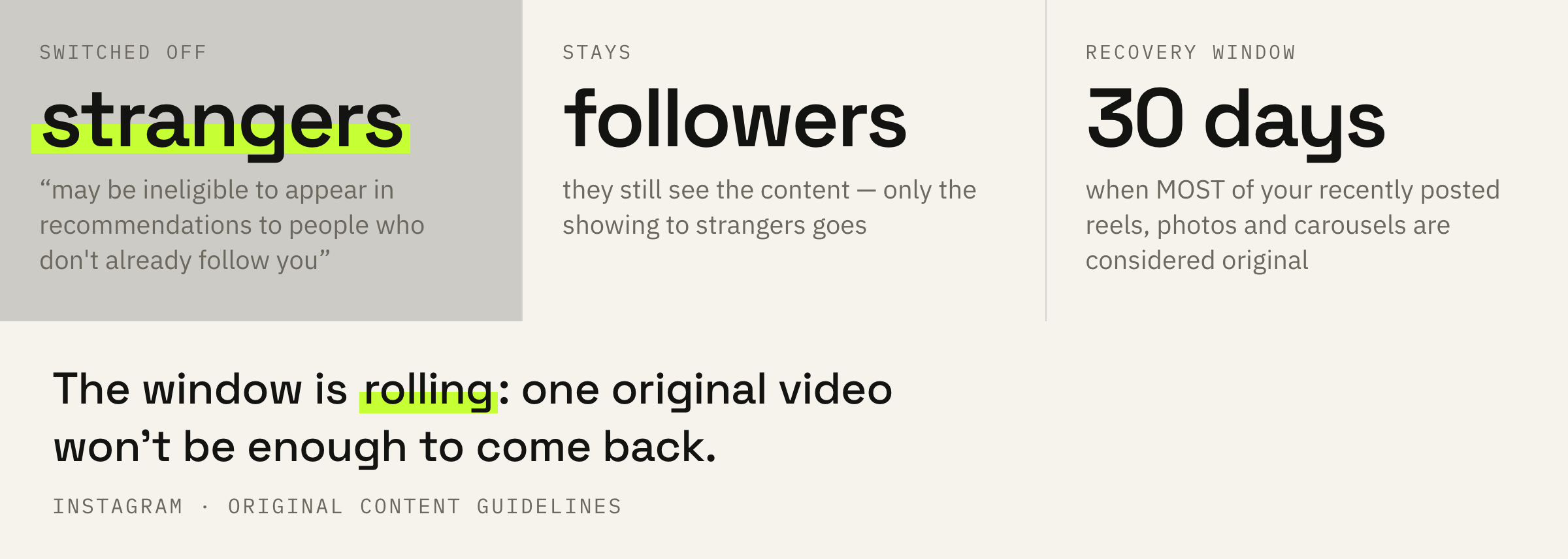
The window is rolling, which means one original video is not enough: what counts is the majority over the last thirty days. If half the feed is made up of somebody else's material, sorting it out will take a month.
The mechanics yes, the material no
This is where two different actions get confused most often.
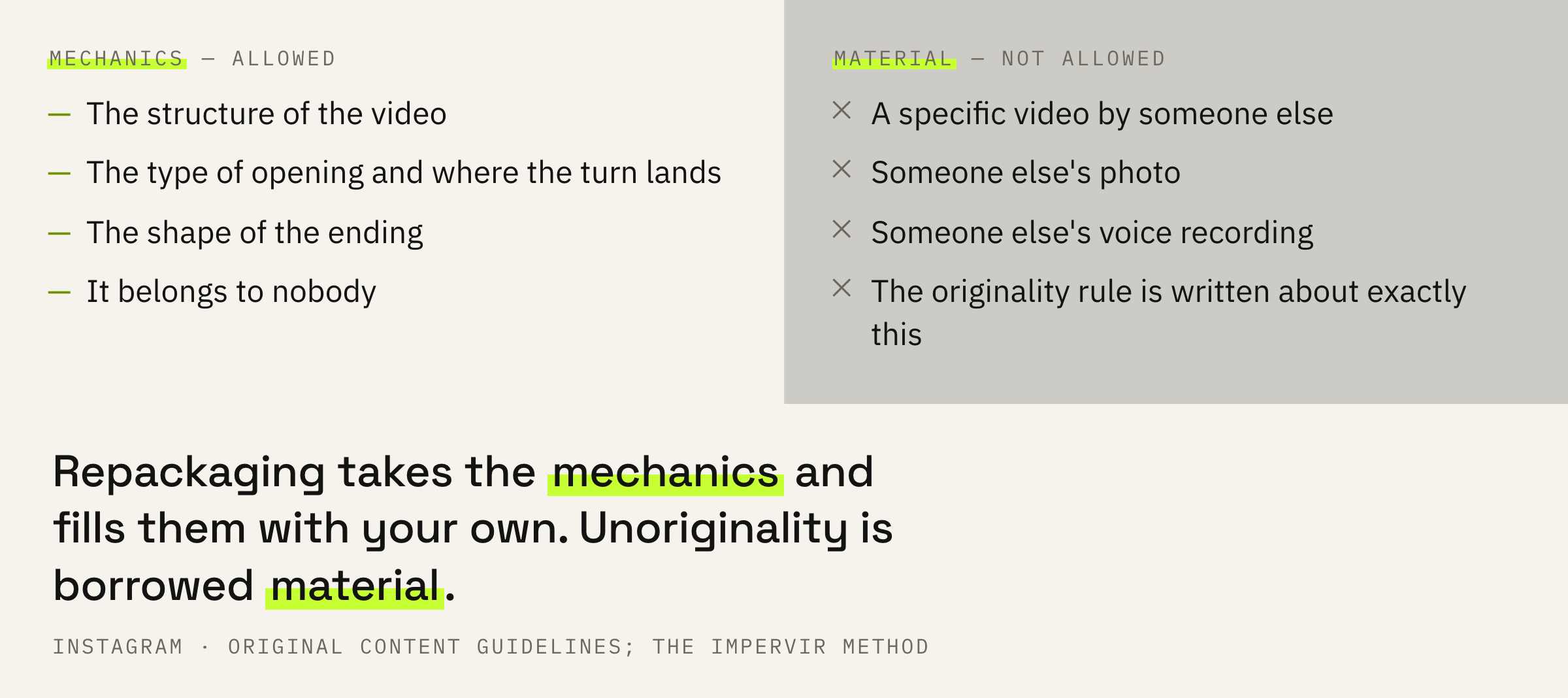
Copying in social media is allowed and necessary, but not everything indiscriminately. The difference runs between the mechanics and the material.
The mechanics is the structure of a video and the type of opening: how the beginning is built, at which moment the turn appears, how it ends. It belongs to nobody, and repeating it is fine.
The material is a particular video, photo or voice recording. It belongs to its author, and the originality rule is written about exactly that. What the first looks like without the second we covered separately: the repack: take the mechanics, put in your own meaning.
If your reach has dropped and the cause is unclear, we'll look at your feed and tell you whether there is anything in it the platform would consider unoriginal.
What not to do
Five tricks the platform named directly.
And the extreme in the other direction: deciding that now you may not draw inspiration from other people at all. You may. The rule is written about material, not about ideas, and it doesn't forbid repeating a structure that works.
What to do next
Two minutes for today.
Take your last three posts and apply the test from the document to each one. Mentally take away your contribution and look at what is left.
If almost everything is left, add what is missing: your voice, your text, your own footage. What this looks like at the start of an account: Instagram from scratch.
We'll look at your posts and tell you where the contribution is enough and where a video rests on somebody else's material.
If you want your content to work for recommendations rather than against them — leave a request. We'll get in touch if there are slots available at the moment. There is usually a queue and a wait.