The first 200 subscribers: what Telegram allows
The owner invites the first 200 people, then the channel is on its own. A new subscriber sees the whole history, and a link sent to strangers costs you access.

- Social media & AI
- Mechanics breakdown
- ≈ 7 min
Launching a channel usually starts with sending the link around your contacts. Telegram describes this part with an exact number: the owner invites the first two hundred people, and after that the document says the channel is on its own. In the same answer sits a warning about sending links to strangers, which can cost you the ability to write to people.
The exact number of invitations and what happens after it. Why the channel is filled before the first invitation. What sending the link to strangers threatens. When a private channel counts as public. Seven minutes of reading.
Two hundred invitations by hand
The number is named in the document in plain words.
Telegram answers the question about invitations directly and briefly.
As the channel's owner, you may invite the first 200 subscribers to your channel. Once the subscriber count reaches 200, the channel is on its own.
Telegram FAQ · “How do I add people to my channel?”
Two hundred is the limit on adding by hand, not the limit of the channel. The same document says that a channel's subscriber count is not limited at all.
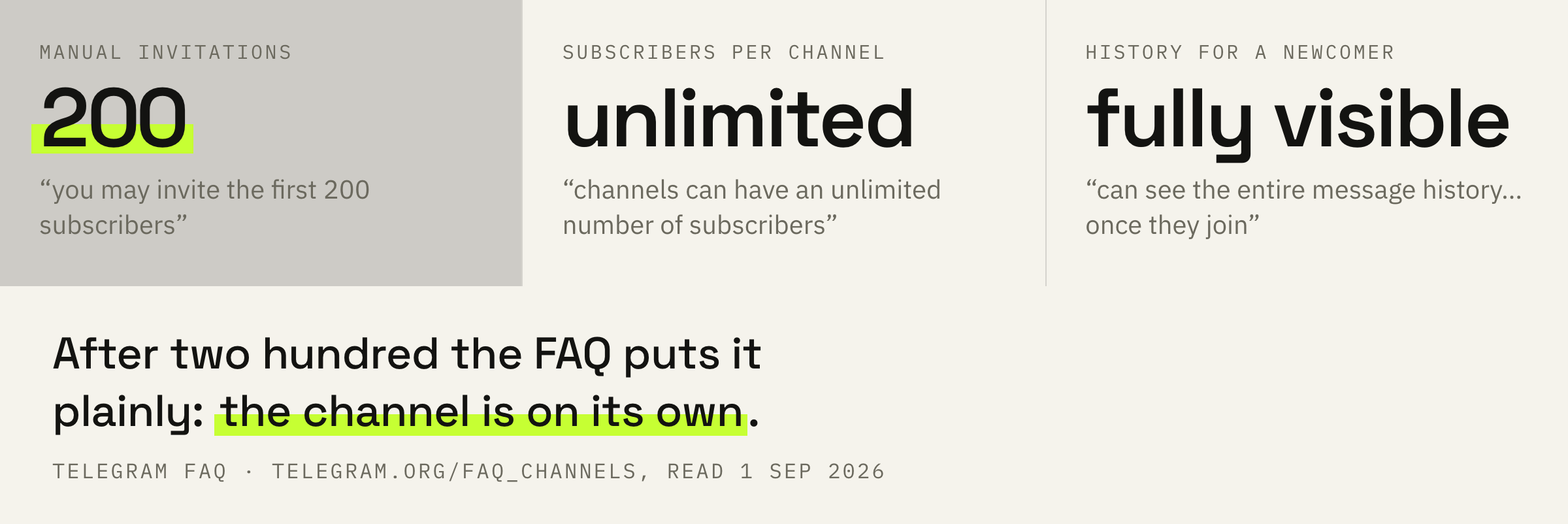
The phrase about being “on its own” describes a change of mode. After that, growth goes through the link, through similar channels and through other people talking about the channel.
A new subscriber sees the whole history
The line that changes the launch order.
In the description of a channel there is a sentence people usually skim past.
New subscribers can see the entire message history in a channel once they join.
Telegram FAQ · “What's a channel?”
Unlike groups, where the history can be hidden, a channel shows everything. A person who arrives today also sees the very first post, made on an empty channel.
Hence an order that is the reverse of the usual one. First the channel is filled, and only then are the first two hundred people invited. An invitation into an empty channel spends the most expensive thing there is: the attention of people who have already agreed to read you.
Enough for a person who scrolls the channel to the end in a minute to understand what it is about and why to subscribe. The platform names no numbers here, but the mechanics are unambiguous: the history is visible in full and works as a showcase.
Sending links to strangers and the ban
The warning sits in the same answer as the number 200.
Right after the permission to invite two hundred people comes a restriction.
Please do not send channel links (or other unsolicited messages) to strangers. If they report spam from your account, you may be banned from contacting other people, however good your intentions.
Telegram FAQ · “How do I add people to my channel?”
The wording about good intentions removes the main argument. The grounds are the recipients' complaints, and the sender's intent plays no part.
The practical conclusion: the two hundred invitations are spent on people who know you. Cold outreach down a list puts at risk the personal account the channel is run from.
When a private channel counts as public
The distinction lives inside a single caveat.
The difference between a public and a private channel is described briefly, but with an important caveat.
Please note that private channels with publicly available invite links will be treated in the same way as public channels, should it come to content disputes.
Telegram FAQ · “How are private and public channels different?”
So a channel's privacy is decided not by a toggle but by where the link sits. A link to a private channel published in open access makes the channel public in the platform's eyes. The choice between public and private we went through separately, and that caveat is the key one there.
One more line from the same FAQ: a message deleted in a channel disappears for all subscribers. The history can be edited after publication, and the reader is left with no traces.
The launch order
Five steps, where the invitations come last.
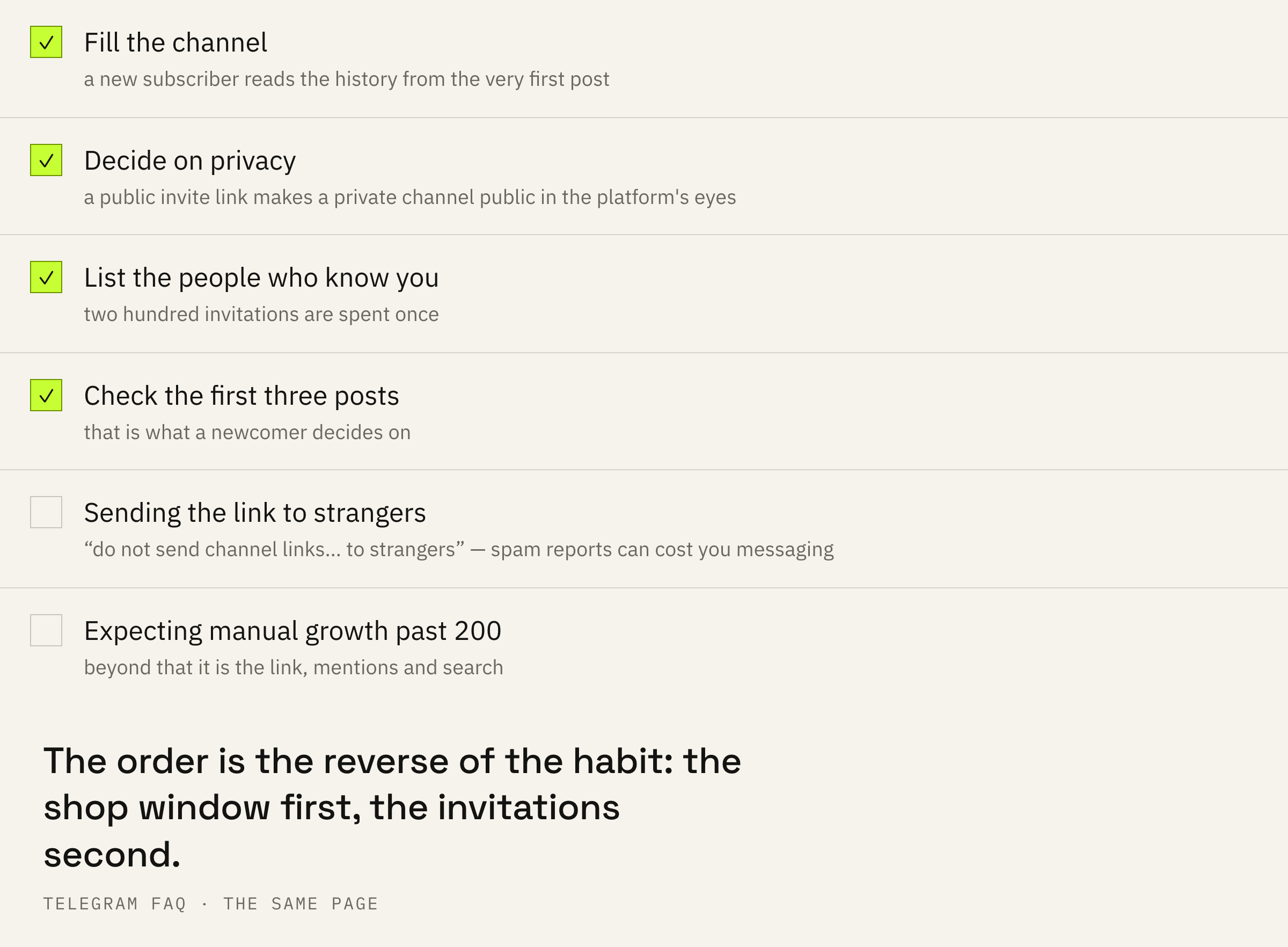
First: fill the channel so that its history reads as a showcase. A new subscriber will see it in full.
Second: settle the question of public status and of where the link will sit. The breakdown of running a channel explains what changes after that.
Third: put together the list of those two hundred who know you. It is the only resource of manual growth, and it is spent once.
Fourth: invite, rather than send the link to strangers. The price of that mistake is named in the document directly.
Fifth: look at the channel's numbers. The view counter works differently than it seems, and that is worth knowing before the first conclusions.
Open the channel the way a new subscriber will see it: from the very first post. If the first three posts do not explain what the channel is about, the invitations are better put off.
Three mistakes at the start
Each one is described in that same FAQ.
Every week we go through what Instagram, Threads and Telegram say about themselves: ranking cards, help pages, updates. No invented numbers and no borrowed tables.