How to run a telegram channel: what to publish and how to measure
A channel has no reach machinery: a post goes to subscribers and to nobody else. From that follow different content, different numbers and three settings that decide more than any content plan.
- Social media & AI
- Mechanics breakdown
- ≈ 10 min
Advice on “how to run a telegram channel” is usually copied from advice on running a blog in a feed. But a channel is built on a fundamentally different principle: it has no reach machinery, and every post goes to people who have already chosen you. From that follow different content and different numbers.
How a channel differs from a feed in its machinery, what is worth publishing because of that, which numbers mean what, and which three settings decide more than the content plan. Ten minutes of reading.
A channel has no reach
That is the starting condition, not a reason to complain.
Open Telegram: the screen shows nothing but the chats and channels you subscribed to yourself. A place where the platform would slip you posts by unfamiliar authors does not exist in the app.
So the familiar logic of “make a post that takes off” doesn't work in a channel. There is nowhere to take off to: the post goes to subscribers and to nobody else.
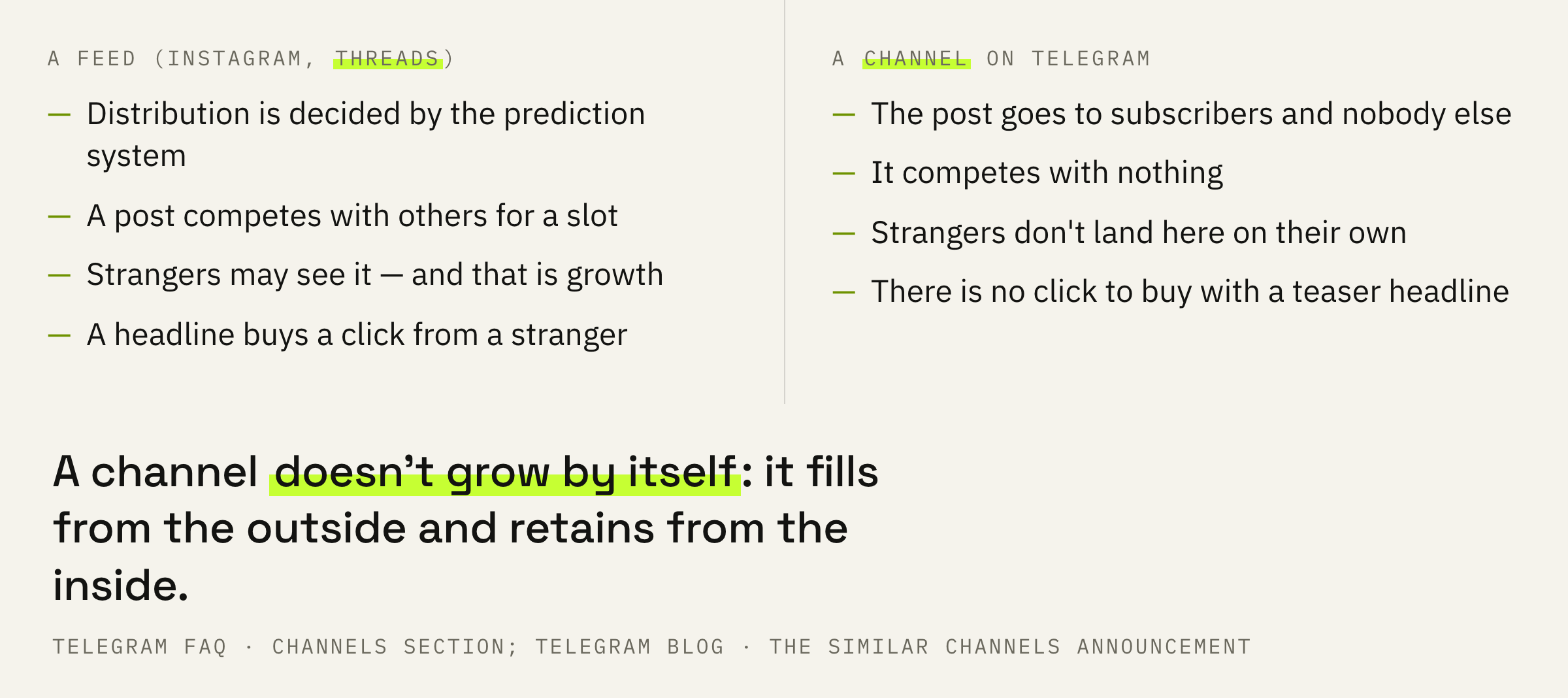
The platform has exactly one automatic showcase, and it works off an audience you have already gathered: similar channels are selected by audience overlap. Hence the order: people first, everything else after.
A channel doesn't grow on its own. It is filled from the outside, and from the inside it holds people. Everything you publish works on the second job, and judging that by the reach number first makes no sense.
What follows from this for content
Our own method works only halfway here.
We have a rule we repeat on every text platform. A trigger format brings reach and zero trust. An expert format brings trust and zero reach.
Only the pairing works.
Fares Akhmedov, IMPERVIR
In a channel the first half of that pairing loses its point. A trigger post is needed where there is something to fight for: being shown to people who don't know you. In a channel there are no strangers, and all the energy spent on a headline for the sake of a click goes into the void.
So the balance shifts. In a feed the pairing is roughly even; in a channel it tips towards the expert and the personal: people have already come, they need a reason to stay, not a reason to notice.
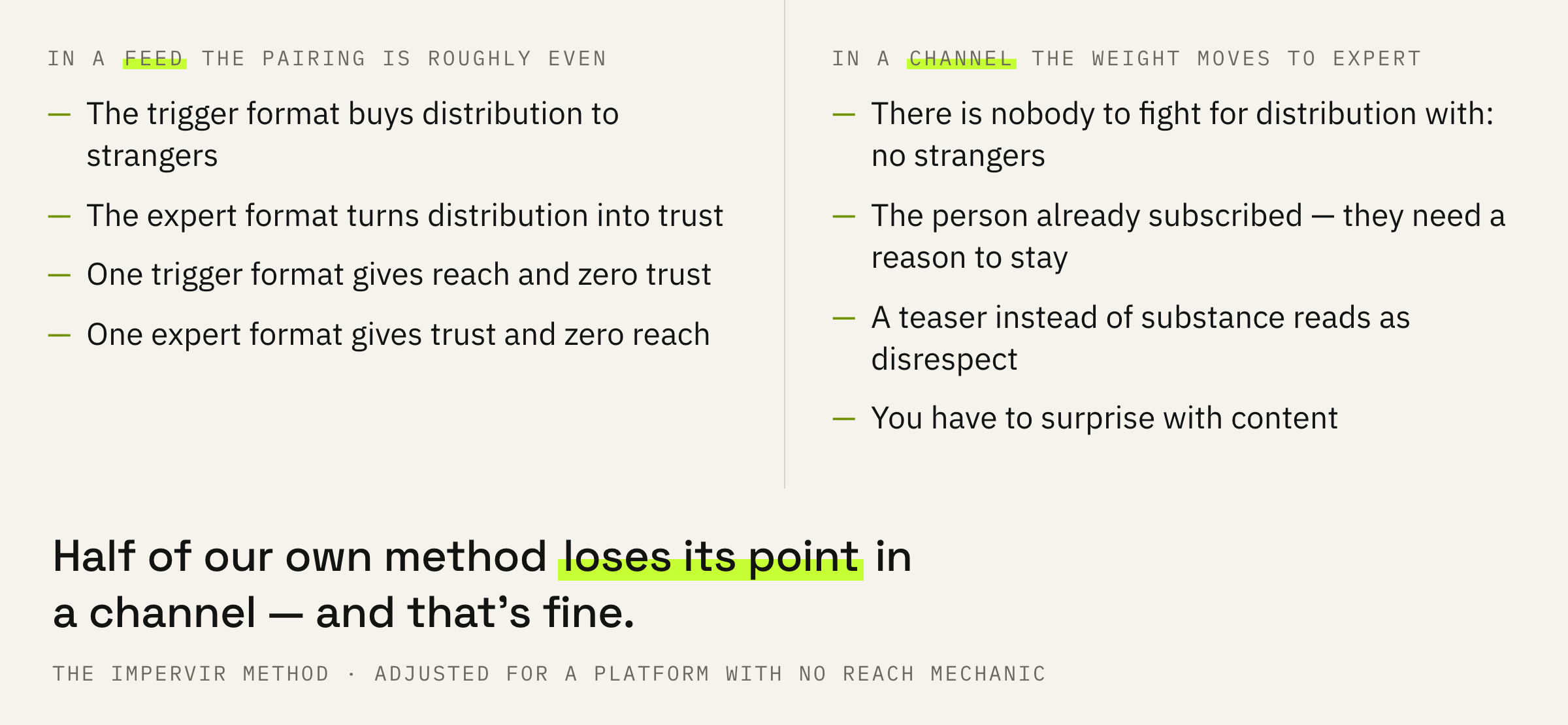
It does not follow from this that a channel has to be boring. Something else follows: in a channel you have to surprise with substance. Packaging doesn't help here. A teasing headline in a feed buys a click from a stranger; in a channel it irritates a person who has already trusted you.
Which numbers mean what
The most visible number is the most deceptive one.
The first thing a channel owner sees is the view counter under the post. It is the worst number to judge by: the platform itself calls it approximate, counts forwards, and roughly every four days counts again a person who has already been there. The full breakdown is in the piece on the view counter and its repeat visits.
Three other numbers do work. Click-throughs on the link in the post: they can't be accumulated through returns. Replies and reactions: a person leaves them. Subscriber growth in the day after publication: it answers the question of whether the post worked for growth or not.
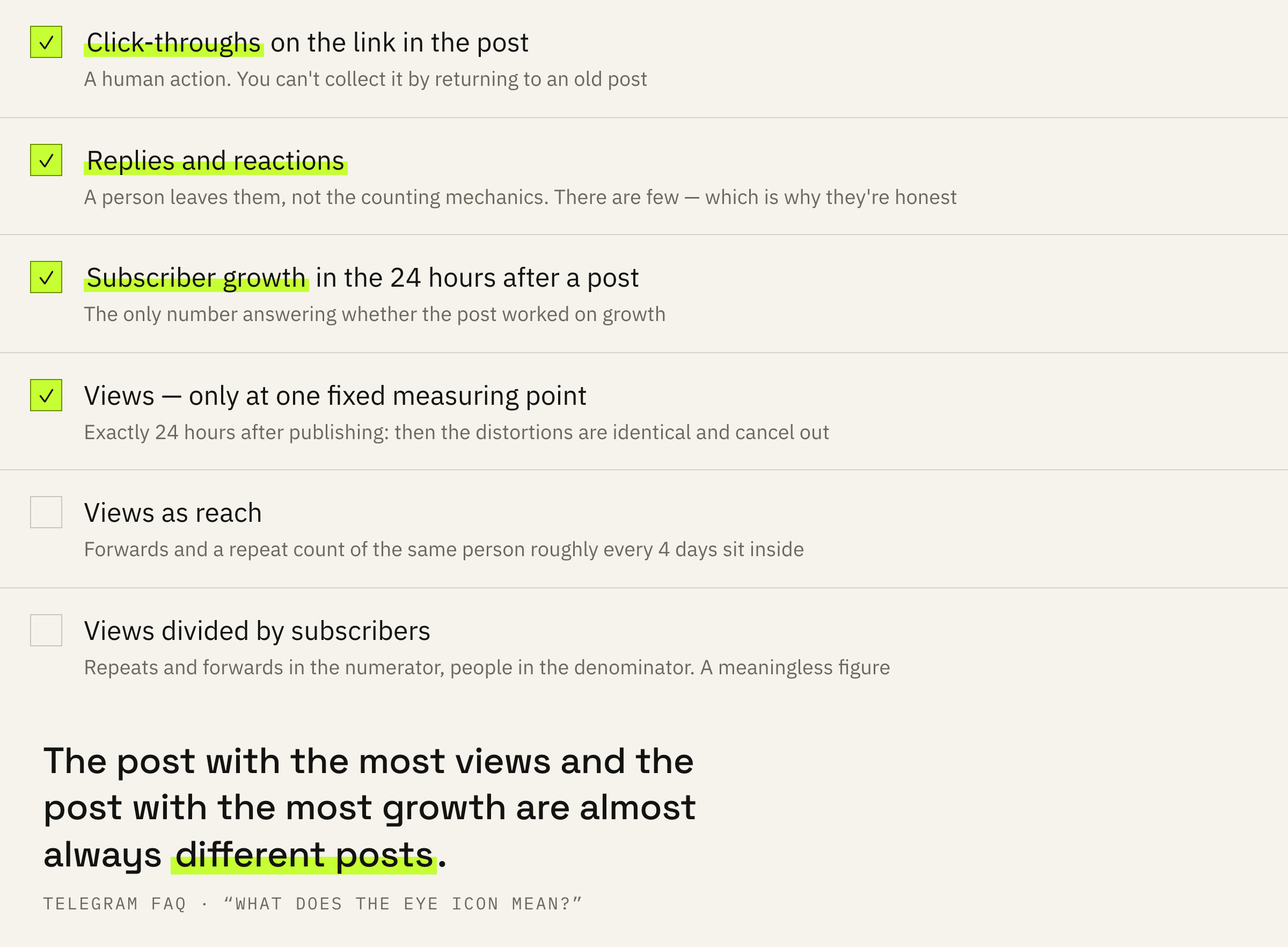
If you do look at views, always take them at one and the same moment — for example exactly a day after publication. Then the distortions are the same for all posts and cancel each other out, and comparison inside your own channel becomes honest.
Three settings that decide more than the plan
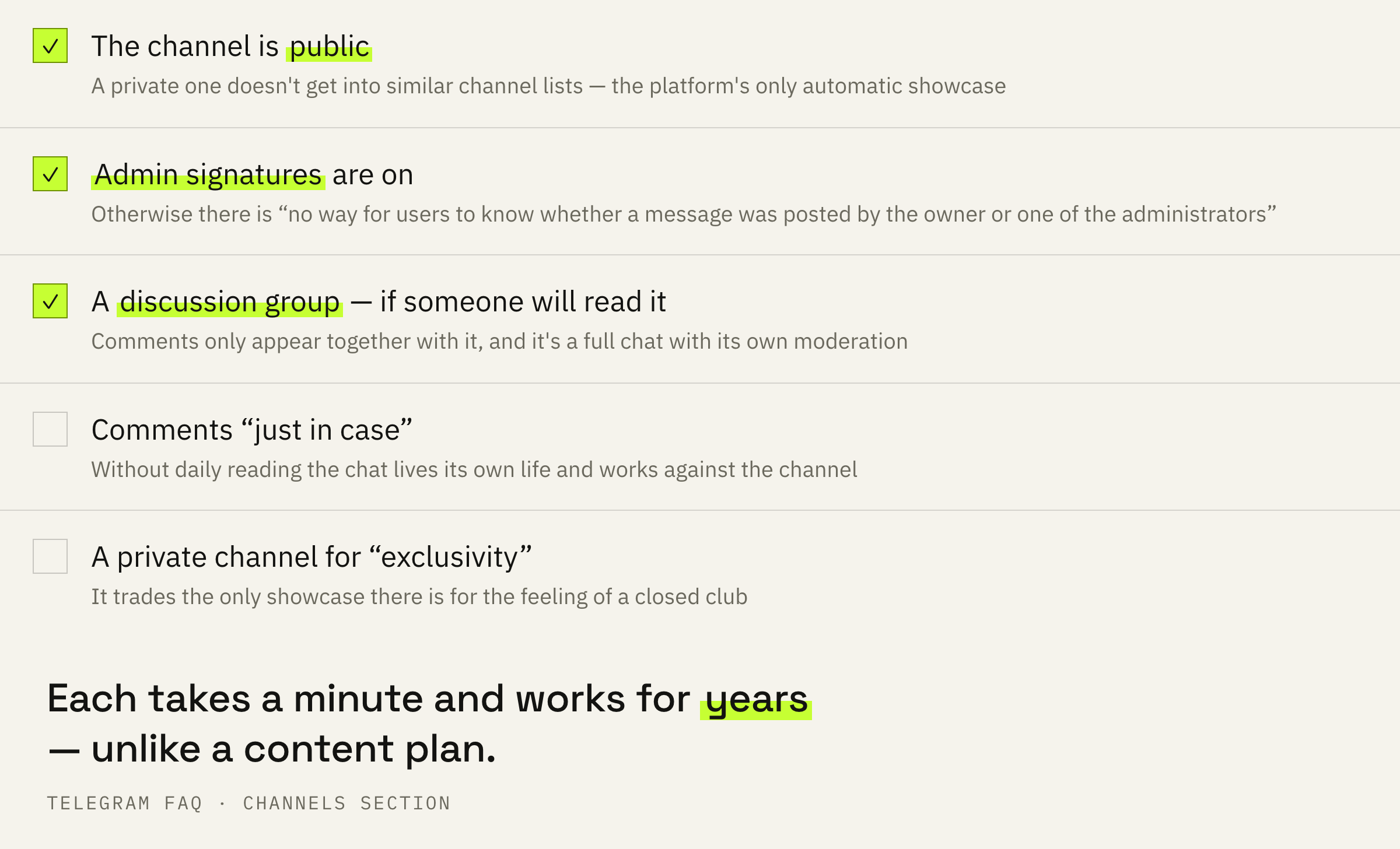
Each takes a minute and works for years.
First: the channel has to be public. A private one doesn't get into the similar channels lists — the platform states that condition directly, and it is the only automatic showcase you have.
Second: admin signatures. By default the channel is nameless: the reader can't see who exactly wrote the post. One switch brings a person back into the channel — the breakdown is here: comments and signatures in a Telegram channel.
Third: a discussion group, if you are ready to read it every day. Comments appear only together with it, and it is a full chat with a life of its own, not a widget under the post at all.
If you have a channel but no understanding of what works in it, we'll look at it and tell you what to change first.
What to do this week
Five steps, and the first takes a minute.
First: open the settings and check two things — whether the channel is public and whether admin signatures are on. These are one-off decisions, and after that they work by themselves.
Second: set up one external source of people — not three. With one source, it's clear whether it works or not; with three, it's unclear which of them does.
Third: pick a rhythm and hold it for two weeks. One post a day every day is stronger than seven posts on Monday and silence until the next one.
Fourth: under every post, write down four numbers — views a day later, link clicks, replies, and how many people were added that day. In two weeks you'll have your own table instead of other people's advice.
Fifth: open the similar channels tab in your channel's profile — the platform itself shows whose audience overlaps with yours. That is its answer to the question “who are my readers”.
Take your table and find the post with the biggest subscriber growth. Almost certainly it is not the post with the most views. The real content plan starts from that discrepancy.
What not to do
Five habits carried over from the feed.
And the general extreme: running the channel as a second feed. Duplicating Instagram posts into it is the easiest thing of all, and that is exactly why people unsubscribe from such channels: what lands in the inbox is what the person has already seen in the feed.
What to do next
Two minutes for today.
Open the channel settings and switch on admin signatures if they are off. It is the cheapest change in the whole article and the only one that works straight away.
Then start a table with four columns and fill it in for two weeks. Somebody else's content plan won't suit you, and your own will assemble itself.
We'll look at the channel, its subscriber sources and its recent posts and tell you what works in it and what you do out of feed habit.
If you want your channel to have a rhythm of its own and a table of its own — leave a request. We'll get in touch if there are free slots at the moment. There is usually a queue, you have to wait.