Views in Telegram: why there are more of them than subscribers
Telegram itself calls its views approximate: forwards count towards the total, and after about four days the platform forgets your view and counts you again.
- Social media & AI
- Problem breakdown
- ≈ 8 min
A channel in Telegram is usually judged by the number under the post. Telegram itself writes about that number in a way that means once you have read it you can no longer use it as before: it is approximate, it counts forwards, and after a few days it counts one and the same person again.
What exactly the counter counts, why a private channel can have more views than members, and which numbers to judge the channel by instead. Eight minutes of reading.
It measures spread, not readers
The difference sits in one sentence from the help centre.
The channels section of the Telegram FAQ answers the question “what does the eye icon mean”. The answer is shorter than you expect, and it holds two important words at once.
Each post in a channel has a view counter. Views from forwarded copies of your messages are also included in the total count. This way you can see how far it has spread.
Telegram FAQ · the channels section
The first word here is “forwarded”. If your post was forwarded into somebody else's chat and twenty people read it there, those twenty end up in your counter. The people are not subscribed to you and may never have heard of you.
The second is “how far it has spread”. The platform names the counter's purpose itself: it shows spread. Not the audience, not reach in the usual sense, and certainly not the number of readers of the channel.
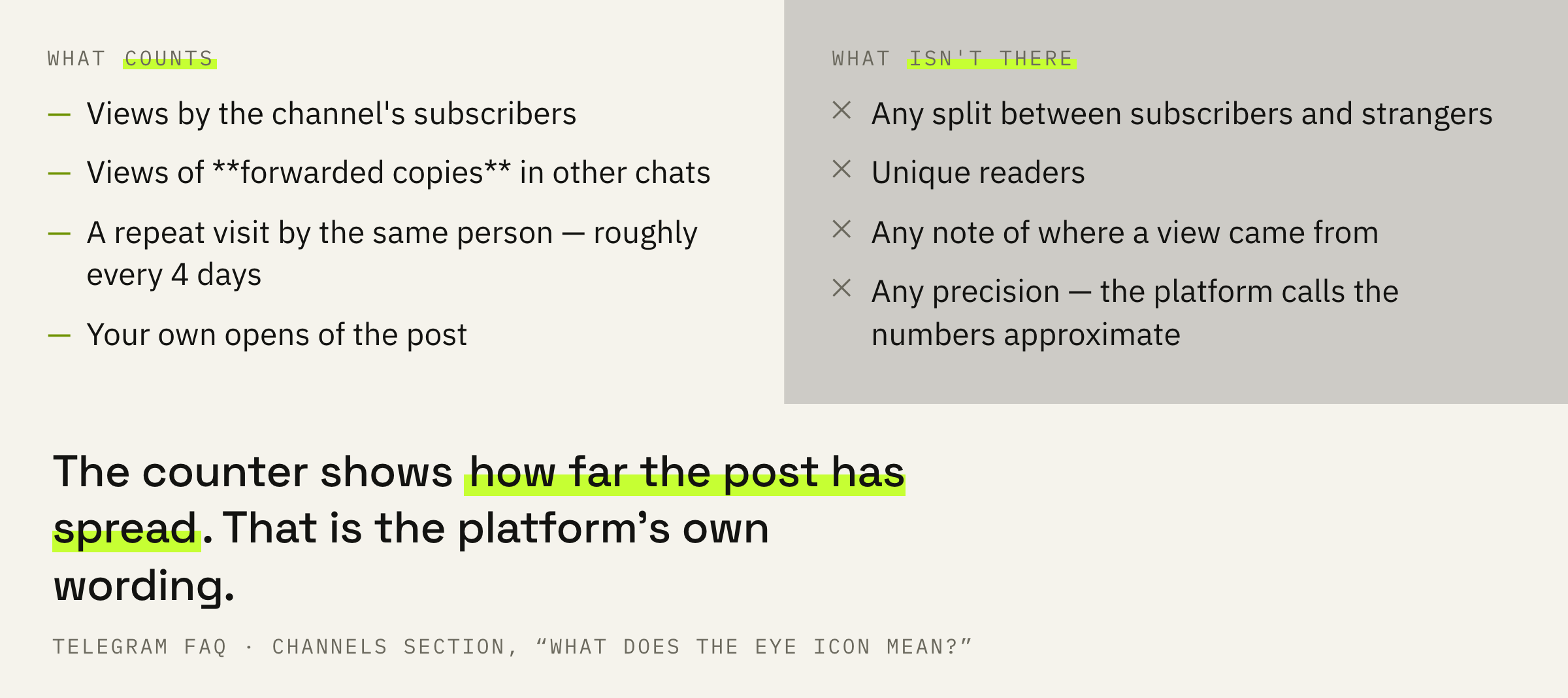
The Telegram FAQ exists only in English: the address with the Russian version returns “Page not found”. So the quotes here are the platform's own wording — you can check us against the source instead of taking our word for it.
Why the number grows on its own
The line after which the counter reads differently.
Further on in the same answer comes a caveat that almost nobody reads to the end. We give it in full.
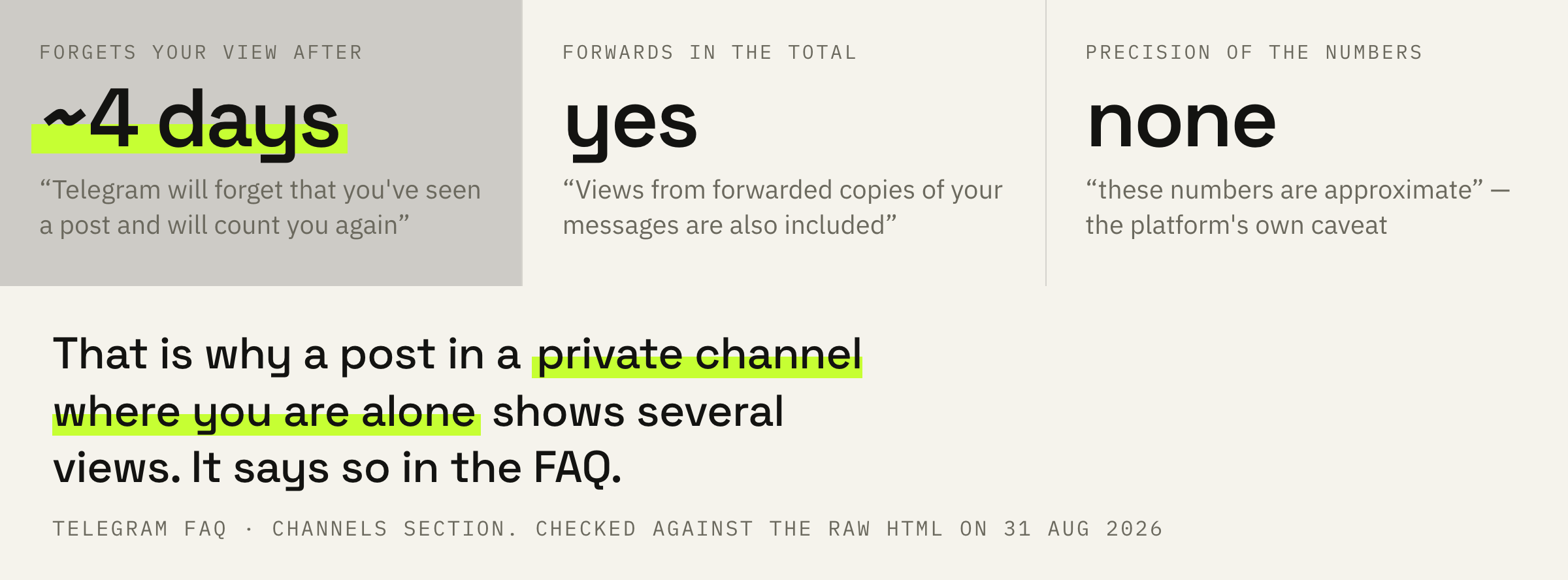
Please note that these numbers are approximate — we don't want to keep a record for everything you've ever viewed. After a short while (around 4 days), Telegram will forget that you've seen a post and will count you again if you navigate to it.
Telegram FAQ · same place
This is not an estimate and not our guess: the platform directly calls its numbers approximate and explains why. Keeping the view history of every person is expensive, so it gets forgotten after a few days.
The consequence is simple. One and the same reader who comes back to your post once a week will add four views to the counter over a month. A post that lives long and gets returned to grows not only because of new people.
For this reason you may see several views for posts in a private channel where you are alone.
Telegram FAQ · same place
And there is the answer to the question people ask search engines most often: why a channel has more views than subscribers. The answer is in the platform's documents, and it is not about inflated numbers and not about bots.
What you can't do with views
Three habitual moves that break against this caveat.
First: dividing views by subscribers. This is the most common metric in chats about channels, and it means nothing. The numerator holds forwards and repeats, the denominator holds people. The value that comes out has no meaning.
Second: comparing posts of different ages. Yesterday's post has had twenty-four hours, last year's has had a year of returns and forwards. The difference between them speaks about time and has nothing to do with the content.
Third: judging somebody else's channel by views. You don't know how many forwards there are, how old the posts are, or how often people come back to them. The number is visible, what stands behind it is not.
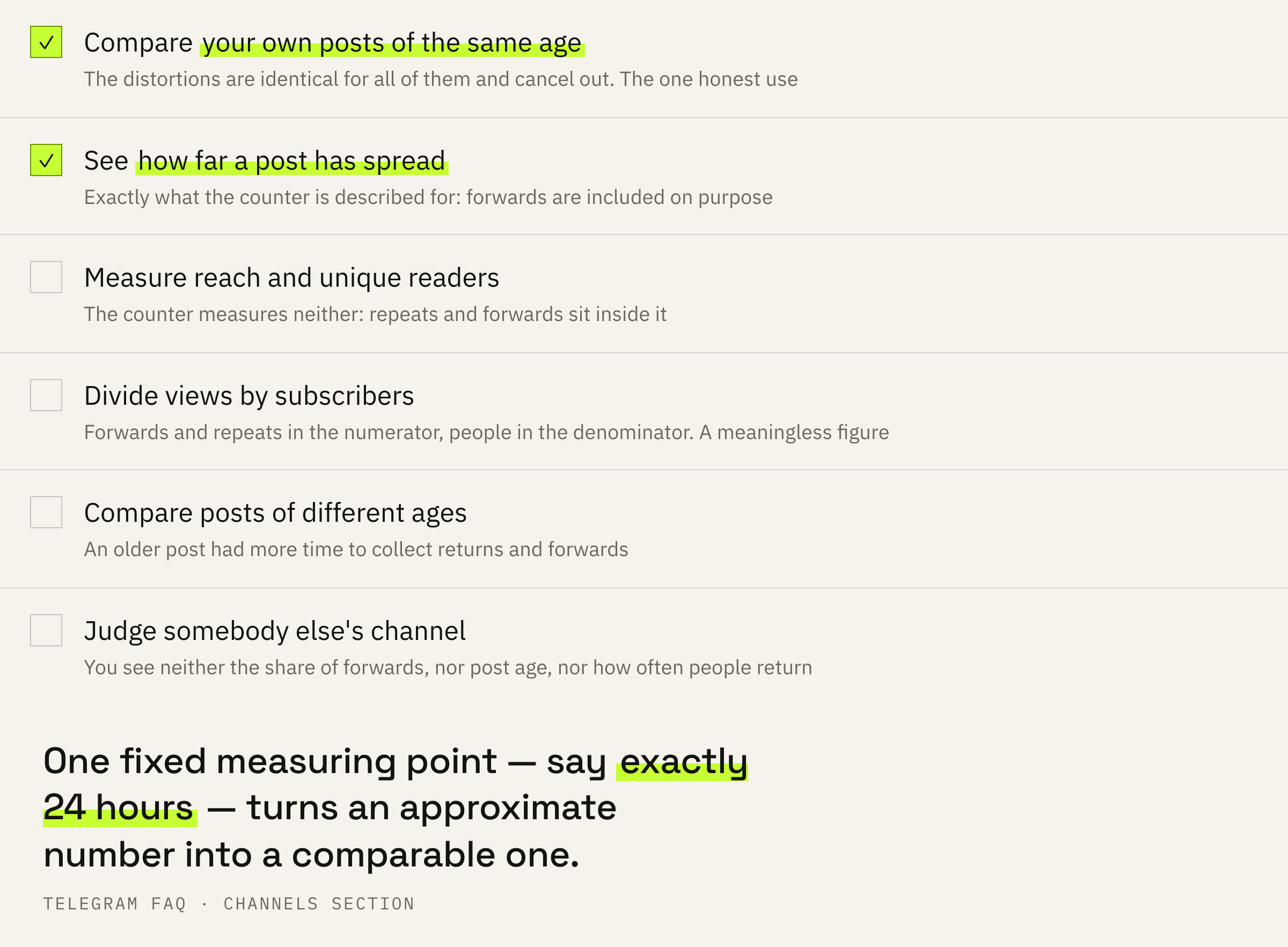
Comparing your own posts of the same age with each other. You take ten posts and look at the number for each exactly twenty-four hours after publication — that comparison is an honest one. All the distortions are the same for all ten and therefore cancel each other out.
We applied the same principle to another platform, where it also gives one number covering all the viewers at once: Threads insights and what they don't show.
If it's unclear from the channel whether it's growing or standing still, we'll look at your numbers and tell you which of them mean something.
What to do this week
Four numbers instead of one.
First: get into the habit of looking at the number exactly a day after publication, and not whenever the mood takes you. One and the same measuring point turns an approximate number into a comparable one.
Second: if there is a link in the post, count the click-throughs on it and compare them between posts. A click-through is a human action, it can't be accumulated through returns to an old post.
Third: count replies and reactions. There aren't many of them, and that is exactly why they are honest: a reaction is left by a person, not by the counting machinery.
Fourth: look at the subscriber growth in the day after a post. This is the only number that answers the question “is the channel working for growth”, and the view counter has no effect on it whatsoever.
Take ten posts and write down four numbers for each: views after a day, click-throughs, replies and subscriber growth. It will almost certainly turn out that the post with the most views and the post with the biggest growth are different posts. The work starts from that discrepancy.
What not to do
Four decisions around a number that is approximate.
And the general extreme in the other direction: deciding that since the counter is approximate, there is no point looking at it. It is worth looking at — you just need to ask it the question it does answer. It shows how far the post has spread, and it does that honestly.
What to do next
Two minutes for today.
Open the last ten posts of the channel and write out the views next to the publication date. If the posts are of different ages, you will see that the number grows along with age almost regardless of the content.
Then pick one measuring point and hold to it. Where people in a channel come from in the first place we covered separately: similar channels in Telegram.
We'll look at your channel and tell you which numbers in it mean something and which ones you count for nothing.
If you want the channel to grow predictably — leave a request. We'll get in touch if there are slots available at the moment. There is usually a queue and a wait.