Public or private channel on Telegram: what each one loses
A private channel isn't found by search and isn't shown in lists of similar channels. And an invite link in open access, by the FAQ's own explicit caveat, makes it equal to a public one in content disputes.
- Social media & AI
- Mechanics breakdown
- ≈ 8 min
The choice between a public and a private channel is usually made by feel: private seems more solid. Telegram has a document about this, and in it there is one line almost nobody knows about: a private channel with a publicly available link is treated by the platform as public.
How the two channel types differ according to the document, what exactly a private one loses, and why an invite link in a post changes its status. Eight minutes of reading.
The difference in one sentence
The FAQ describes it without extra words.
Public channels have a username. Anyone can find them in Telegram search and subscribe. Private channels are closed societies: to join, you need to be added by the owner or to receive an invite link.
Telegram FAQ · the channels section, in the platform's own wording
So exactly one thing separates them: having a username and, as a consequence, getting into search. Everything else is the same for both types, including an unlimited number of subscribers and new members' access to the whole message history.
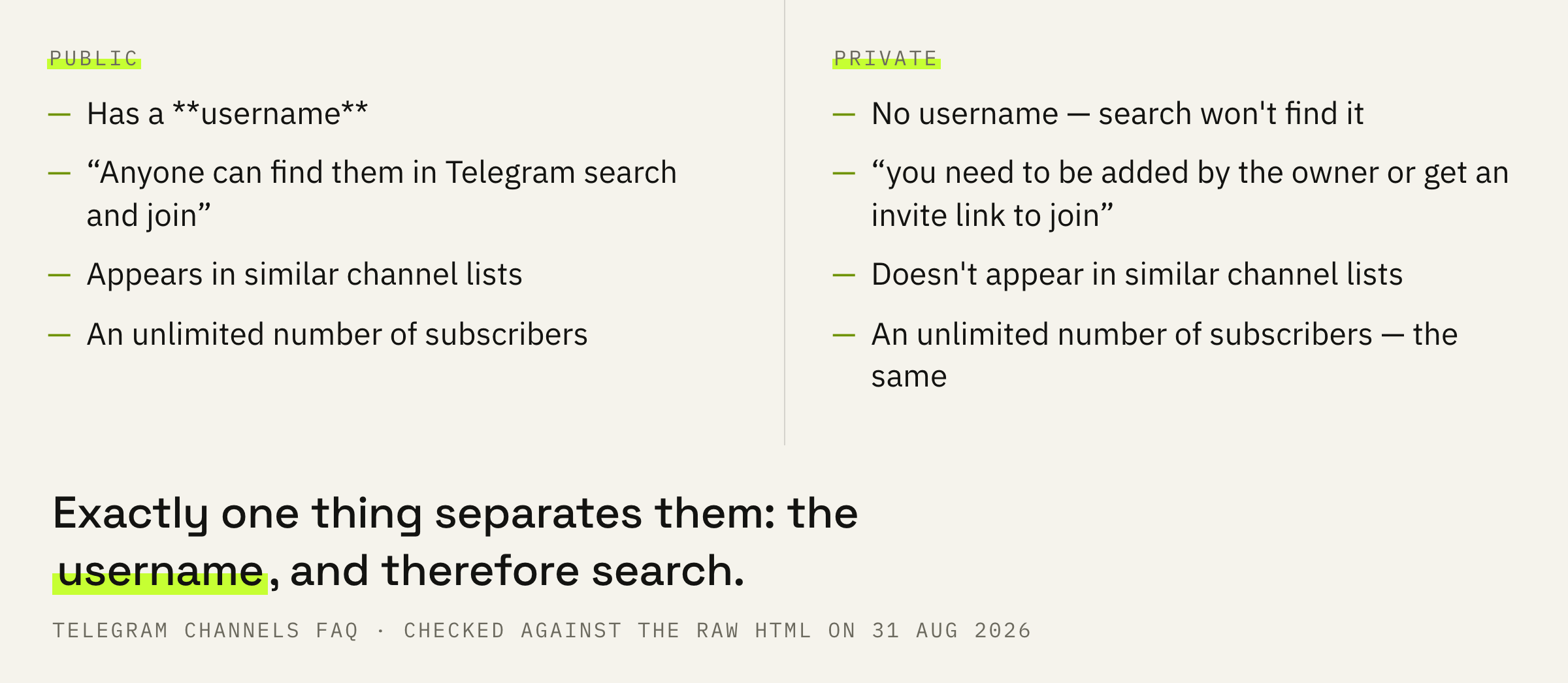
The Telegram FAQ exists only in English: the address with the Russian version returns “Page not found”. The quotes here are given in the platform's own wording.
A publicly available link changes the status
The line that makes it worth reading the FAQ to the end.
Further on in that same answer comes a note that turns the usual idea of a channel's privacy upside down.
Please note that private channels with publicly available invite links will be treated in the same way as public channels, should it come to content disputes.
Telegram FAQ · the same section, in the platform's own wording
Let's take it literally. If the link to your “private” channel sits in an open post, in the profile header or on a website, then for the platform it stops being a closed society in matters of content.
This is not a ban and not a threat. It is a clarification that being private in Telegram is a property of access, not an indulgence for content. A channel anyone can walk into through a link from an open source is considered open in essence by the platform.
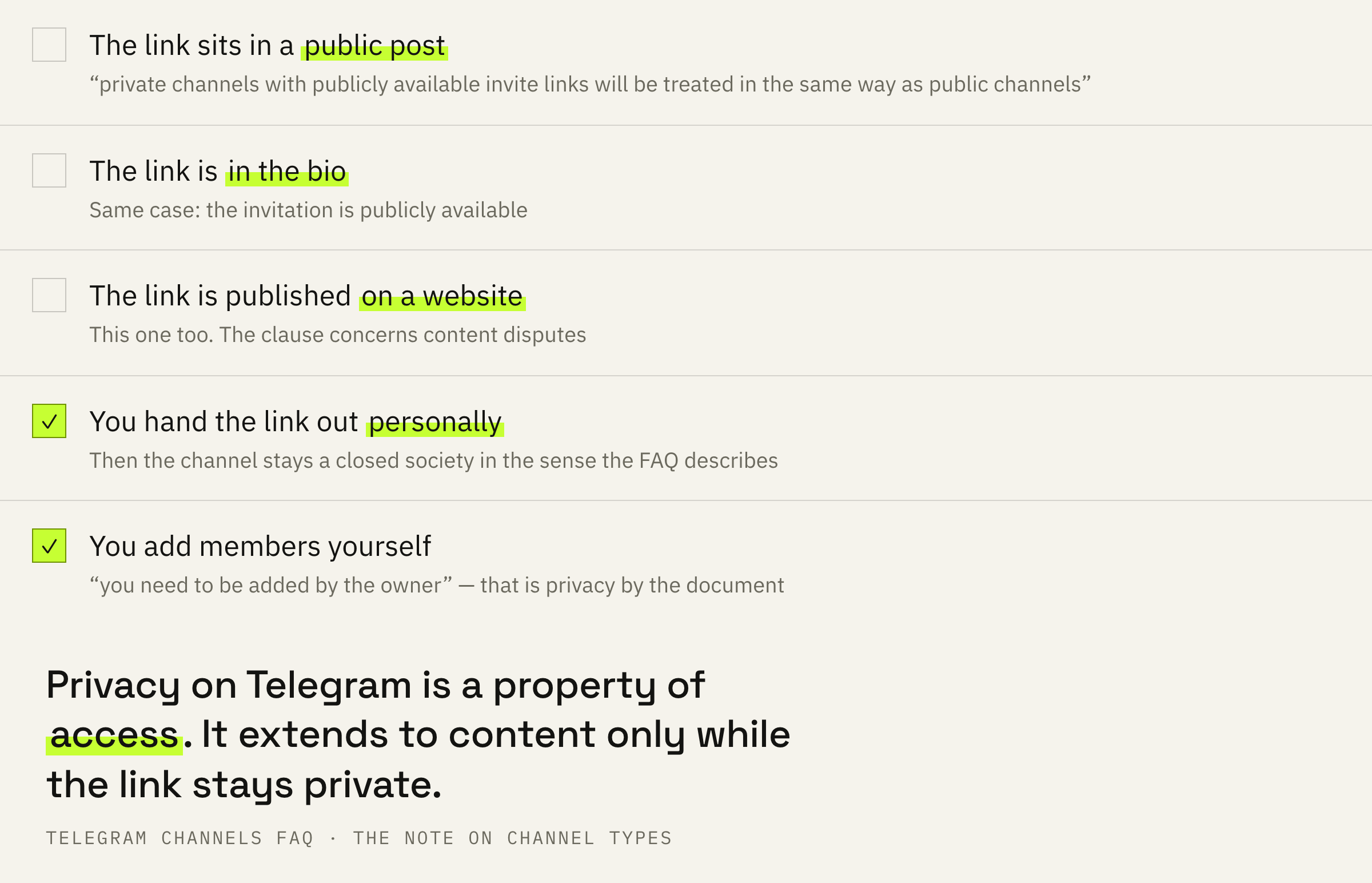
If you chose a private channel for the privacy of its content, the link to it should not sit in open access. If the link is needed publicly after all, then the content is worth running the way you would for a public channel.
Search and the only showcase
Two losses, both described by documents.
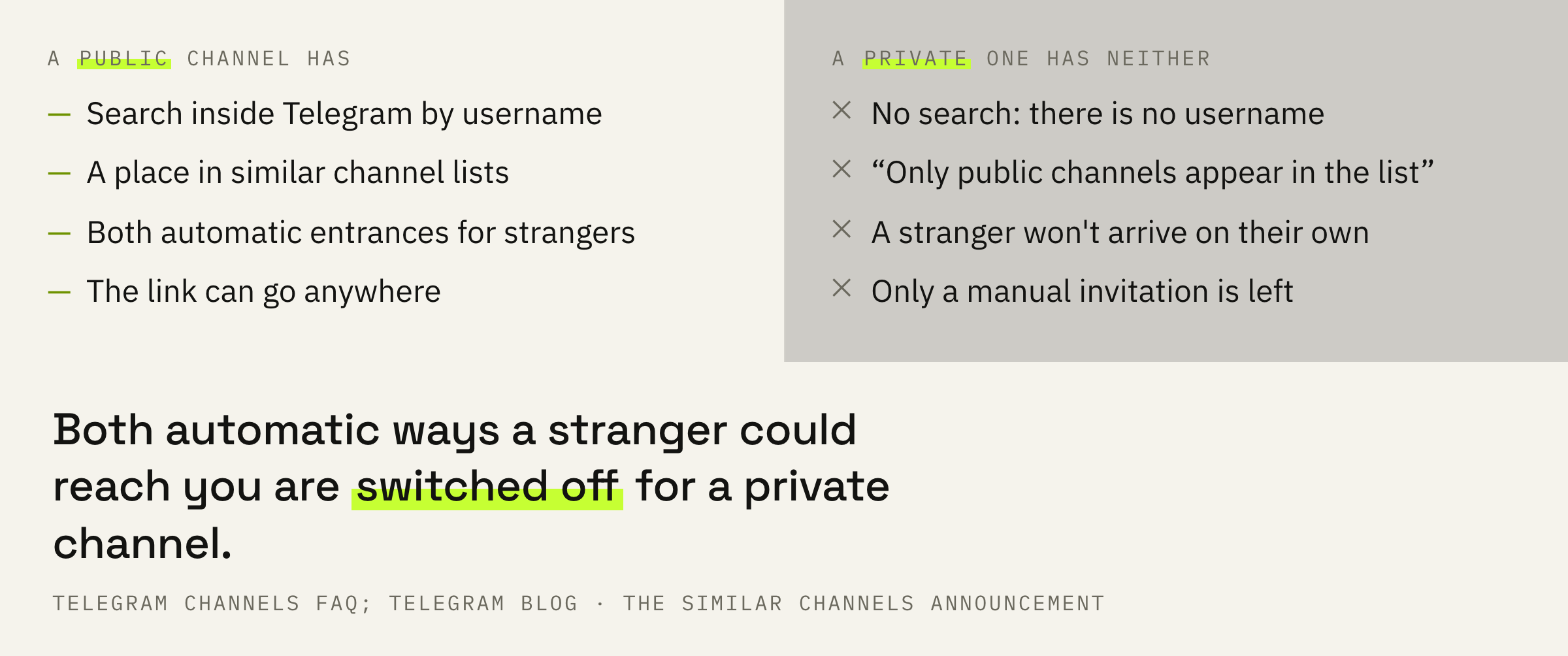
The first loss is obvious from the definition: a private channel has no username, which means it can't be found by search inside Telegram. The only entrance is an invitation.
The second one is heavier. Telegram's blog about similar channels says that only public channels are shown in the list. That is the platform's only automatic showcase — a detailed breakdown: similar channels on Telegram.
Add it up: a private channel isn't found by search and isn't shown next to other people's channels. Both automatic ways a stranger could come to you are switched off.
If it isn't clear which type the channel should be for your task, we'll look at the funnel and say where it stands in it.
How to choose for the task
Three questions, and all of them are about the task, while feelings don't help here.
First question: should the channel bring new people in by itself. If yes, it has to be public — otherwise both automatic entrances are closed, and you'll have to fill it by hand only.
Second: where the link will sit. If it is in an open post or on a website, being private gives you only the absence of search, and in matters of content the channel is still considered public.
Third: what exactly you are closing off. If it is access — a private channel works. If it is content that must not reach outsiders, then one setting isn't enough: the link must not go into open access at all.
Public — when the channel is part of the funnel and has to gather people. Private — when it is part of the product and people get into it by your decision. The mixed option, where a private channel is advertised publicly, gives the downsides of both and the upsides of neither.
What not to do
Four decisions made by feel.
And the general extreme: choosing the channel type before the task. First you decide why the channel exists and where the people in it come from, then the setting. What this looks like as a whole: how to run a telegram channel.
What to do next
Two minutes for today.
Look at where the link to your channel sits right now. If it is private and the link stands in an open post or on a website, you have no privacy — you only have the absence of search.
If the channel is meant to grow, check that it is public and has a username. Without that it won't get into search or into lists of similar channels.
We'll look at where the channel stands in your funnel and say what it should be for that task.
If you want the channel to work for a task rather than exist on its own — send a request. We'll get in touch if there are slots available at the moment. There is usually a queue and a wait.