Instagram giveaways: what Meta prohibits outright
The standard follow-and-win giveaway matches an example from the Spam section almost word for word. Four wordings from the rules and one exception.
- Social media and AI
- Mechanics breakdown
- ≈ 8 minutes
“Follow, like the post, tag two friends and we will draw an iPhone” is the standard giveaway wording. The Meta Community Standards carry an example of their own: “If you like my Page, I will give you an iPhone!”. It sits in the Spam section, in the list of what is prohibited. The match is almost word for word, and it is better to know that before the launch than after it.
Four wordings from the rules that an ordinary giveaway falls under. The single exception the document names. What the rules say about buying engagement. What the section does not contain at all. Eight minutes of reading.
A prize in exchange for engagement
Two clauses that most giveaways fall under.
The Spam section carries a list of what is prohibited. Two clauses in that list describe giveaways directly.
Offering giveaways (i.e. offering others a chance to win) of cash or cash equivalents in exchange for engagement (e.g. ‘Anyone that likes my Page will be entered to win USD 500’).
Meta Community Standards · the “Spam” section
The next clause is shorter, and the example inside it reads like a ready-made giveaway post: “Offering to provide anything of monetary value in exchange for engagement (e.g. ‘If you like my Page, I will give you an iPhone!’).”
The key word in both clauses is the same: exchange. What is prohibited is neither the prize nor the giveaway itself, but the pairing of “perform an action and get a chance to win”.
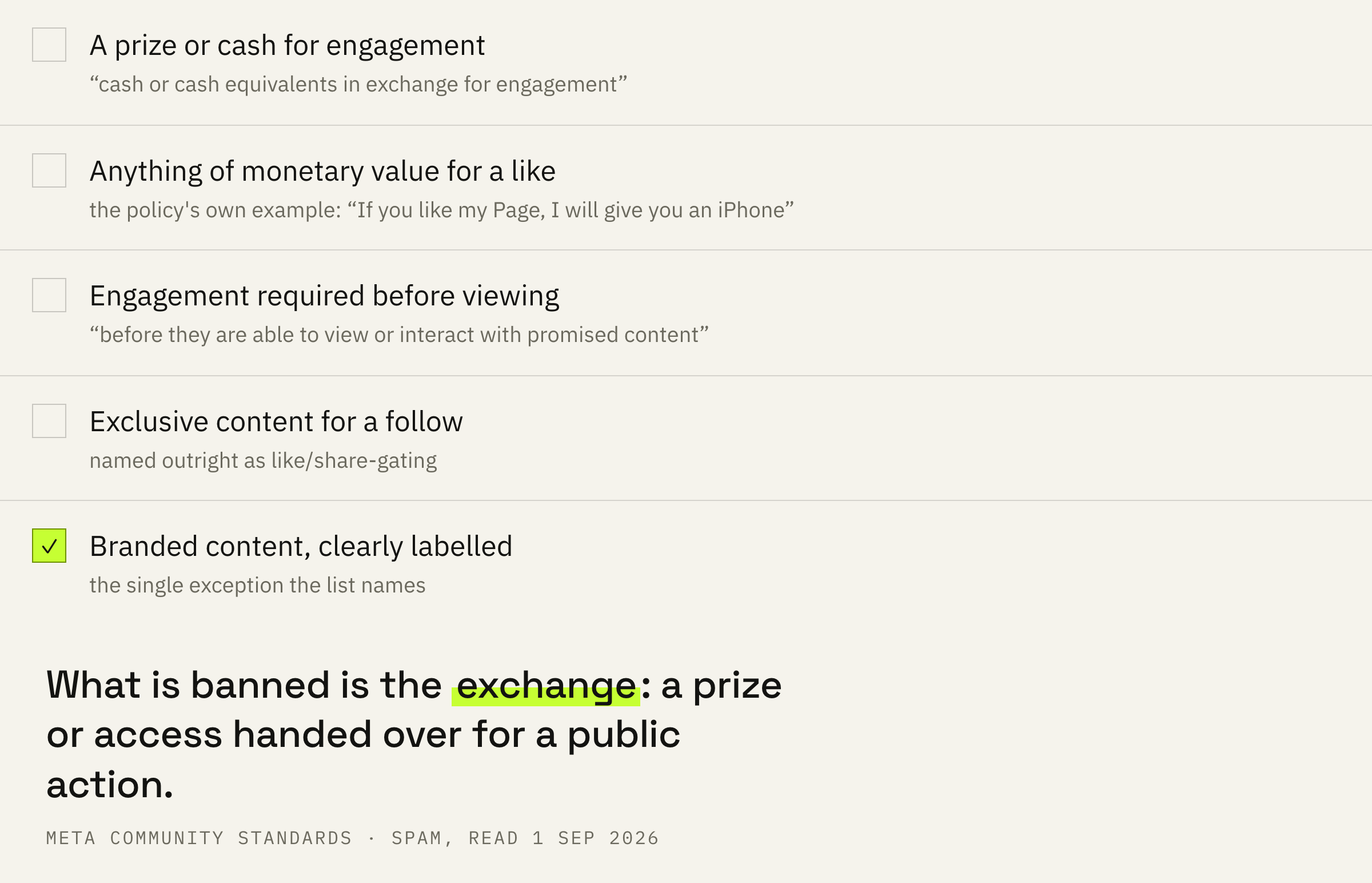
The examples in the document speak of Facebook Pages, but the section sits inside the Community Standards, which apply across every Meta service, Instagram included.
Access to content for a like
The third and fourth clauses, the ones that are recalled least often.
Two more clauses follow, both about the conditions of access. The first covers any request to engage before viewing.
Requiring or claiming that users are required to engage with content (e.g. liking, sharing) before they are able to view or interact with promised content.
Meta Community Standards · the same place
The second is given a term of its own and placed in the list of deceptive practices.
Like/share-gating: Requiring users to engage (in the form of likes, shares, follows or any other public-facing form of engagement) to gain access to specific, exclusive content.
Meta Community Standards · the “Spam” section, the subsection on misleading links
A widespread mechanic falls under this description: “follow us and the guide will come back to you”. The material is promised in exchange for a follow, that is, for a public form of engagement. There is a way to hand out something useful without that condition, and a channel suits it better.
Three mechanics: a guide for a follow, access to a private chat for a share, entry to a giveaway for tagging a friend. All three are built on exchanging access or a prize for public engagement, and all three are described in the “Spam” section.
Selling and exchanging engagement
The clause that closes off both bought engagement and follow swapping.
Attempting to or successfully selling, buying or exchanging for engagement, such as likes, shares, views, follows, clicks and use of specific hashtags.
Meta Community Standards · the “Spam” section
The wording covers buying followers, agreed mutual follows and swapping activity in chat groups alike. The word “exchanging” stands right next to the word “buying”.
Being shown to people who do not know you is arranged separately, and bought engagement does not move it: recommendations work by rules of their own. Account restrictions, meanwhile, are visible on a screen of their own, and we went through it in detail.
The single named exception
One reservation for the whole list.
The clause about handing over anything of monetary value in exchange for engagement carries a reservation.
It reads like this: “except clearly identified Branded Content, as defined by our Branded Content Policy”.
So a paid collaboration with a brand is provided for by the rules, as long as it is labelled. The paid partnership label in the app exists for exactly that.
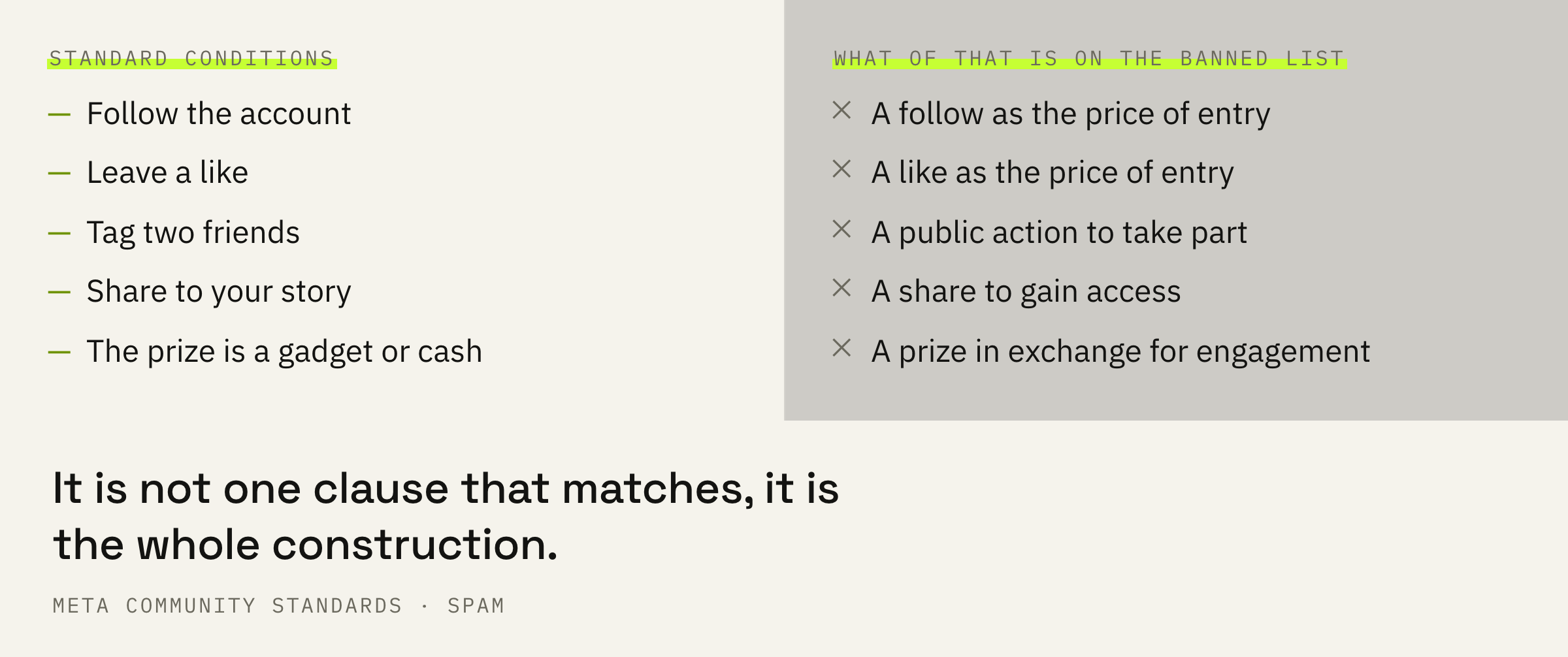
There is no other exception in the section. Everything not marked as Branded Content is judged by the general clauses.
What the section does not say
Worth naming, so that nothing is invented on behalf of the document.
The “Spam” section does not name the contest itself as a prohibited form. What is prohibited is the exchange of a prize for engagement, not the contest as such.
There is no list of permitted mechanics in it. The document describes prohibitions, and the conclusion “so everything else is allowed” does not follow from it.
There are no penalties in it. What happens after a violation is described in other documents, and tying those texts together without grounds is not worth doing.
And there are no numbers in it: no permitted count of giveaways, no time frames, no thresholds. Any table of “contest limits” from the blogs was taken from somewhere else.
The checks to run on a giveaway
Four questions before the terms are published.
The first question: what a person gets for the action. If it is a prize or access to material, the mechanic falls under the clauses described above.
Second: whether public engagement is compulsory in order to take part. Likes, shares and follows are named in the document outright.
Third: whether the collaboration is labelled, if a partner supplies the prize. Branded Content is the only exception in the list.
Fourth: why you want this contest at all. If it is for the sake of reach, it is worth checking those expectations against what reach actually brings.
Every week we go through what Instagram, Threads and Telegram say about themselves: ranking cards, help pages, updates. No invented numbers and no borrowed tables.