5.2M views and two sales: why reach doesn't bring customers
Why big reach doesn't bring customers: our new Threads account gained 16,843 followers and 2,000 people went to Telegram, but only two bought. Breaking down where it fell apart.
- Threads
- Case study
- ≈ 7 minutes
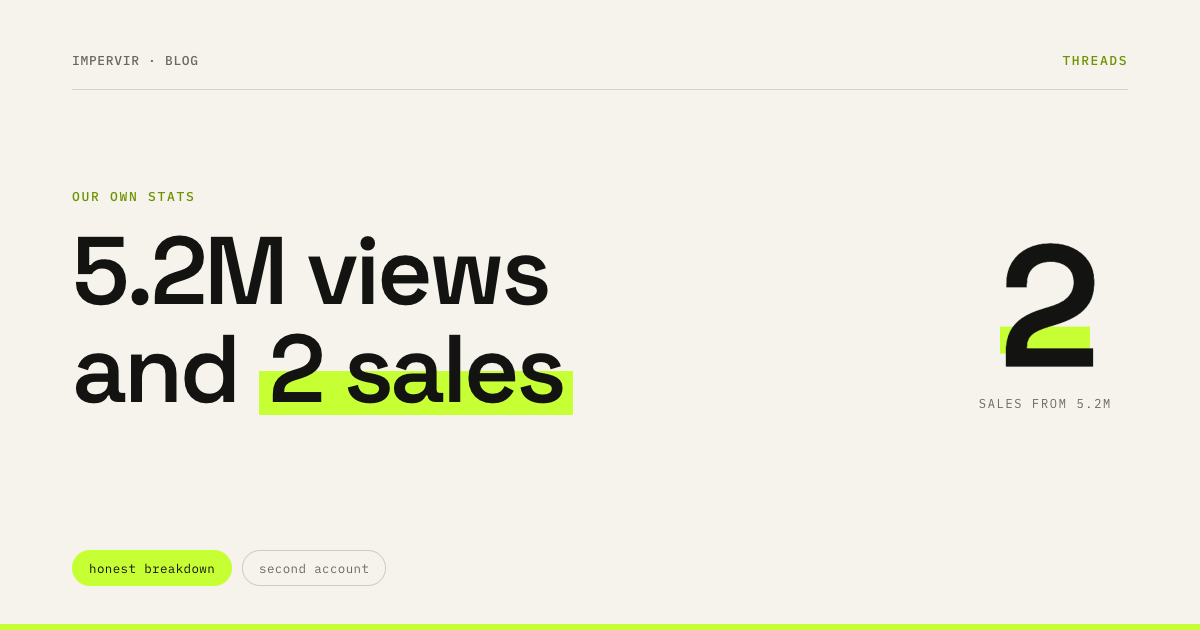
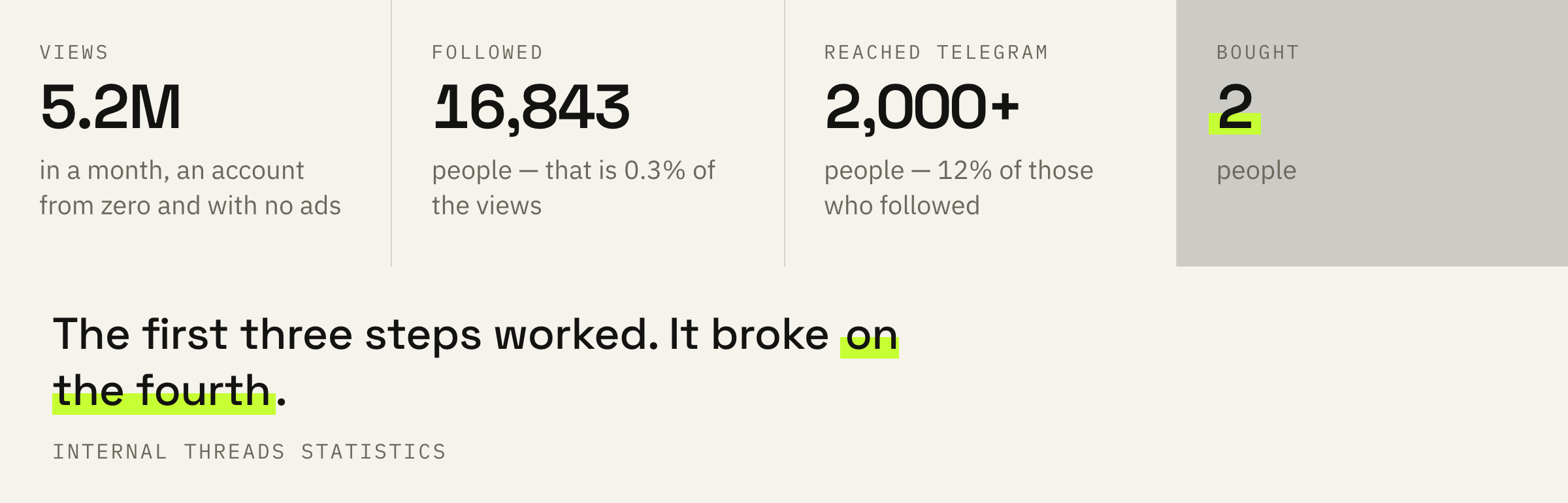
We launched a new Threads account and gained 16,843 followers in a month. Views hit 5.2 million, over two thousand people clicked through to Telegram. Sales — two.
A breakdown of why big reach doesn't turn into money, plus one question worth asking yourself before your first post. Seven-minute read.
Numbers for the month
An account built from scratch, no ads, no old audience.
The account was brand new. No followers, no history, no traffic spillover from anywhere.
The first three numbers look like success. The fourth one explains why we're even writing this breakdown.
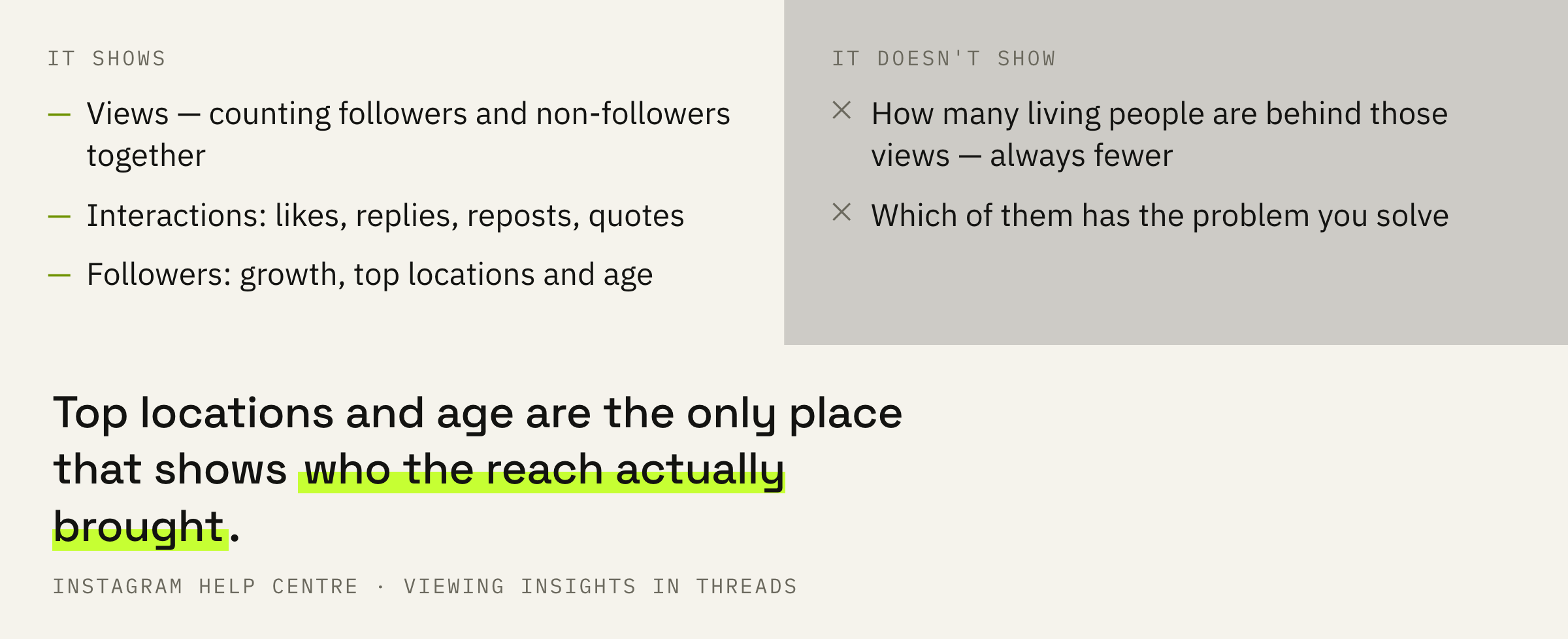
Before digging in, it helps to know what you're actually looking at in Threads analytics. There are three metrics, and each answers its own question.
Open threads.com on desktop and click "Insights" in the left menu. The default period is the last 90 days, adjustable via "More options." Instagram itself notes that some metrics are approximate and still being refined.
We didn't check top locations and follower age back then, though we should have. A broad topic brings people in from everywhere, and that shows up in geography before it shows up in sales.
For comparison: our first account got 13 million views and 1,300 people into Telegram. How the spillover itself works — in a separate breakdown.
What worked: a broad topic
Reach doesn't come from expertise — it comes from a relatable pain point.
We didn't invent posts from scratch. We scouted Western accounts, borrowed the mechanics, then rewrote the text in our own voice.
The strongest post of the month got 334,431 views. It was about why iPhones overheat.
Your iPhone isn't overheating because it's old
334,431 views. The second-strongest post was the same angle in different wording — 316,761.
This has nothing to do with marketing or our expertise. It's a broad, universal topic that basically everyone gets.
This is exactly how reach mechanics work: the platform shows your post to people who don't follow you, and they respond to something they recognize in themselves.
Reach comes from a relatable pain point. Depth kicks in at the next step, once someone's already watching. The broader the topic, the cheaper the view.
Fifty trial signups and two purchases
The point where reach stopped turning into money.
Out of those two thousand people, over fifty took a free trial of our tool. Two bought.
The trial isn't a barrier — it's free, no card needed, set up in ten minutes. If fifty people took it and only two bought, it's not about price or payment method.
We built reach with one audience and sold to another. People came for advice about their phone and left with a tool for running a Threads blog. They didn't reject the purchase — there was simply nothing for them to buy.
Why it happened
A broad topic and a narrow product don't add up.
A broad topic gives you cheap reach. It also brings in people who don't have your problem.
Someone reading about iPhone overheating doesn't need a Threads tool. They're not worse or colder as a lead — they're just about something else entirely.
An expert post works the opposite way. It gives you little reach, but it brings in exactly the person whose pain matches what you solve.
Count the people who actually have your problem.
Which leads to a simple rule that cost us a month to learn.
You can build reach on anything. Only the right audience buys.
If your reach is growing but sales aren't — it's almost always because the topic and the product don't match. Send us your profile and we'll tell you exactly where the mismatch is.
What we're changing
Three decisions for next month.
We're not dropping broad topics — they're the cheap way into the feed. But now every broad post is followed by an expert one, and that's the one that converts our own audience.
And the main thing — a question we now ask before publishing, not after a month of work.
Ask yourself before the post: can the person who responds to it actually buy what you're selling? If not, take the post, but follow it with an expert one.
How to search for these posts yourself and by what criteria to select them — in the breakdown on finding other people's viral threads.
What to do next
If you're seeing the same picture.
Threads still gives cheaper reach than any other platform. We'll look at your profile, tell you which formats will get reach specifically in your niche, and calculate how long it'll take to pay off.
If you want content that brings in people with your specific need — leave a request. We'll get in touch if there are open slots right now. Usually there's a queue, so you may have to wait.
And to see how it works live, subscribe to our Telegram.