Instagram feed recommendations: ten predictions
Recommendations have a system card of their own: ten predictions and thirty-one signals. One prediction is computed by a language model — that is what the document says. Plus windows from 12 hours to 84 days.
- Social media & AI
- Mechanics breakdown
- ≈ 10 min
Feed recommendations on Instagram have a system card of their own: ten predictions and thirty-one signals, listed by the platform. One prediction on that list stands apart — it is computed by a language model, and the platform says so in plain text.
All ten predictions for recommendations, the prediction an LLM computes, comparison windows from twelve hours to eighty-four days and the platform's honest caveat about how complete the list is. Ten minutes of reading.
Recommendations are not the same feed
They have a card of their own and a prediction list of their own.
Meta publishes system cards: documents that list, for every surface, what exactly the system is trying to predict. The following feed has a card of its own, and feed recommendations have their own, separate one.
The difference matters. The following feed decides in what order to show the people you follow. Recommendations decide whether to show you an unfamiliar author at all. For anyone who is growing, the second system is the one that counts.
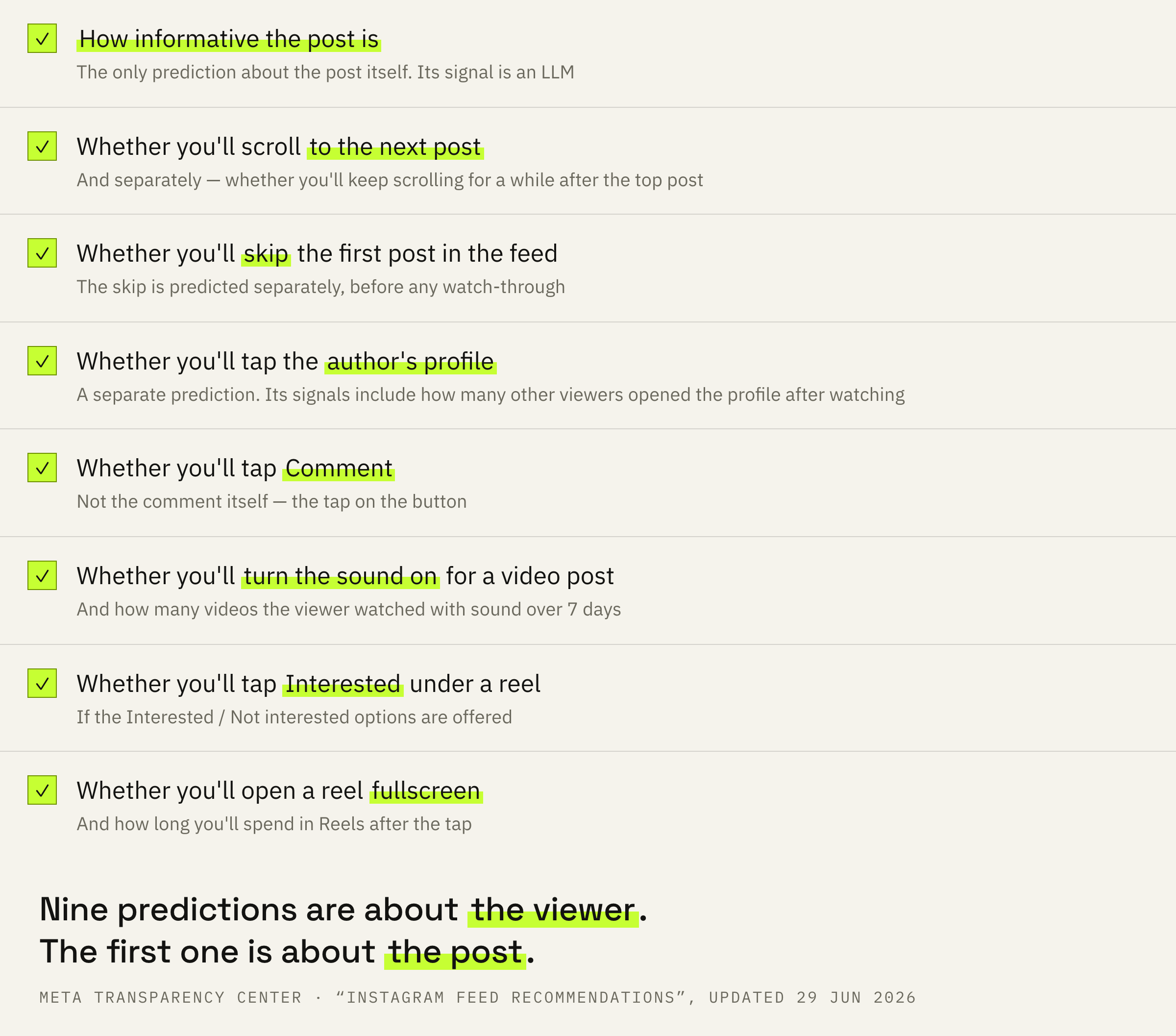
The list has the predictable: whether you'll scroll on, whether you'll tap the author's profile, whether you'll tap “Comment”. And the less obvious: whether you'll skip the first post in the feed and whether you'll turn the sound on for a video.
The card's address is worth writing down correctly. A link of the “ig-suggested-posts” kind returns 404: the document is called “Feed Recommendations” and sits at an address with “ig-feed-recommendations”. We spent a separate check on this.
Quality is computed by a language model
The line that made opening the card worth it.
First on the list of predictions stands a wording that is unlike all the rest.
How informative the post is.
Meta Transparency Center · the “Instagram Feed Recommendations” card
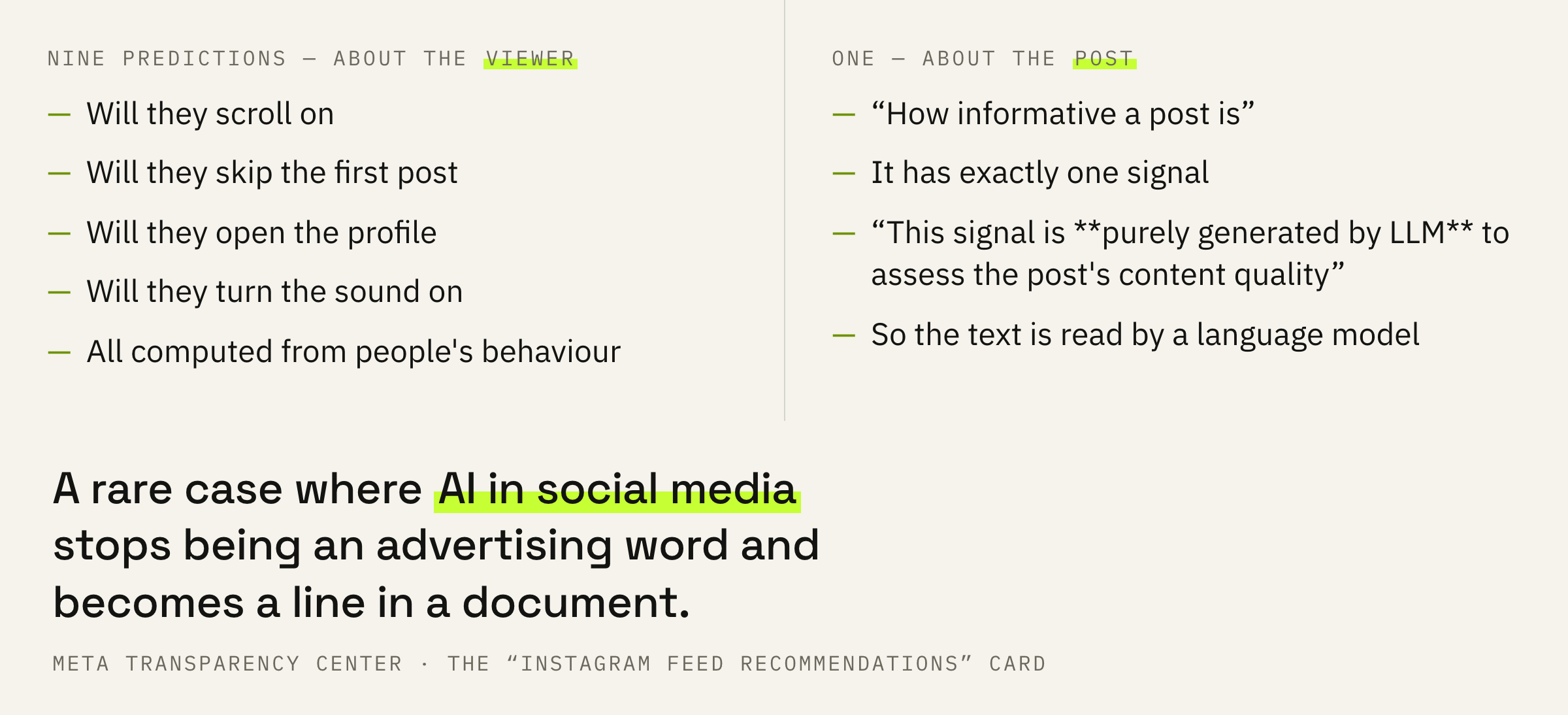
All the other predictions describe the viewer's behaviour: will scroll, will tap, will turn the sound on. This one describes the post itself. And it has exactly one signal in the card.
This signal is purely generated by LLM to assess the post's content quality.
Same place, in the signals block for the informativeness prediction
Read it literally. The quality assessment of a post is given by a language model, and the platform names this directly, without vague words like “our systems”. For our section this is a rare case where AI in social media stops being a marketing word and becomes a line in a document.
The caption under a post is read by a model, and read for informativeness. That is no reason to write “for the algorithm”: the model assesses the same thing a person would — whether the text has any substance. But it is a reason to stop publishing posts captioned with a single emoji.
From twelve hours to eighty-four days
The platform names the periods directly, and they differ.
The card's signals list the windows over which the viewer's behaviour is counted. They are not the same, and that matters for understanding why an account is “remembered” differently.
Twelve hours: how many times the viewer watched Reels videos. Seven days: how many times they opened the Reels feed and how many videos they watched with sound. Eighty-four days: how much time they spent on a particular author's content.
The age of the material itself is counted separately: how many posts aged one to three days, eight to fourteen and fourteen to twenty-one days the viewer watched.
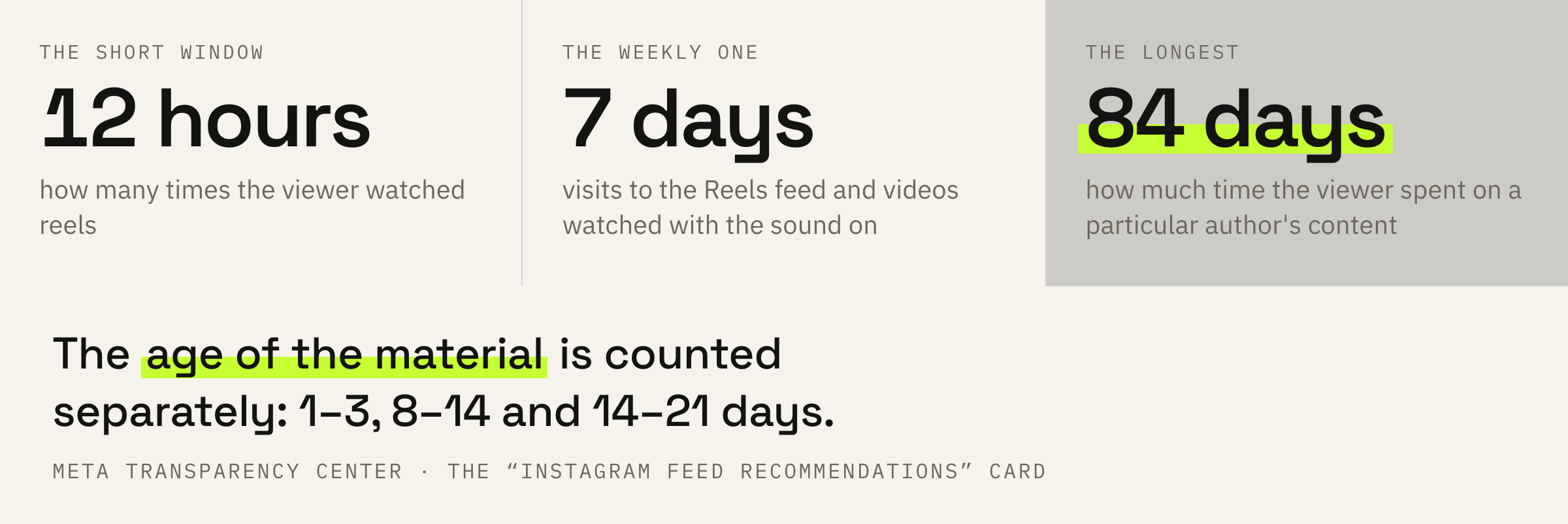
Eighty-four days is almost three months. It is the longest window in the whole card, and it explains why an author with a history and a new account start from different conditions. How this looks from the reach side we covered separately: how reach works on Instagram.
The signals also include “Device platform, for example iOS, Android”. We give this as a fact from the document and draw no conclusion from it: the card does not say how exactly the platform affects delivery, and guessing here is not our job.
What isn't in the card
Two caveats the platform makes itself.
Below are some of the significant predictions – and input signals that inform them – that we use in this AI system.
Meta Transparency Center · same place
The word “some” is the key one here. The ten predictions are what the platform chose to show, and they are not a complete list. Any reasoning of the kind “the algorithm has exactly ten factors” contradicts the very first line of the document.
These models and their input signals are dynamic and change often as the system learns and improves.
Same place
The second caveat sets an expiry date on everything covered here. The card was updated on the twenty-ninth of June two thousand twenty-six, and the next edit may change what is on the list.
We give the card's update date everywhere we rely on it, and we reread it before every new article about algorithms. A claim that “such-and-such factor works on Instagram” without a date is a claim with no expiry date, and the platform has no such things.
If your posts don't reach people who don't know you, we'll look at your account and tell you at which step the delivery is lost.
What to do this week
Four steps that follow straight from the list.
First: write a caption that has substance. The informativeness prediction is computed by a language model, and a caption of a single smiley gives it nothing to assess.
Second: look at the first frame. Among the predictions there is “the probability that you will skip the first post in the feed” — that is, the skip is predicted separately, before any watch-through.
Third: give a reason to open the profile. A profile visit is a separate prediction, and its signals include how many times other viewers opened the author's profile after watching.
Fourth: compare your posts inside the same windows the platform names. A week against a week, three months against three months. A comparison of “yesterday against last year” measures nothing.
Take five posts with a caption that has substance and five with a formal one. If the difference in profile visits is noticeable, you have seen that very prediction at work with your own eyes, without anyone else's article.
What not to do
Four conclusions the card does not support.
And the common extreme: believing recommendations decide everything. They decide the showing to strangers, and before that there is admission: if an account doesn't meet the conditions for recommendations, not a single prediction from the card applies to it. A breakdown of admission: Instagram from scratch.
What to do next
Two minutes for today.
Open your last five posts and read the captions one after another, the way an outsider would. If the substance is only in the picture, you have nothing to cover the informativeness prediction with.
If the posts don't reach strangers at all, the matter may not be the caption but the originality of the material: what Instagram considers unoriginal.
We'll look at your recent posts and tell you what in them works for showing to strangers and what gets in the way.
If you want your content to travel beyond your own audience — leave a request. We'll get in touch if there are slots available at the moment. There is usually a queue and a wait.