Is there monetisation on Threads, and where the money comes from
The platform doesn't pay for views, and Instagram's bonuses are temporary and invite-only. The one money route inside Threads is a paid post with a mandatory label. Where income actually comes from.
- Threads
- Problem breakdown
- ≈ 9 minutes
The question “how do you make money on Threads” usually expects an answer about a rate per view. There is no such rate. What there is: one official money route inside the app itself, and a clear mechanic by which a text feed turns into income — just not from the platform.
What Instagram pays creators for and why Threads isn't on that list. The only way to earn inside the app, with every requirement the platform sets. And where the money actually comes from. Nine-minute read.
Five ways to earn, and Threads is in none of them
The platform publishes the list itself; no guessing required.
Instagram keeps a separate page for creators listing how you can earn there. There are five ways: subscriptions, gifts, badges, branded content through the Creator Marketplace, and bonuses.
Threads is not mentioned on that list once. Not as a separate route, not as a note to an existing one.
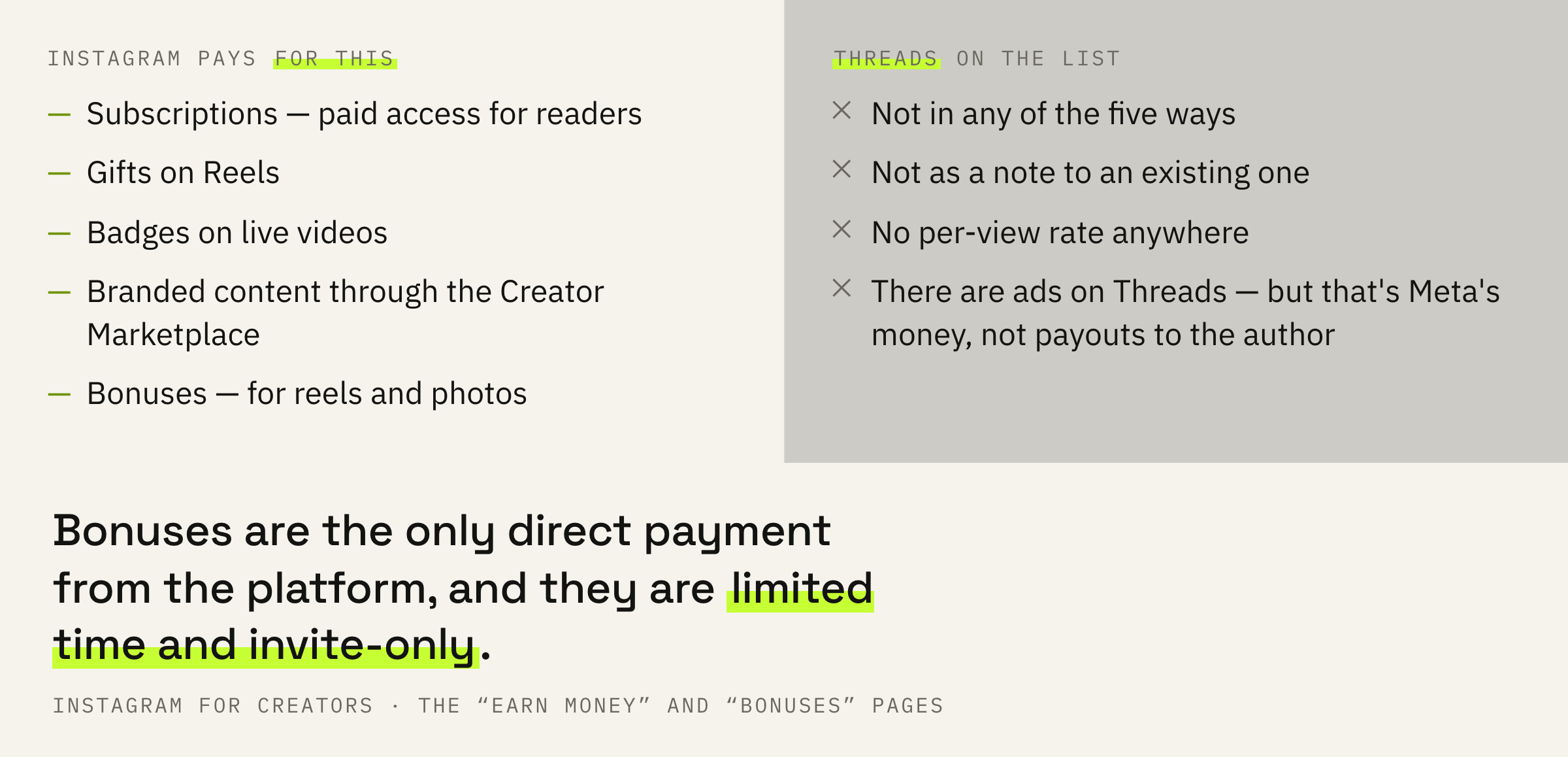
This is not an inference from indirect signs but the absence of a line in a document the platform maintains for creators. It takes a minute to check and it updates along with the product.
There are ads on Threads, and there is a paid ad-free subscription. But that is Meta's money from advertisers: none of it goes to the author. The difference shows in where those pages sit in the help centre — under advertising. They are not in the monetisation section.
Bonuses: why you can't apply for them
The most common question, and the platform answers it in two lines.
Of the five routes, bonuses are the only one where money comes straight from the platform, with no brands and no audience of yours involved. Which is exactly why they get asked about most.
Bonuses reward you for the performance of your reels and photos, including carousels and single image posts.
Instagram for Creators, the “Bonuses” page
The first thing that line shows: bonuses are counted on videos and photos. Text posts aren't in the list at all. Threads, meanwhile, is a text app.
Bonuses are limited time and invite-only as we build toward a sustainable program.
Same page, the “Bonuses eligibility” section
You cannot apply for bonuses. The programme is temporary and invite-only — that is its own wording. Any guide on “how to get into the bonus programme” describes a door that doesn't exist.
Which gives a practical conclusion for planning. You can't build a forecast on payouts from the platform even where they exist: the platform itself calls the programme temporary.
Branded content and the mandatory label
The only official money route inside Threads.
Inside Threads there is exactly one way to earn that the platform documents and supports with its own interface: a paid post agreed with a brand. And it comes with a hard requirement.
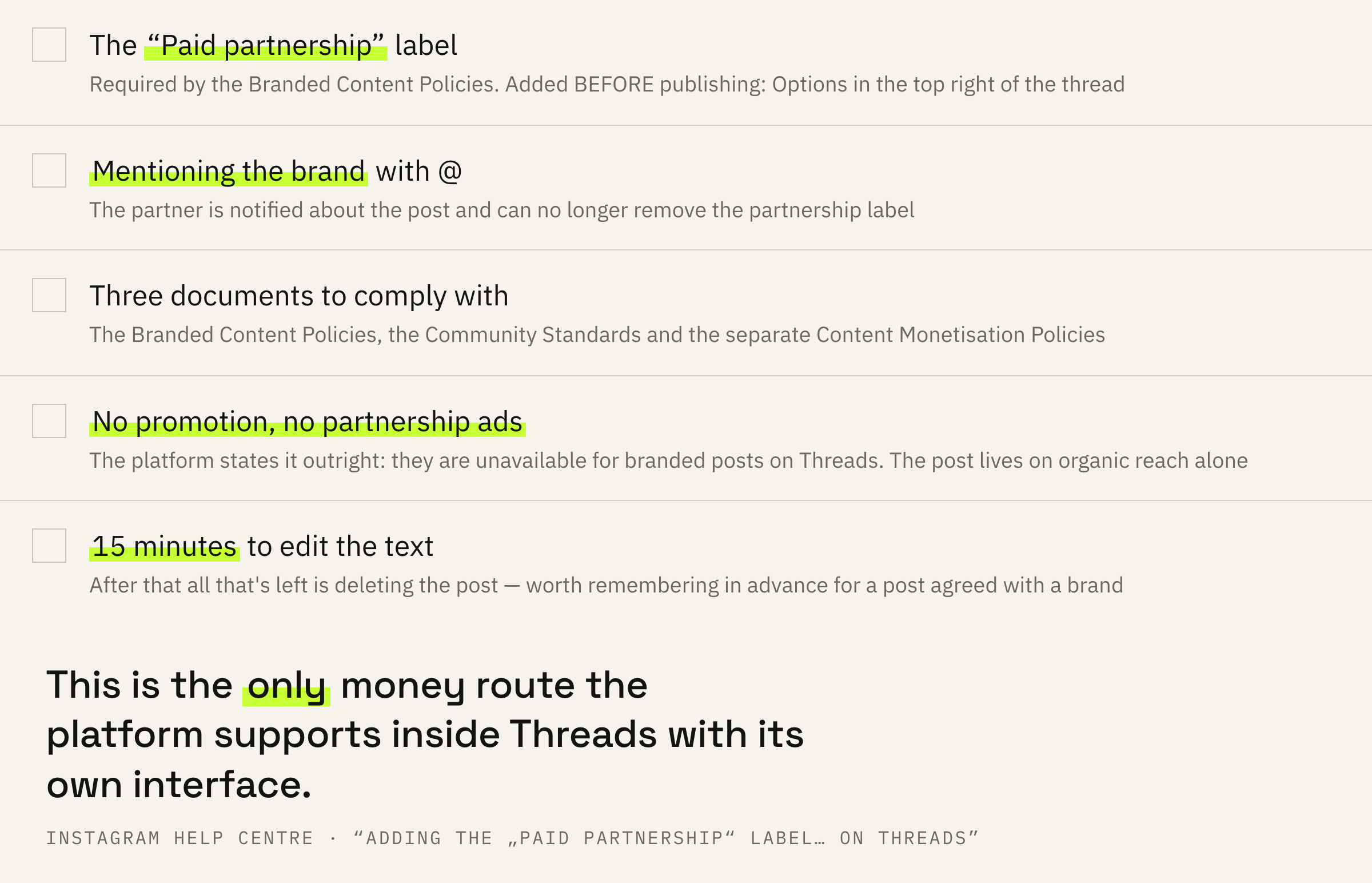
When you create organic branded content on Threads, our branded content policies require that you use the paid partnership tool to indicate when a commercial relationship has influenced the post.
Instagram Help Centre · branded content on Threads
When writing a thread, tap “Options” in the top right, then “Add paid partnership label”. In the text put an @ before the brand you're working with. Once published, the brand partner gets a notification, and they cannot remove that label afterwards.
There are three requirements, and the platform lists them together: the Branded Content Policies, the Community Standards and the Content Monetisation Policies. That last document is separate, and it is stricter than the first two.
What that label doesn't come with
Two limits that make brands cautious about it.
Partnership Ads and Boosting of organic branded posts are not currently supported in Threads.
Instagram Help Centre · same page
For you that means this. A paid post on Threads lives on organic reach alone: the brand can neither push it with budget nor turn it into an ad from their side.
For the brand it means the result depends entirely on how your feed travels. Hence the question they ask first in negotiations: how many people read your ordinary posts.
The text of a thread can be edited for fifteen minutes after posting; after that all that's left is to delete it. In a paid post where every phrase was agreed, that is worth remembering before the “Post” button. Afterwards it's too late.
If you have reach on Threads and it brings no money, we'll look at your profile and tell you at which step the enquiries are lost.
Threads is where people find you
The money doesn't come from the feed, it comes after it.
Add up the three facts above. The platform doesn't pay for views. Bonuses are counted on videos and handed out by invitation. A paid post needs a brand that comes to you. What's left is what works for most people: selling your own thing.
For us it looks like this. Threads brings inbound enquiries, and they close in messages and on calls: the invoices of clients who came from there sit between five and fifteen thousand dollars. Not one cent of that was paid by the platform.
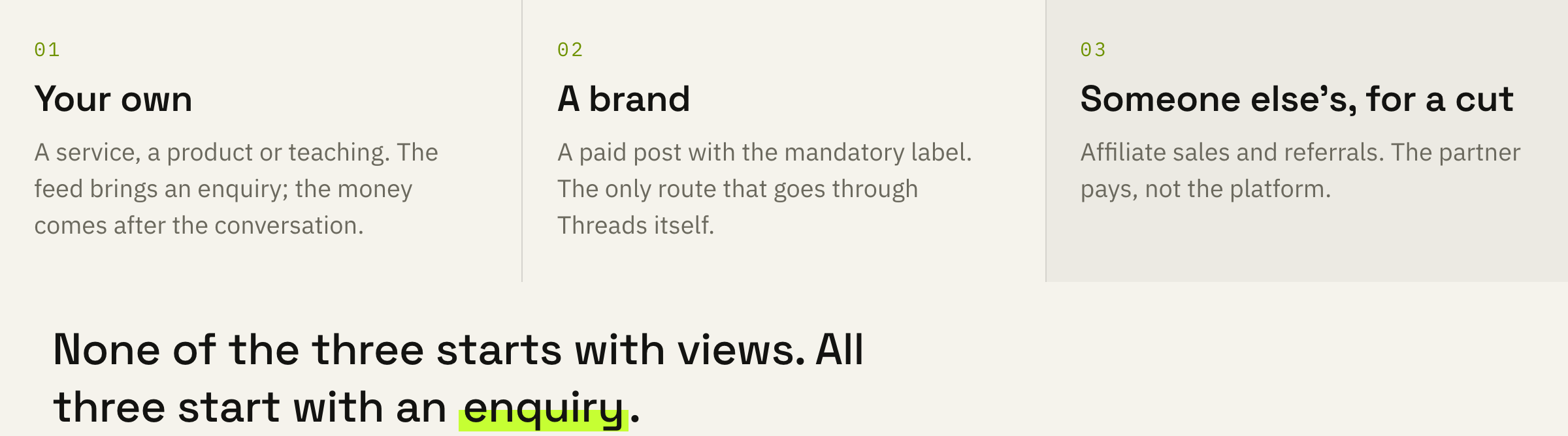
Count enquiries, not views. A feed with ten thousand views and two DMs is worth more than a feed with a hundred thousand views and silence.
How exactly to turn reach into enquiries we covered separately: where to lead people from Threads and why big reach can bring no sales at all.
What to do this week
Four steps, and none of them is about waiting for payouts.
First: put in one sentence what people could pay you for. Until that sentence exists, the feed runs empty no matter the reach.
Second: start counting enquiries. How many people wrote to you, how many got to a conversation. Views take no part in that count.
Third: gather your evidence for brands in advance. Threads insights on a computer show views, interactions and followers over ninety days, and the panel can be pinned as a column on the home screen. That is your negotiating material.
Fourth: if you already have a paid post, format it by the rules the first time. The “Paid partnership” label goes on before publishing, and the text can only be edited for fifteen minutes.
In a month compare two numbers: how many views there were and how many enquiries came. If views grew and enquiries didn't, reach isn't the issue, and adding more of it is pointless.
What not to do
Four expectations, each of which costs months.
On identical calls to action and how they end, there is a separate breakdown: what the platform restricts accounts for.
What to do next
One sentence for today.
Write in one sentence what people could pay you for, then look at your last ten posts: how many of them lead the reader toward that sentence, even indirectly.
If none do, reach has nothing to do with it. Start with what you sell. The number of people who read you is secondary here.
We'll look at your profile and recent posts and tell you what people actually buy from you and what's missing before they start reaching out.
If you want Threads to start bringing enquiries — leave a request. We'll get in touch if there are slots available at the moment. There is usually a queue and a wait.