The Instagram feed: ten predictions and the first 10 seconds
Three predictions out of ten are computed by the card separately for the first post of the session. Plus the mechanics of the carousel, the reordering of its cards and what the platform calls informative content.
- Social media & AI
- Mechanics breakdown
- ≈ 9 min
The following feed has a system card of its own, separate from recommendations. It has ten predictions, and three of them are computed separately for the first post you saw when you opened the app.
All ten predictions of the following feed, three separate predictions for the first post, the mechanics of the carousel and the fact that the platform may reorder its cards. Nine minutes of reading.
Three predictions out of ten are about it
There is nothing like it in any other card.
First, about what this document is. Instagram has several feeds, and each has a system card of its own. Here we are talking about the following feed — the one that shows the people you follow.
Recommendations — that is, the showing of unfamiliar authors — live in a separate card with predictions of their own: a breakdown of the recommendations card. They must not be mixed.
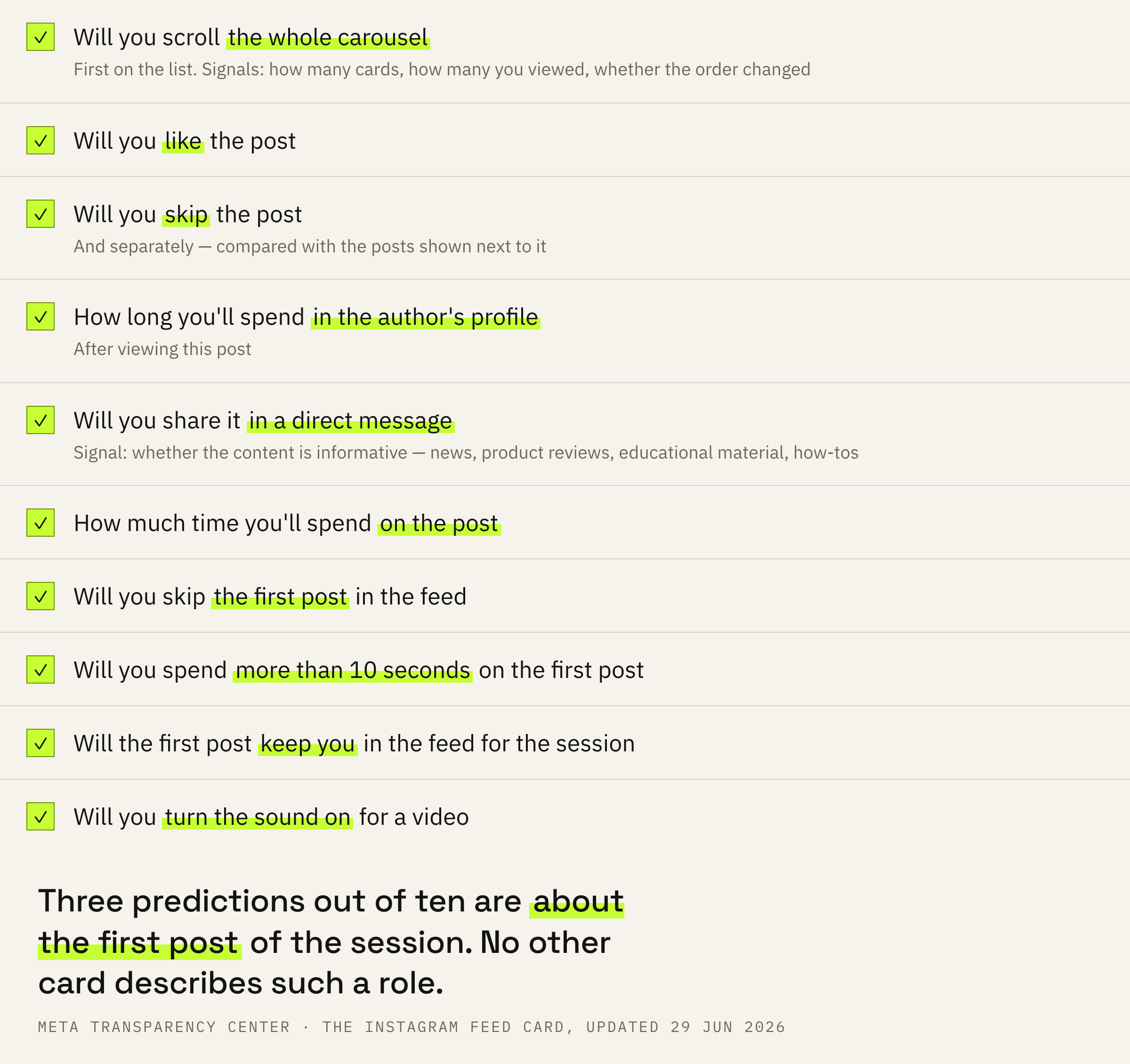
Now the thing that makes this card worth reading. Three predictions out of ten are worded not about a post in general, but about the first post of the session.
How likely you are to spend more than ten seconds on the first post. How likely you are to skip over the first post in Feed. How likely the first post you see is to keep you spending time in your Feed during this session.
Meta Transparency Center · the “Instagram Feed” card
Ten seconds are named directly. And whether the first post keeps the person in the feed at all is assessed separately: that is, the platform predicts not only the reaction to the post, but the fate of the whole session after it.
Landing first in someone's feed is a separate event with a separate assessment. A post that came first and did not hold attention affects more than itself. This is the only card where the platform describes such a role.
The carousel and the reordered cards
The second prediction the neighbours don't have.
First on the card's list stands the prediction about the carousel: whether you will scroll through it in full. For a format many consider outdated, that is a notable place.
Its signals are more interesting. The count includes how many times you swipe to the next card, how many cards you view and how many there are in the carousel in total. And then comes a line that explains oddities authors have been noticing for years.
Whether the carousel was reordered in your Feed.
Meta Transparency Center · same place, in the signals for the carousel prediction
That is, the order of cards in a carousel may differ from the one you uploaded them in, and the platform counts the very fact of the reordering as a signal.
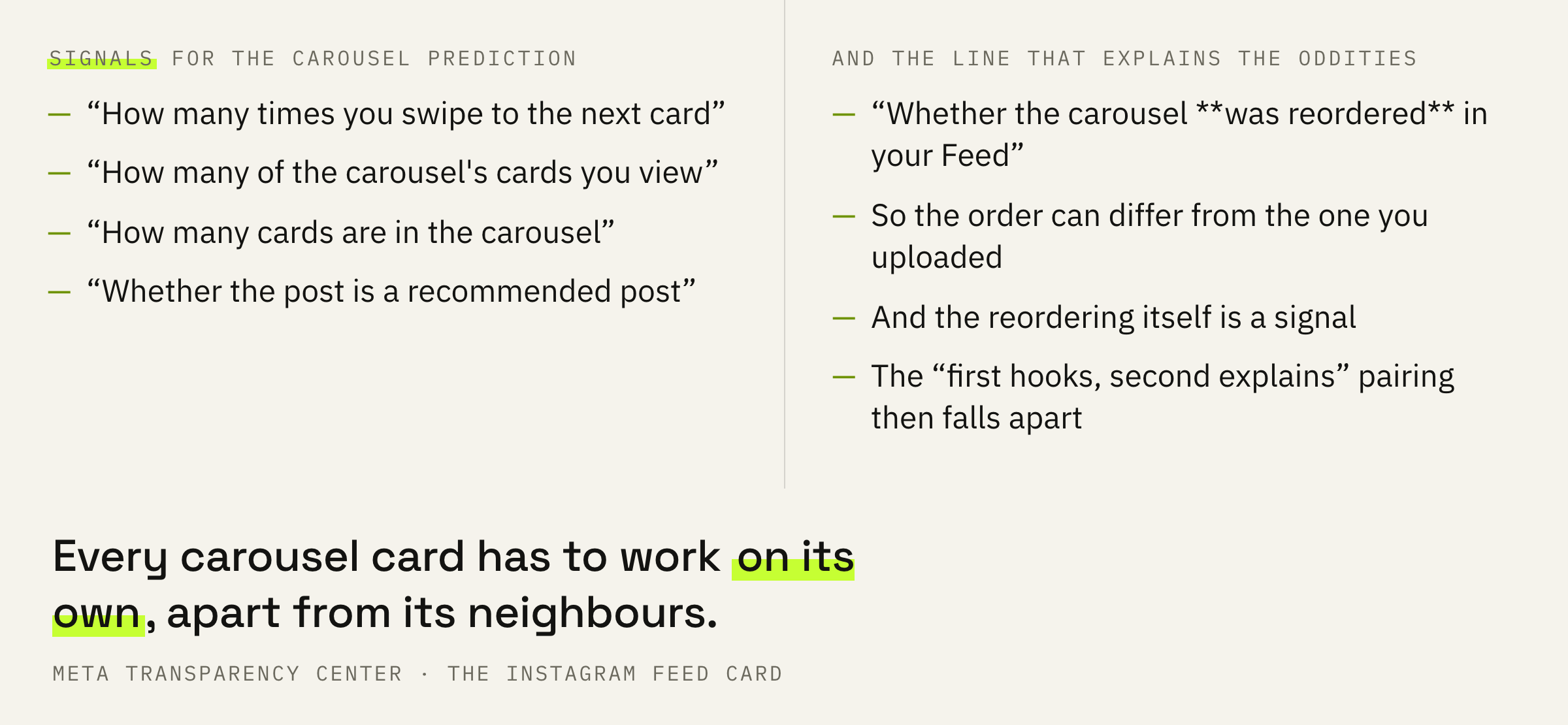
The practical conclusion here is a cautious one: since the order may change, relying on “the first picture hooks, the second explains” is risky. Every card has to work apart from its neighbours too.
The skip is counted in comparison with its neighbours
Not on its own.
Among the predictions there is the probability that the post will be skipped. And the main thing here is in the signal attached to it.
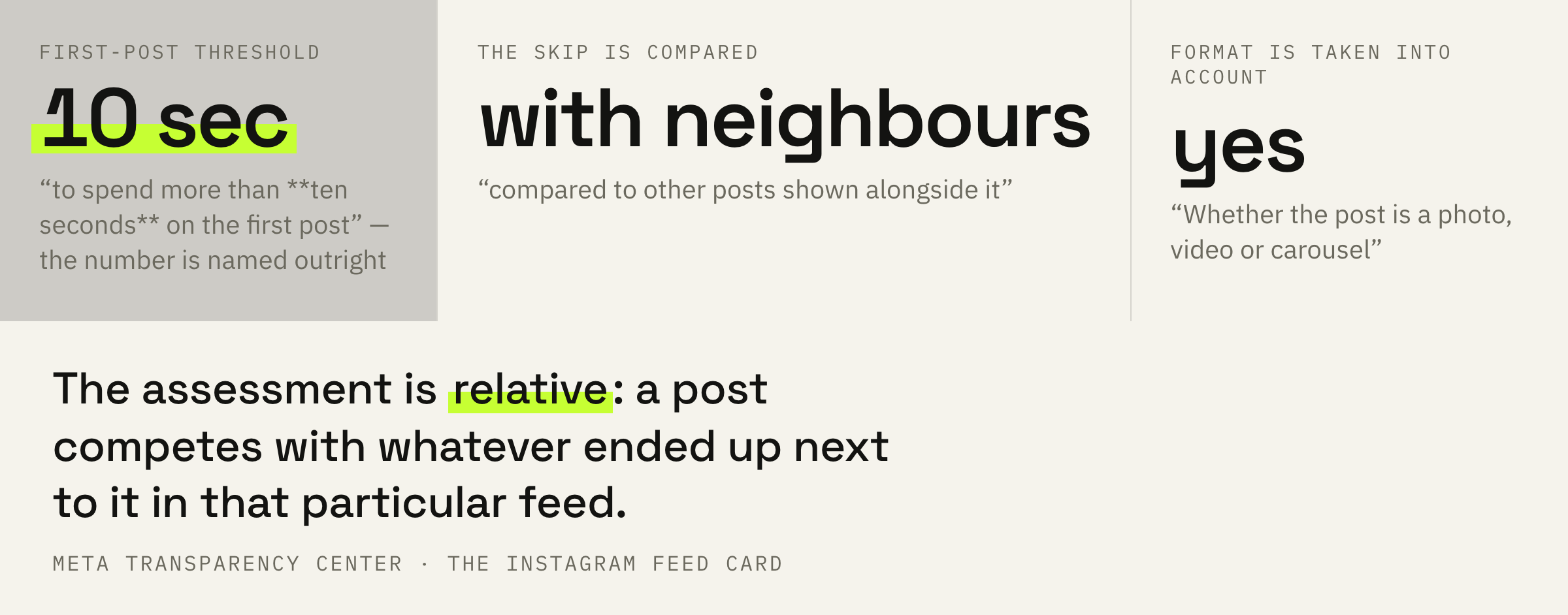
How likely you are to skip this post compared to other posts shown alongside it.
Meta Transparency Center · same place
The assessment is relative. A post competes not against an abstract standard, but against whatever ended up next to it in one particular person's particular feed.
Next to it in the signals stands the format as well: photo, video or carousel. That is, the platform compares the probability of a skip taking into account what the post is.
Informativeness decides the DM share
And the platform lists what it treats as informative.
A separate prediction is the probability that the post will be shared in a direct message. The signal for it is worded unusually specifically.
Whether the post is informative content (news, product reviews, tutorials, how-tos).
Meta Transparency Center · same place
The four examples in brackets are the answer to the question of what the platform treats as informative. A news item, a review, an educational material, an instruction. Not an opinion, not a mood, not aesthetics.
Recommendations have a similar prediction, only there the quality is assessed by a language model. Here the wording is simpler, but the list of examples gives more that is practical: how this is arranged in recommendations.
The card opens with the words “Below are some of the significant predictions” — that is, the list is incomplete. And it ends with a warning that the models and input signals change often. The document was updated on the twenty-ninth of June two thousand twenty-six.
If your followers have stopped seeing your posts, we'll look at the recent ones and tell you where the showing to your own audience is lost.
What to do this week
Four steps straight from the card.
First: look at your posts from the point of view of the first ten seconds. That number is named directly, and it is about the first post of the session — the one a person sees the moment they open the app.
Second: build a carousel so that every card works on its own. The order may change, and the pairing “the first hooks, the second explains” falls apart then.
Third: add to your posts what the platform itself calls informative. A review, an instruction, a breakdown. That is the direct route to the prediction about sharing in direct messages.
Fourth: compare posts within one format. The probability of a skip is counted taking format and neighbours into account, so comparing a carousel against a video is pointless.
Take five carousels and five single posts and compare them within their own groups. If the carousels consistently lose, look at the second card: it may be that it doesn't work without the first.
What not to do
Four conclusions the card does not support.
And the general extreme: thinking that the following feed decides everything. It is responsible for the showing to your own audience. The inflow of new people comes through other surfaces: Explore and recommendations.
What to do next
Two minutes for today.
Open your latest carousel and look at the second card separately, without the first. If it doesn't make sense on its own, a reordering costs you half the meaning.
If your posts have stopped reaching your followers, it is worth ruling out the simple causes first: how reach works on Instagram.
We'll look at your posts and tell you what works for the showing to followers and what doesn't.
If you want your followers to see your posts — leave a request. We'll get in touch if there are slots available at the moment. There is usually a queue and a wait.