Close Friends on Instagram: what the green ring actually gives you
The list closes off posts, notes, reels and stories, but the Help Centre says nothing about distribution. The closeness prediction is computed from messages instead.
- Social media & AI
- Mechanics explained
- ≈ 8 min
Close Friends is treated as a way to lift your reach: a narrow circle, a green ring, interest. In Instagram's Help Centre the list is described as a visibility setting, and there isn't a word there about distribution. Separately, in the stories system card, there is a closeness prediction — and it is computed from something else entirely.
What exactly the list closes off and why it isn't limited to stories. What the person you added sees, and what the others on the list see at the same time. How the closeness prediction differs from the list and which signals it is computed from. Eight minutes of reading.
Four formats at once
The very first line of the Help Centre is broader than people assume.
The Close Friends list is known as a way to show a story to a narrow circle. The Help Centre describes it more broadly.
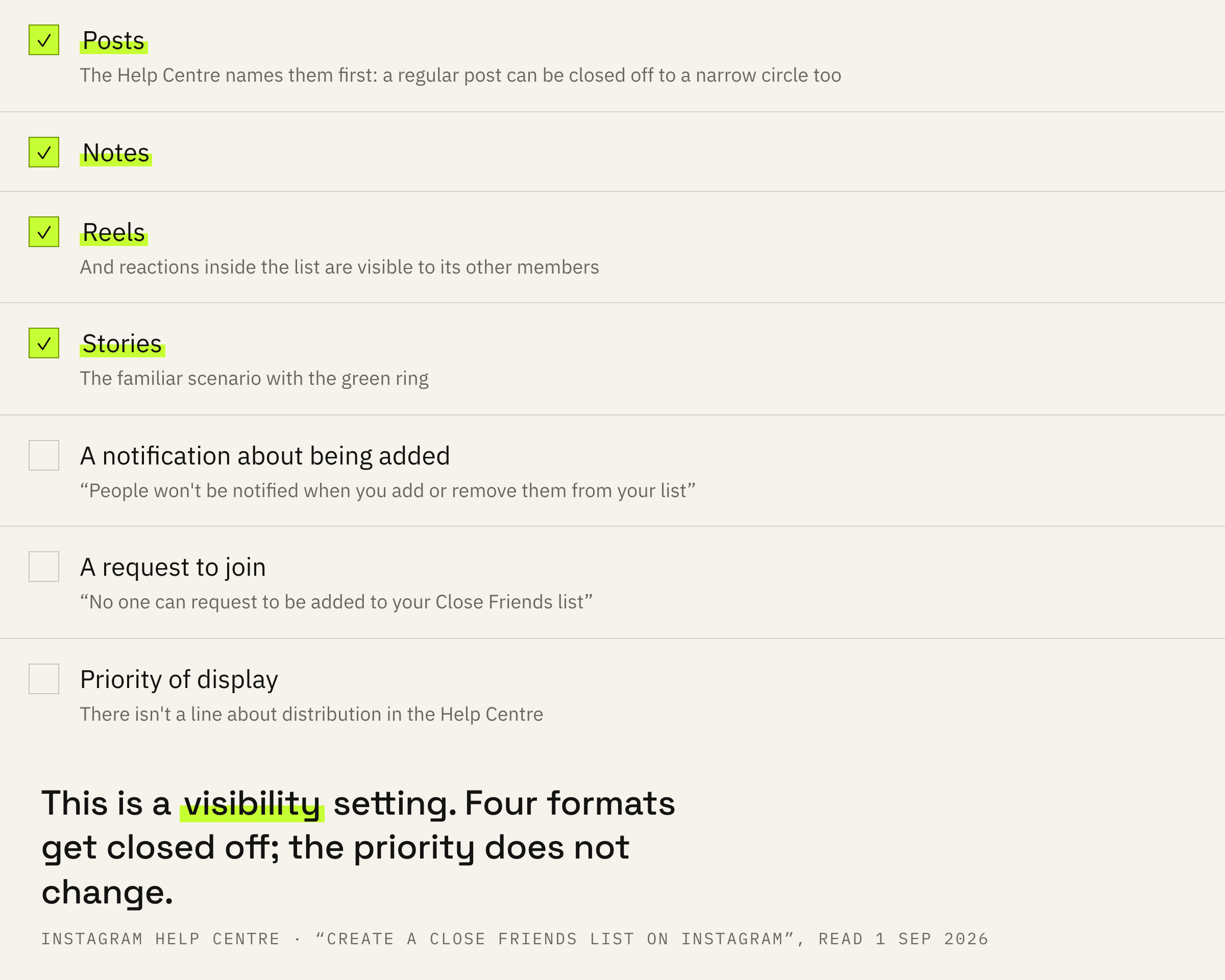
You can create a Close Friends list on Instagram so that when you share things like a post, note, reel, or story, you can choose for only people on that list to see it.
Instagram Help Centre · “Create a Close Friends list on Instagram”
Four formats: posts, notes, reels and stories. A regular post, a reel and a note can all be closed off to a narrow circle.
Next the Help Centre names two properties people usually forget. First: “People won't be notified when you add or remove them from your list.” Second: “No one can request to be added to your Close Friends list.”
“More” in the bottom left → “Settings” → the “Who can see your content” section → “Close Friends”. The path is taken word for word from the Help Centre; the list can be updated at any time.
The badge, the ring and other people's reactions
Inside the list people see each other.
Someone who ends up on the list notices it themselves, even though no notification is sent.
When someone is added to your Close Friend list, they'll see Close friends when viewing your notes, reels or stories that lets them know they're part of your list. They may also see a green ring around your profile photo.
Instagram Help Centre · the same page
And there is a third property worth reading carefully if you are assembling the list out of clients or colleagues.
If someone on your list likes, comments on or shares your reel, others on your close friends will be able to see their username and how they interact with your reel.
Instagram Help Centre · the same page
Inside the closed circle the members are visible to one another by name and by action. For a list of friends that is fine. For a list where you have gathered clients from different companies it becomes a question best settled before the first post.
The list is a tool of trust, not of segmenting by interest. The people on it see the green ring, the badge and each other's reactions. By assembling it as a “segment of warm audience”, you are introducing these people to one another.
Family or a good friend
A separate prediction that has nothing to do with the list.
Now the second half of the topic. The stories system card lists ten predictions the platform computes for every story. One of them looks as if it were written about close friends directly.
How likely it is that you and the story's author are family or good friends.
Meta Transparency Center · the “Instagram Stories AI system” card, updated 18 Sep 2025
The temptation to join one to the other is strong: you added a person to the list, so the platform counted the closeness. That is not in the card. The signals for the prediction are listed, and the list is not among them.
Something else is counted: how many messages you have exchanged, whether you are friends on Facebook, whether you talk outside Instagram.
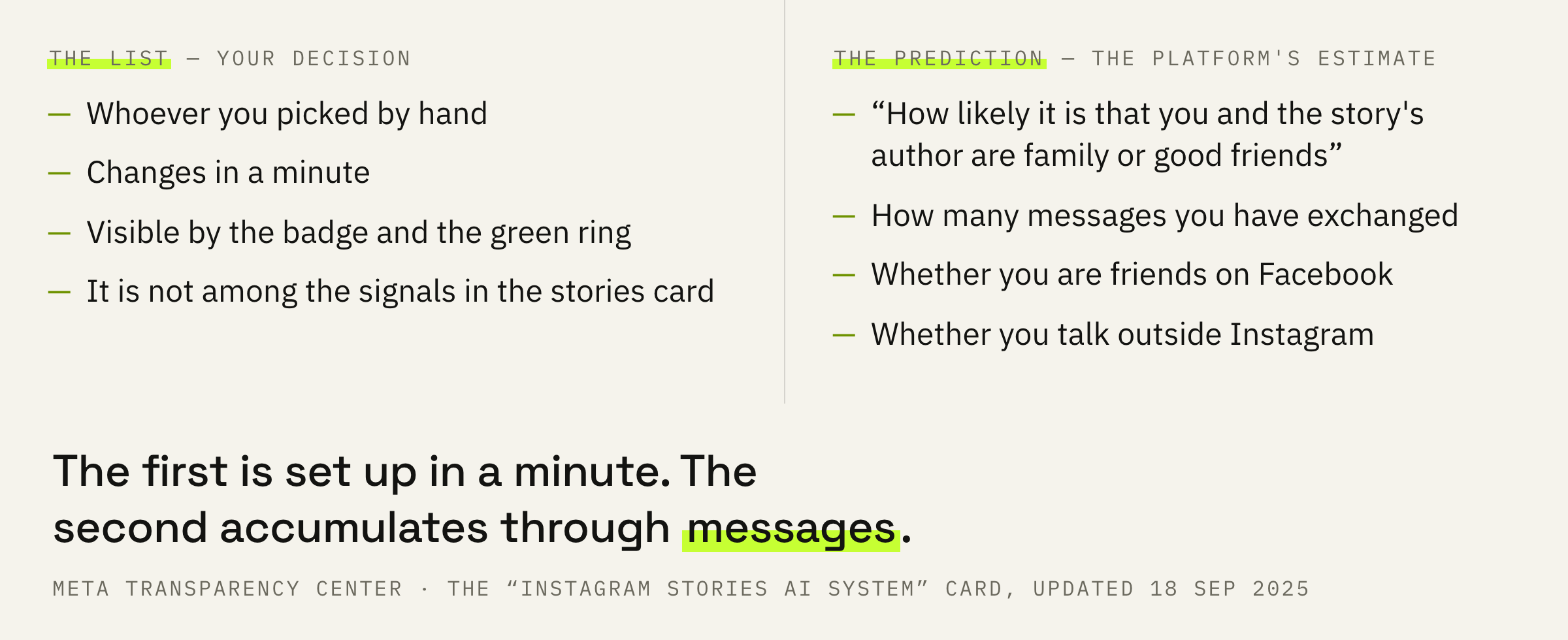
The difference here is simple and important. The list is your decision about whom to show things to. The prediction is the platform's estimate of how much the two of you actually talk. The first is set up in a minute, the second accumulates through messages.
The prediction is worded from the reader towards the author: the platform predicts that for the viewer, the story's author turned out to be a close person.
What happens to reach
The story pool is built so that the author picks the focus.
Stories have no recommendation entrance. The card describes the gathering outright: the system gathers all potential stories, excluding advertisements, shared by accounts you follow.
Simple arithmetic follows. An ordinary story is available to all of your followers, and from there the order in the tray is decided by those people's behaviour. A story for close friends is available only to those you have chosen, and nobody else will see it.
Neither the card nor the Help Centre says that stories for close friends are shown higher or more often. Claims that “close friends get several times the reach” do not rest on the platform's documents. What does change is the set of people the story is available to at all.
From this follows the only honest application to reach: the list narrows your audience deliberately. You trade breadth for density and get viewers who chose you. If the task is the opposite one, gaining new people, then the mechanics of the stories card itself are what work, and the list is no help here.
How to use it
Three scenarios where the list genuinely helps.
First: closed breakdowns for people who have already paid. The list solves the access problem without a separate channel and without a bot. The people inside see each other — for a club that is a plus, and it is worth warning them in advance.
Second: drafts and raw material. A post, a note or a reel in a narrow circle tests the wording before the whole account sees it, and it costs a single tap.
Third: rebuilding the conversation. If you want the platform to count you over time as close to particular people, what matters is messages, not the list. Answer messages and react to the stories of those who matter.
In two weeks open your stories insights and compare two numbers: viewers of ordinary stories and viewers of close-friends stories. If the second is several times smaller than the first, everything works as intended: you narrowed the audience on purpose.
What not to do
Three mistakes that show up immediately.
The fourth mistake costs more than the previous three. The green ring is often switched on for the feeling of being chosen, and then the same thing everyone else gets is shown inside it. A reader who opened a “closed” story twice and saw an ordinary announcement will not open the ring a third time.
Every week we go through what Instagram, Threads and Telegram say about themselves: ranking cards, help pages, updates. No invented numbers and no borrowed tables.