Four prompts we use to prepare Threads posts
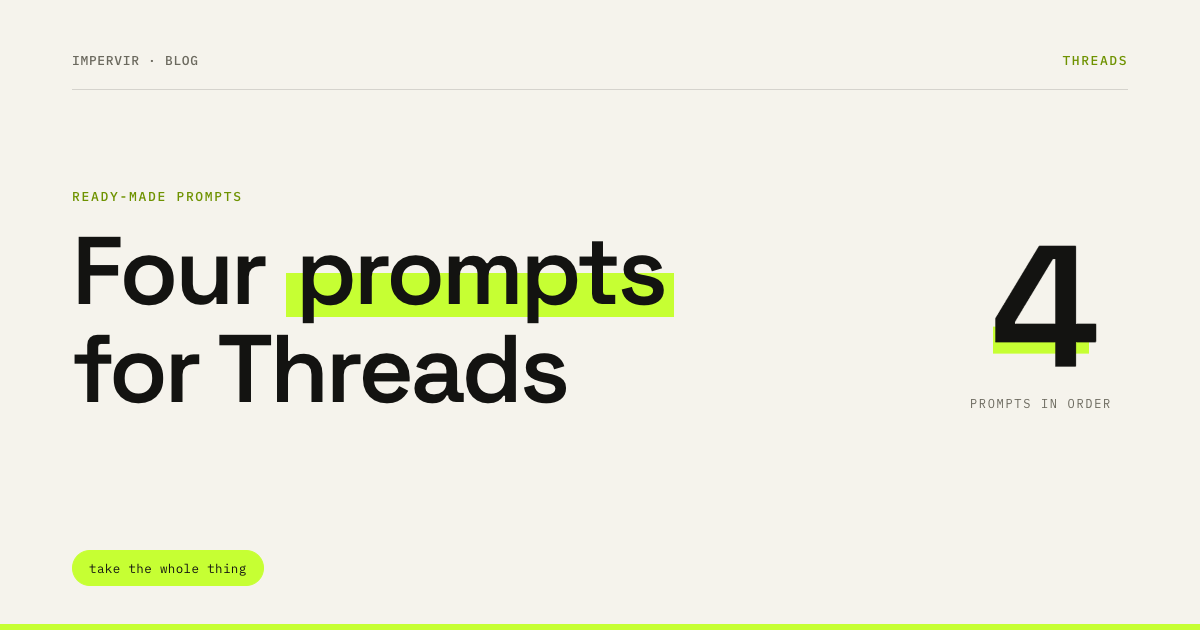
Four ready-made prompts in order: audience, positioning, ideas, and voice. What to plug into each one and why a single prompt gives you an average, generic text.
- Threads
- Prompts
- ≈ 10 minutes
One prompt won't solve the task. A post is built from four steps, and at each one the neural network needs to know something different: who you're writing to, what makes you different, what to talk about, and in what voice.
All four prompts in full, the order to run them in, and what to plug into each one. Grab them and use them. Ten minutes of reading.
Why one prompt doesn't work
Each next one relies on the answer of the previous one.
Asking to "write a post for Threads" gives you a text that could be handed to any author. The neural network knows neither your audience nor your position, so it writes something average.
The four prompts below go in order and pass their result to each other. The first describes the reader, the second — your position, the third gives topics, the fourth writes in your voice.
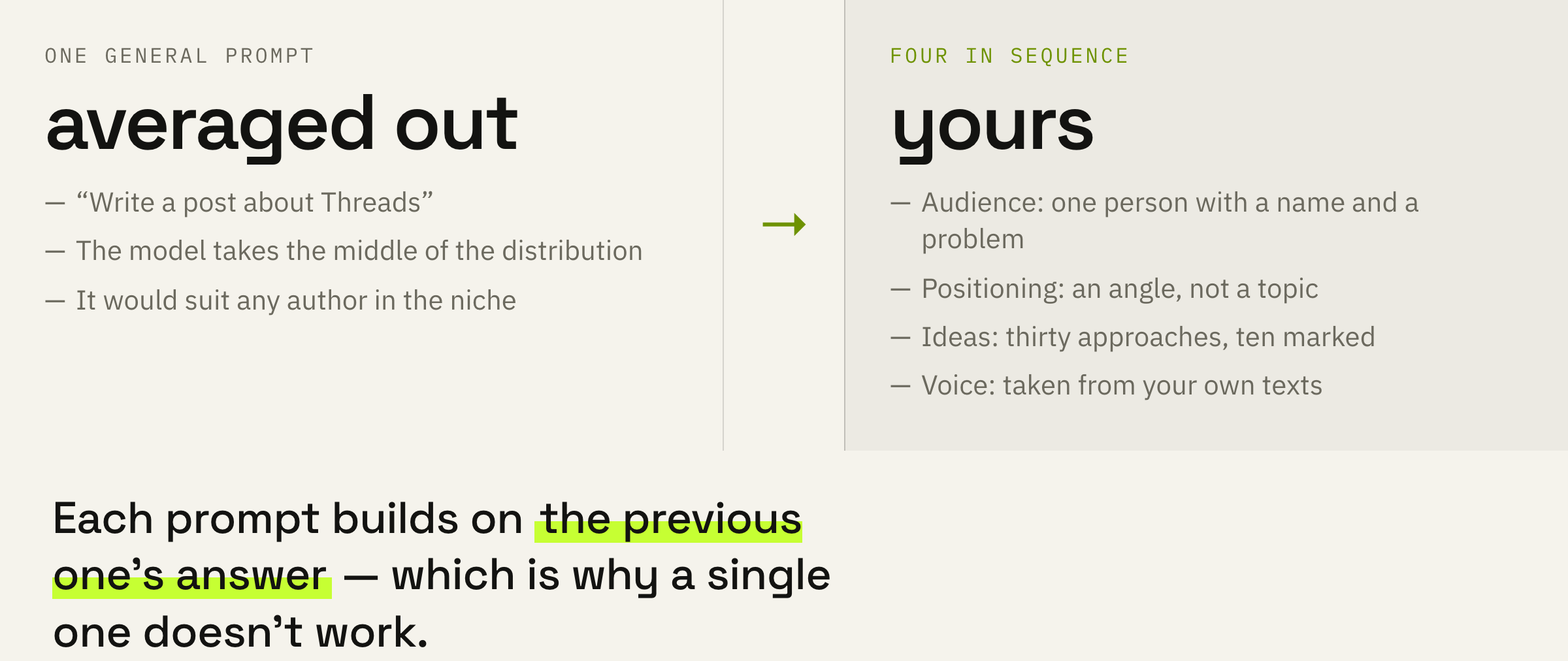
Save the answers from the first two prompts separately. You'll need to plug them into the third and fourth every time — without them, you'll get an average text again.
Prompt 01 · Audience
One real person instead of "entrepreneurs 25–45".
The first prompt is needed to get a person instead of a category. Categories don't read posts, people do.
Pay attention to the second point of the answer — the pain map. It splits into three layers, and they work differently.
Prompt 01 · Audience
Act as an audience strategist. Help me build a detailed portrait
of the ideal reader on Threads.

My niche: [fill in]
What I sell or plan to sell: [fill in]
Who I roughly see as my audience: [fill in]

Give me:
1. One specific ideal reader (name, situation, why they opened Threads).
2. A pain map: surface, hidden, root, with examples of their real phrases.
3. 15–20 words and phrases they actually use, so I can put them in hooks.
4. 5 topics that will make them feel "this is about me".
Prompt 02 · Positioning
An angle, not a topic.
Everyone in your niche has a topic. You get remembered for your angle — the position others are afraid to take.
So in the answer, look at point four: where you go against the majority. That's exactly what gets you reposted.
Prompt 02 · Niche and positioning
Act as a positioning strategist for Threads (a text platform for opinions).

My niche: [fill in]
My experience and results: [fill in]
The audience I want: [fill in]
What I want to sell: [fill in]

Give me:
1. 3 strong positioning angles (an angle and opinion, not a topic).
2. For each: who it's for, what pain it addresses, why it sparks debate and reposts.
3. 2 versions of a three-line profile bio (position, benefit, call to action).
4. My signature tension: 1–2 beliefs where I go against the majority.
Prompt 03 · Ideas and angles
Thirty ideas and ten marked ones.
The third prompt gives you volume. Thirty ideas is a month's worth of supply to pick from. You don't need to write all of them.
Ask it to sort by type and be sure to mark the ten strongest. Without this request, you'll get a flat list where it's unclear where to start.
Prompt 03 · Ideas and angles
Act as a content strategist for Threads. Generate 30 post ideas
for my niche, based on formats that have proven viral.

Niche: [fill in]
Audience and their pains: [fill in]
My strong opinions: [fill in]

Sort by type: opinions and provocations, personal stories, value and methods,
myth-busting, engagement. Give each idea a draft hook (first line).
Mark 10 with the highest potential for replies and reposts.
Prompt 04 · Voice and hooks
The most important of the four.
The fourth prompt does two things at once: first it extracts a profile of your voice from your own texts, then it rewrites someone else's working format for your topic.
You can't skip the first step. Without five to ten of your own texts, the neural network will write in its own voice, and that's recognizable from the very first line.
Prompt 04 · Voice and hooks
Act as an editor and copywriter for Threads.

Step 1. Here are 5–10 of my texts, extract my voice profile
(rhythm, phrase length, humor, vocabulary, tone of address): [paste texts]

Step 2. Here's a format or trend I want to repack: [paste trend]
My topic: [fill in]

Do this:
- Repack this format for my topic in my voice (not a literal translation).
- 10 variants of the opening line: opinion, promise, pain recognition,
  curiosity, number. Mark the 3 strongest.
Where to find the format itself for step two — in the breakdown about finding other people's viral posts.
Three mistakes when working with prompts
They're why the result comes out average.
We ran the fourth prompt without the first step for a long time — just asking it to "write in my voice." In that case the AI honestly writes in its own voice and can't tell you it did.
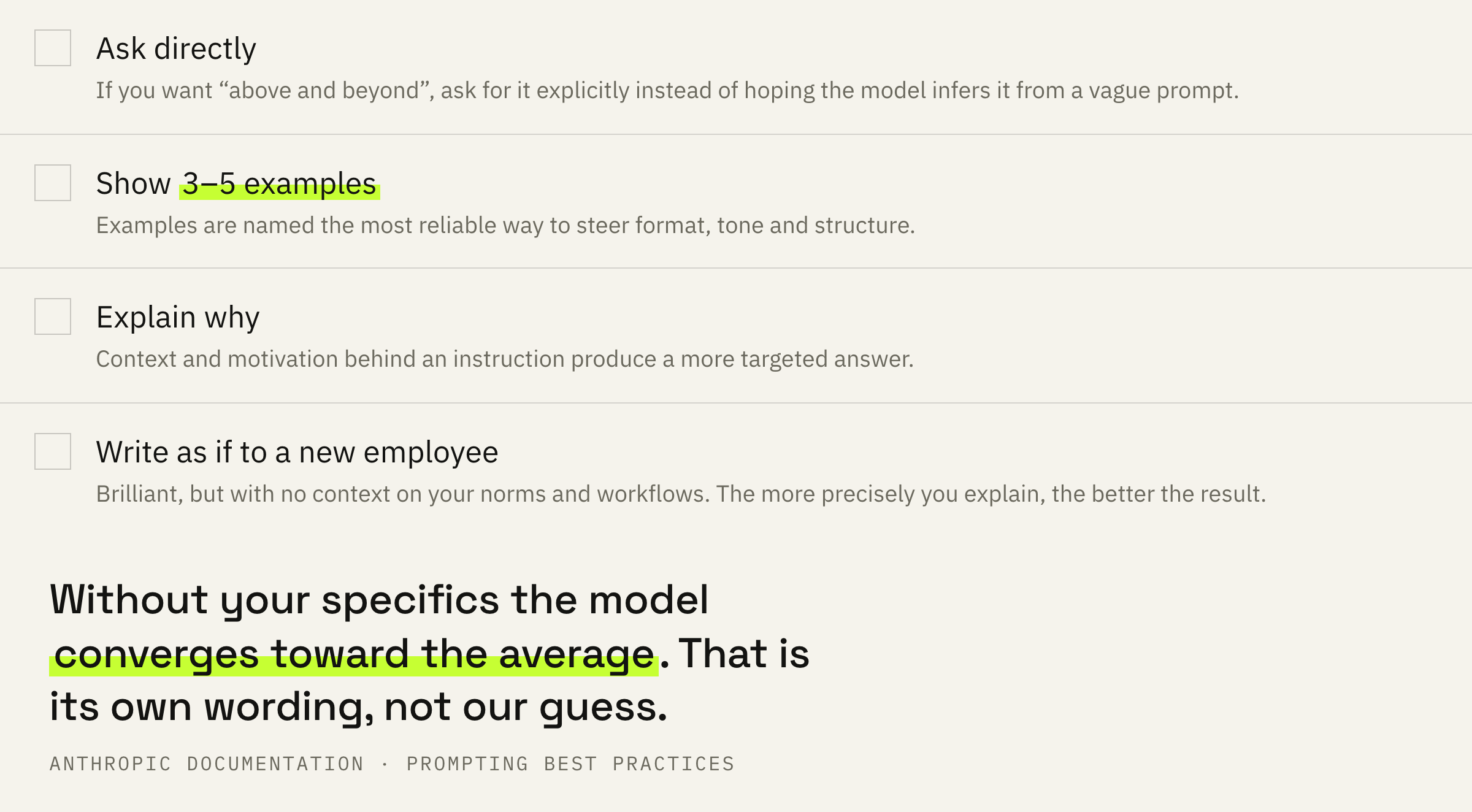
This is a good place to check with the people who build these models. Anthropic states plainly in its prompting documentation: the model gravitates toward an averaged, "on distribution" result. Not a bad one — an average one.
And that's where the fix comes from too. If you want above-average results, you have to ask for them explicitly. They flat-out advise against expecting the model to figure it out from a vague brief.
This has a practical takeaway for your voice profile. Set up a separate project for your blog and keep the profile there: project memory doesn't mix with your other conversations.
If you're working in incognito or a different model, you'll have to paste the profile in by hand every single time.
From the same source come two formatting techniques that matter more than any wording tweak.
In our chain, this changes the order inside the third and fourth prompts. The answers from the first two steps go on top as context, while the task itself stays at the end.
A prompt is only as good as what's fed into it. The answers from the first two steps are your actual setup — not the wording of the request itself.
What to do next
By hand or in one click.
Run the four prompts in order, save the answers from the first two, and reuse them going forward. It takes one evening the first time, then ten minutes per post.
This tool runs through the whole chain on its own: finds viral threads, holds onto your voice profile, and rewrites the post to sound like you. All that's left is to check it and publish.
First day free, no card, no signup. Set it up in ten minutes and test it on your own account.
Try it free for 1 dayNot ready for a tool — the prompts above work and are free, use them.